




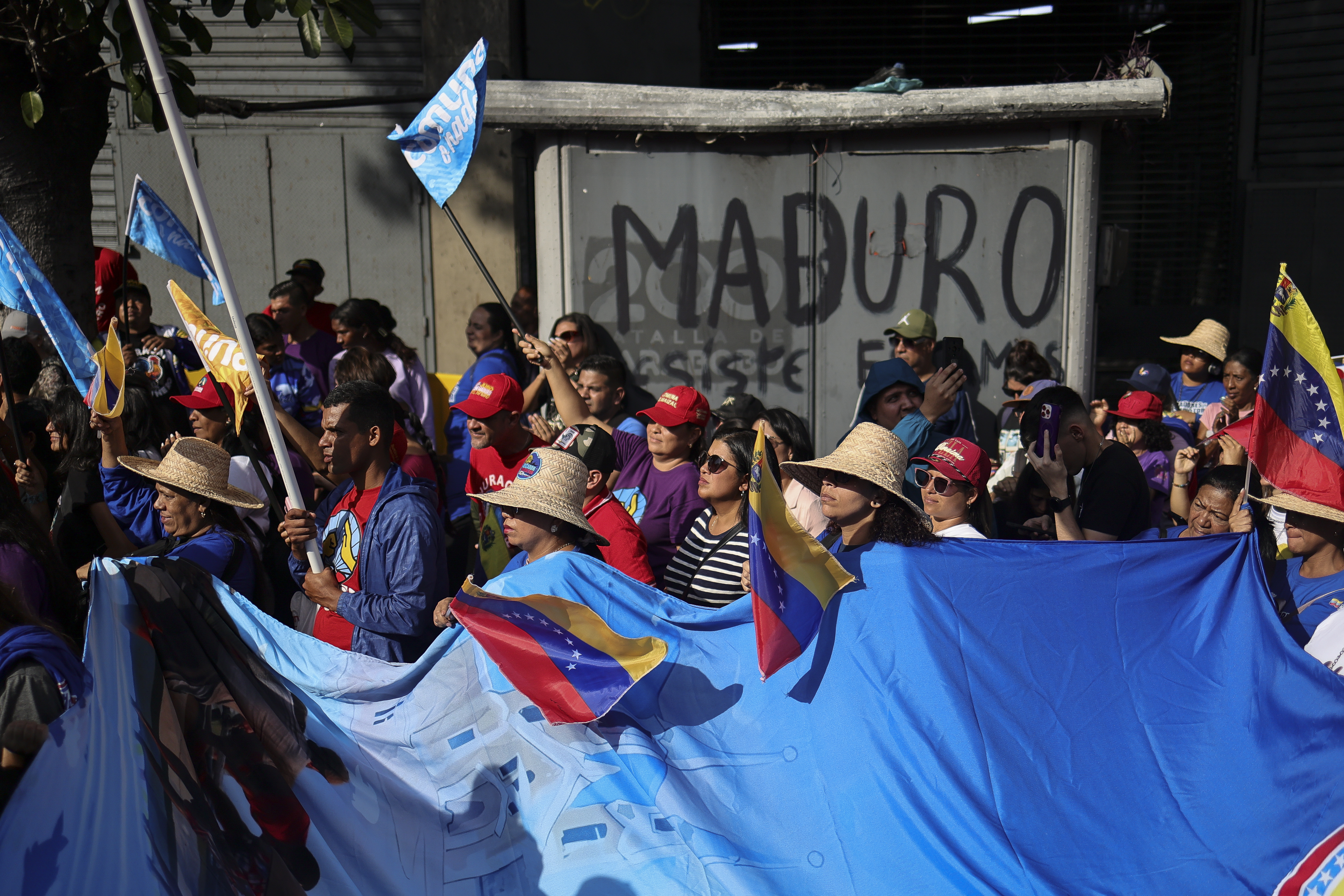
 People participate in a rally in support of Nicolás Maduro and his wife Cilia Flores after their capture by US forces, on 6 January 2026 in Caracas, Venezuela. (Photo: Jesus Vargas / Getty Images)
 /file/dailymaverick/wp-content/uploads/2025/10/label-Op-Ed.jpg)
America’s military removal of Venezuela’s president Nicolás Maduro sent shockwaves far beyond Latin America. In Africa, it was met with indignation and unease. For many African governments, the event revived longstanding anxieties about sovereignty, external intervention and the fragility of international law in an increasingly polarised world.
South Africa described it as a manifest violation of the United Nations (UN) Charter, which prohibits member states from threatening or using force against the territorial integrity or political independence of any other state. SA argued that the charter did not authorise external military intervention in matters within the domestic jurisdiction of a sovereign country.
This position was not merely legalistic, but reflected a deeply rooted African sensitivity shaped by decades of external interference.
Ghana was even more explicit, condemning the use of force outright, saying the operation violated the UN Charter, international law and Venezuela’s sovereignty and territorial integrity.
Ghanaian authorities warned that attempts to impose external control over another country – including its natural resources – posed serious risks to global peace and stability. This language echoed African states’ enduring unease over resource-driven interventions masquerading as security operations.
The African Union (AU) expressed concern over Maduro’s abduction, saying Venezuela’s complex internal challenges could be addressed only through inclusive political dialogue among Venezuelans themselves. Chad, echoing this sentiment, underlined its commitment to respect for international law and the preservation of Venezuela’s peace, stability and territorial integrity.
Taken together, these reactions reveal a common African instinct: reject the normalisation of regime change by force, regardless of the target or the justification.
Some may see these reactions as inconsistent with Africa’s stance on Russia’s Ukraine invasion. But that reading is misleading. What Africa demonstrates is not inconsistency, but continuity – albeit with variations in tone.
In 2022, SA called on Russia to withdraw its forces from Ukraine in accordance with the UN Charter, which enjoins states to resolve disputes peacefully. While Pretoria avoided overtly condemning Moscow in ideological terms, it did not endorse the violation of Ukraine’s sovereignty.
‘Unprovoked attack’
Ghana, meanwhile, was unequivocal: Foreign Minister Shirley Ayorkor Botchwey described Russia’s invasion as an “unprovoked attack” on the sovereignty and territorial integrity of a UN member state.
The difference between responses to Ukraine and Venezuela lies less in principle than in register and diplomatic posture. African states have always defended sovereignty and international law; what varies is the political context, the balance of power involved and the space available for rhetorical escalation. The same can be observed in the European Union Commission, whose reactions to Ukraine starkly diverged from what it said about Venezuela.
America’s military action against Venezuela raises a more uncomfortable question for Africa: in a world where might is right, how can sovereignty be protected? Also, how could alignment with Russia and China deter unilateral US intervention?
Venezuela, like Iran, maintains close political and economic ties with both Moscow and Beijing. Yet neither power was willing – or able – to prevent the US military action. This exposes a central paradox of the multipolar world: emerging powers might have economic muscle and diplomatic influence, but US military dominance is unrivalled.
African policymakers should assess the protective value of BRICS, south-south cooperation, or strategic hedging among great powers. These frameworks may expand diplomatic space, but they don’t constitute a security shield against unrestrained hegemons.
Recent US pressure on countries such as South Africa and Nigeria has further complicated Africa’s positions. It has had a sobering effect, reinforcing the view that continental influence does not necessarily translate into strategic immunity. African countries should therefore not misread the Venezuelan episode through a simplistic “imperialists versus the wretched of the Earth” lens – particularly given American oil-related interests.
Inconvenient reality
That framing obscures an inconvenient reality: both Venezuela and Iran are governed by regimes whose democratic legitimacy has been repeatedly questioned. This does not justify external aggression, but highlights a vulnerability that foreign powers can be quick to exploit. The contrast with Ukraine, which has managed to contain Russia’s onslaught, is striking.
Faced with this reality, African leaders may be tempted to pursue two seemingly rational strategies: first, further militarising and securitising their regimes; and second, seeking accommodation with Washington. Both paths are politically expedient – and strategically flawed.
By focusing on regime security rather than popular legitimacy, leaders risk undermining the only truly durable shield against external interference: the consent and mobilisation of their own people. It’s hard to ignore the symbolic lesson of Venezuela: had Maduro enjoyed undisputed electoral legitimacy and broad popular support, the spectacle of his capture by a foreign power would have been politically – and perhaps operationally – far more costly.
The uncomfortable truth is that weak internal legitimacy often enables external aggression. When governments rule through coercion rather than consent, they invite foreign actors to present themselves as arbiters, enforcers or apparent liberators.
As global multilateralism confronts its harshest assaults, AU member states must recommit to the values that drive African multilateralism. The ongoing AU reform process provides an opportunity to redefine the Constitutive Act’s principles of sovereignty, constitutional order and the rejection of unconstitutional changes of government.
This goes to the heart of African countries’ governance models, their relationships with citizens, and their credibility on the global stage. Avoiding this central debate through demagogic electoral cycles or authoritarian reflexes would only deepen the continent’s vulnerability.
The lesson of Venezuela is not only about American power. It is about Africa’s unfinished struggle to reconcile sovereignty with legitimacy, non-alignment with realism, and normative principles with power. Until that is achieved, the continent will continue to denounce violations of international law while remaining exposed to them. DM
Paul-Simon Handy is Regional Director East Africa and Representative to the African Union, Institute for Security Studies (ISS) Addis Ababa.
First published by ISS Today.