




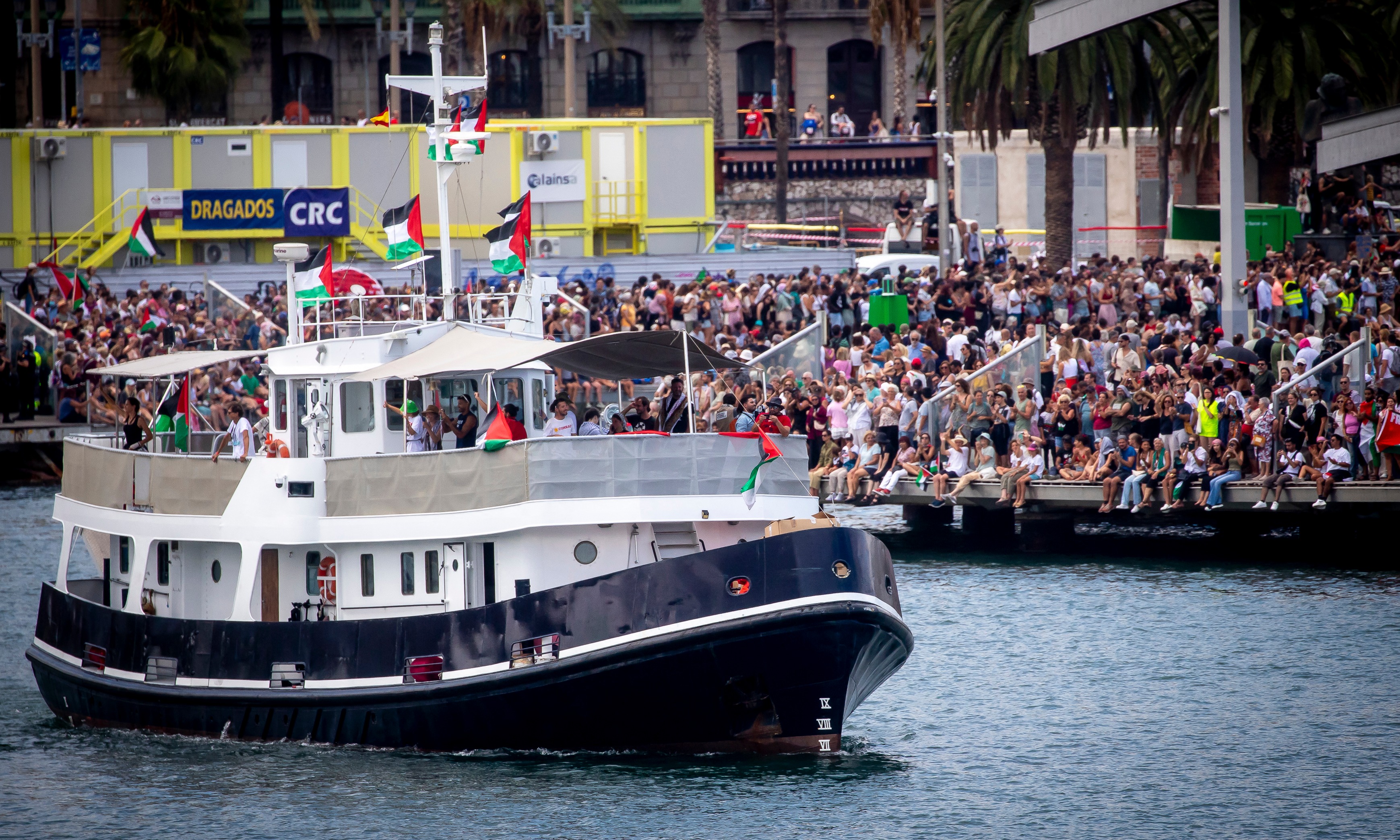
 The Global Sumud Flotilla sets sail from Barcelona towards Gaza on 31 August 2025. Hundreds gathered at Moll de la Fusta to bid farewell to the flotilla. (Photo by Albert Llop / NurPhoto via AFP)
 /file/dailymaverick/wp-content/uploads/2025/10/label-Op-Ed.jpg)
The American journalist and activist Chris Hedges has referred to the flotillas to Gaza as the “world’s conscience”. Channeling Rebecca Solnit, Hedges argues that “the numerous attempts by activists in flotillas, to break the siege on Gaza, are a potent reminder that hope comes through acts of resistance and that we must never accept the status quo”.
The Global Sumud Flotilla is a global movement of everyday people: organisers, humanitarians, doctors, students, union workers and seafarers, uniting across professions and backgrounds to uphold human dignity and international law.
In September 2025, the Sumud “summer” flotilla departed from a range of ports across the Mediterranean and included 42 boats and 462 people. To date, this was the largest and most ambitious mission to break the illegal and immoral siege of Gaza.
Among the participants on the boats were the Swedish environmental activist Greta Thunberg and the Irish actor Liam Cunningham. Six South Africans joined the mission, including Nkosi Mandla Mandela, the grandson of Nelson Mandela, former political prisoner and first president of democratic South Africa. Dr Fatima Hendricks, a South African healthcare worker, was also aboard one of the boats, the Amsterdam, that departed from the port of Bizerte in Tunisia.
Waterborne protests
There is a long history of using boats as a legal form of protest against oppression. One of the oldest examples was the use by Greenpeace of small boats to confront whaling ships and nuclear vessels in the 1970s and 1980s. Greenpeace activists placing themselves between aggressive whaling ships and whales, often at great risk to themselves, became emblematic of environmental protest during that time.
There is also a history of indigenous activists in the United States using canoes and boats to protest against oil pipelines by blocking waterways. Finally, during the 1980s, activists in Europe used kayaks and small boats to block nuclear waste shipments along the canals, rivers and oceans of Europe.
Underlying the use of boats in protest is the symbolism of water that speaks to ideas of mobility, freedom and resistance against the imposition of borders, often based on colonial laws and the legacy of empire.
Additionally, boat-based protests are highly visible and draw participants from across the world, thus serving to amplify the visibility of the issue at hand.
History of the Gaza flotillas
Hamas was elected to power in the Palestinian legislative elections on January 25, 2006, and began ruling in June 2007. Shortly after, Israel began imposing a strict blockade, closing major commercial crossings and severely limiting the movement of goods and people.
In direct response to the deprivation of Palestinians’ rights to health, safety and freedom of movement the first, albeit small, Gaza flotillas began in 2008. What was unique about these first attempts was that a handful of them actually made it to Gaza as Israel had not fully enforced its naval blockade.
This had changed by the middle of 2009 when the Israeli Occupation Force (IOF) began fully enforcing its blockade and ensuring that no boats reached Gaza.
In May 2010, the Gaza Freedom Flotilla included six ships carrying humanitarian aid. On May 31 the flotilla was intercepted in international waters by the IOF. One of the ships, the Mavi Marmara, was then fired upon resulting in the deaths of 10 Turkish pro-Palestine activists. The killings strained diplomatic relations between Israel and Turkey, and despite Israel claiming that it had acted in self-defence, it issued a formal apology in 2013 and agreed to pay $20-million in compensation to the victims’ families in 2016.
/file/dailymaverick/wp-content/uploads/2025/10/6I1A1351.jpg "Activists Zukiswa Wanner, Reaaz Moolla, Zaheera Soomar, Nkosi Mandla Mandela, Fatima Hendricks and Carolyn Shelver at a media briefing at OR Tambo International Airport upon their return to SA on 8 October 2025. (Photo: Felix Dlangamandla)")
Then in June 2015 the Swedish-flagged Freedom Flotilla III carrying activists, parliamentarians, journalists and public figures from more than 20 countries including Israeli Arab lawmaker Basel Ghattas, former Tunisian President Moncef Marzouki and Ana Maria Miranda Paz, a European Parliament member from Spain, was intercepted about 100 miles off Gaza. A number of the ships in this flotilla turned around before encountering the IOF. It was reported that the IOF used tasers during the operation.
In October 2016 the Women’s Boat to Gaza set off. This was part of the Gaza Freedom Flotilla Coalition (FFC) which is a grassroots people-to-people solidarity movement composed of campaigns and initiatives from different parts of the world, working together to end the illegal Israeli blockade of Gaza. The Women’s Boat to Gaza was a flotilla carrying women activists, specifically highlighting women’s roles in resistance and solidarity. It was also intercepted before it reached Gaza.
Activists deported
In 2018, Israeli naval forces intercepted and seized two ships belonging to the Just Future for Palestine Flotilla. The first ship, the Al Awda, was seized on 29 July, while the second, the Freedom, was seized on 3 August. Witnesses on board described IOF assaulting activists, all of whom were later deported from Israel.
There is now a close to two-decade history of flotilla protests against the illegal occupation of Gaza, illegal naval blockade, and apartheid policies directed towards Palestinians. Each time Israel intercepts a flotilla, Israeli commentators are always at pains to state that they are acting according to international law.
Of course, the international law they are referring to is a selective one. In the words of Canadian Prime Minister Mark Carney in January 2026 at Davos: “We knew the story of the international rules-based order was partially false, that the strongest would exempt themselves when convenient, that trade rules were enforced asymmetrically. And we knew that international law was applied with varying rigour depending on the identity of the accused or the victim.” It is this double standard, the selective use of international law, that the flotillas also seek to expose.
For a week starting 2 February 2026 the organising committee of the Global Sumud Flotilla will be in Johannesburg as part of the planning for the Spring 2026 Flotilla mission. This will be the largest coordinated civilian maritime effort to break the siege of Gaza, comprising more than 100 boats and more than 3,000 participants from over 100 countries.
The flotillas are a living embodiment of how, when governments fail to act, people can act while still upholding international and maritime law. And in doing this, they offer a highly visible image to the people of Gaza, providing them with a measure of hope that not everybody has abandoned them, and announce to the world that there is an ever-increasing number of people globally saying enough is enough. DM
Professor Mark Tomlinson is the co-director of the Institute for Life Course Health Research in the Department of Global Health at Stellenbosch University.
Dr Fatima Hendricks is an occupational therapist, director at TSI Orthohealth and TFIL Family trust engaged in community-based healthcare in the Cape Flats. She sailed in the Global Sumud Flotilla 2025 and was captured by IOF forces in international waters. She was detained for six days in Ktzi’ot Prison along with other flotilla participants.
Professor Hassan Mahomed is a public health medicine specialist at the Division of Health Systems and Public Health in the Department of Global Health, Stellenbosch University.
Ayesha Vahed is an attorney of the High Court of South Africa, as well as a legal reporter and journalist whose work focuses on human rights and amplifying stories often censored or overlooked by mainstream media.