




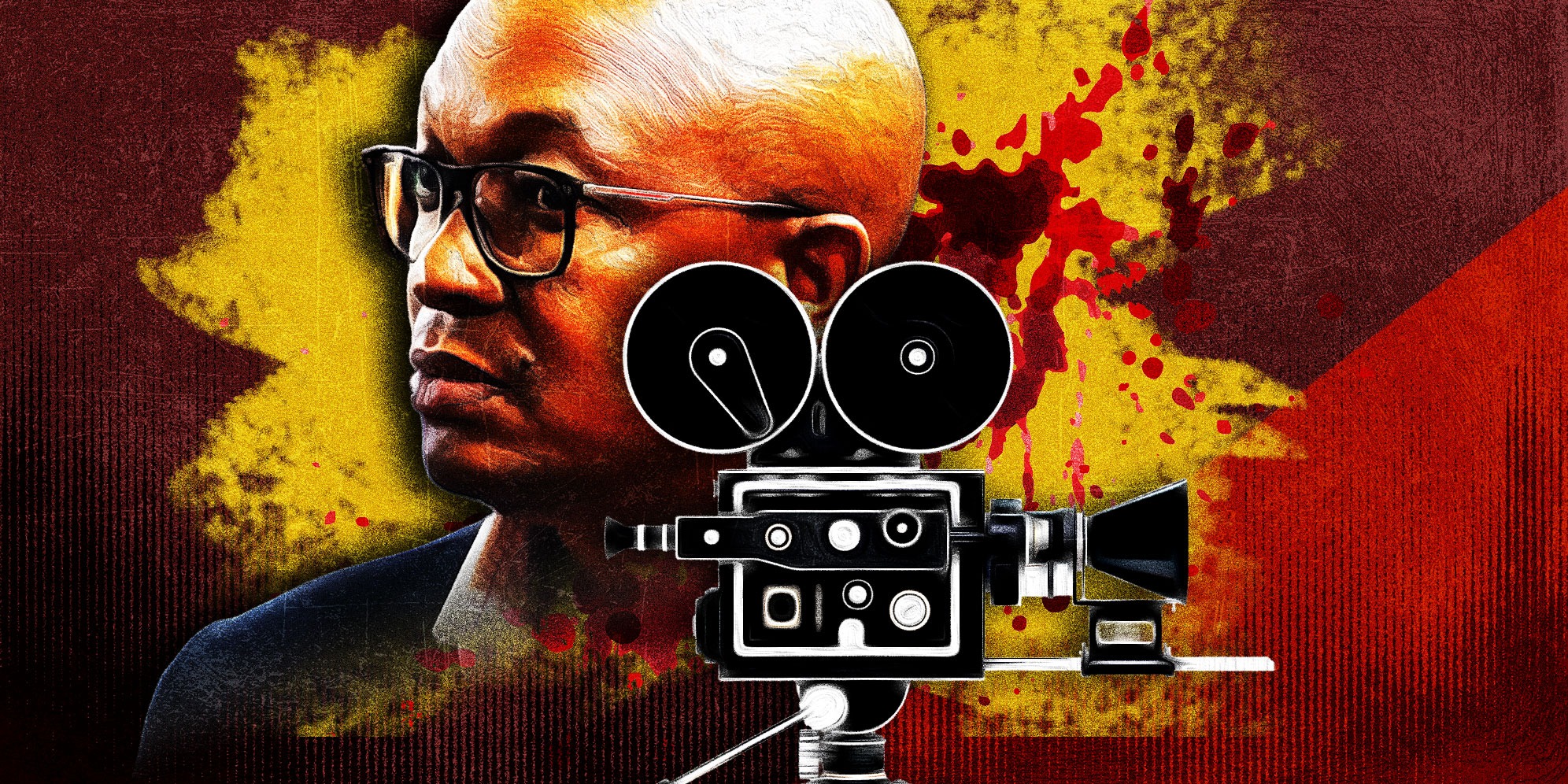
 Illustrative Image: Minister of Trade, Industry and Competition Parks Tau. (Photo: Gallo Images / Sharon Seretlo) | Old movie camera. (Image: iStock) | (By Daniella Lee Ming Yesca)
 Whodunnit?
It’s like a gripping Western, full of dead bodies and bloodshed, except there’s no mystery as to who the villain is: the South African film and television industry has been murdered by the South African government.
In 2026, creative sectors everywhere are having the life squeezed out of them. Corporatisation, consolidation and the rise of ideologically driven authoritarianism have left high-cost, high-risk creative industries like film and television scrambling for scraps in an increasingly small bowl. The Netflix effect has turned a standards-driven artform into an algorithmically driven distraction machine.
Regardless, humans make films. Humans watch films. For South Africa, a country with infinite locations, hardworking crew, great conditions and an unemployment rate of 58% for young people — the perfect labour pool for this sector — how has the grisly demise of its film and television industry been possible?
Or, better put, how has this been allowed to be possible?
Well, at an institutional and policy-making level in this country, culture is worthless. Filmmaking, and culture-making more broadly, are not treated as major drivers of employment, nor as generators of economic activity. South Africa’s culture minister is a faux-gangster troglodyte who thinks books are something you cook, while President Cyril Ramaphosa only has eyes for prize cattle. And yet there are demonstrable successes in proving that culture matters, and culture is an industry.
The oft-cited example of the South Korean entertainment industry understood 30 years ago that investing in culture meant investing in global soft power. Hallyu, or “Korean Wave”, contributed 37-trillion Won (R433-billion) to the economy between 2017 and 2021 alone, according to the Korea Economic Research Institute, and placed the country in the top 10 most culturally influential in the world.
You only need to spend five minutes with an eight-year old – or their parents – anywhere on earth to understand that K-pop has penetrated the world’s consciousness in a way that is undeniable, and deeply, deeply effective. The box office smash hit Parasite jettisoned the country and its star director, Bon Joong Ho, to the Oscars and beyond in 2019, enshrining the country’s film industry as one of the world’s most productive and important. It also earned roughly $260-million off an $11-million budget, despite being fully subtitled.
What’s more, a country that rarely sees itself onscreen and that is unable to make its own myths and build its own legends is little more than a shell, waiting for a hostile takeover.
Daily Maverick has spoken to numerous film and television industry professionals over the course of reporting this story, and they all say the same thing: the industry is on life support. And there’s no one manning the ICU.
Here’s why this is a crisis.
The average film or series employs upwards of two hundred people, some highly skilled, many more in the process of becoming skilled, thanks to the almost entirely practical nature of filmmaking. Almost all positions on a film set begin at a low bar of entry. (No one needs a PhD to score music or design costumes for a movie.) The Netflix series One Piece, one of the few productions currently filming in Cape Town, has a crew of over a thousand people, while each episode costs around $10-million. Indeed, budgets can rise far higher – the final episodes of Stranger Things cost about $50-million each.
The amount of money is staggering – each production is like a medium-sized mine or manufacturing plant, except it leaves no trace and causes minimal environmental damage. It’s all upside, no downside, zero skin off anyone’s back. What’s more, its outputs last forever, without clogging up rivers or peppering your testicles with microplastics.
As a result, across the world, regions and provinces do everything they can to attract film and series productions to their territories. Usually, these inducements focus on a labour rebate system: for every local employed, the government offers $x in terms of a tax rebate, after the money has been spent, and after a set of criteria has been met. (The usual range is between 20% and 40%.)
The higher the rebate, the more attractive the jurisdiction. And, while this sounds like an arms race to the bottom, the numbers say otherwise: for every US dollar rebated to a production, between two and seven dollars are generated in downstream value. Think construction material, food, accommodation, jet and vehicle fuel, insurance fees, recreational drugs and much more.
There are few cheaper ways to provide economic stimulus for any sector.
What is the Department of Trade, Industry and Competition’s Film and TV Incentive?
🎬The DTIC film incentives are cash rebates of 25% to 50% on local spending, designed to boost employment and industry transformation;
🎬Tiered support includes 25% for foreign projects, 35% to 40% for local co-productions and 50% for emerging black filmmakers; and
🎬Eligibility requires meeting B-BBEE standards and minimum spending thresholds.
Despite their obvious utility, tax rebates are far from the only reason filmmakers settle on a specific location. Above all, the story dictates the scenery. In this, South Africa excels. Cape Town is Cape Town, while Johannesburg can play everywhere from Dubai to Lagos to Hell. Proficiency in English is essential, as are the skills and experience of local crews – film sets are governed by complex etiquette and relentless efficiency, while newbies must be appropriately apprenticed. It’s by no means a perfect system. But, if done right, a crew can become a family, the film set a playground for the imagination.
With the ubiquitous adoption of digitally created imagery, state-of-the-art studios complement real-world filming. Competitive jurisdictions offer these services, which require massive upfront investment and constant upkeep – all of which demands policy certainty. With that certainty in place, our weaker currency would make production dollars go further: the ZAR sits in the Goldilocks zone of weakish yet stable-ish. (Or it did, before the United States decided to self-destruct.) But there is zero policy certainty in South Africa, and the result is an industry that is hamstrung in attracting foreign investment.
/file/attachments/orphans/2026-01-2916_13_03-Greenshot_689961.jpg "Cape Town Film Studios is the first world-class, custom-built, Hollywood style, film studio complex in Africa.
<br>(Photo: Cape Town Film Studios / Wikipedia)")
(Photo: Cape Town Film Studios / Wikipedia)
Oh, and as for those who think that filmmaking means fancy white folks in elaborate sunglasses demanding frappuccinos through a megaphone? Not so much any more.
According to a 2022 study of black film professionals undertaken by the National Film and Video Fund (NFVF), “The current moment in South African film and TV has unique promise which, if supported strategically through funding, can markedly increase meaningful participation in the industry for the majority. The expansion of markets for the film and TV industry – particularly internationally – is of vital importance to grow the industry. If addressed strategically, this growth can significantly impact [racial] transformation.”
Translation: if the government steps up, so will the industry, and black professionals will be the immediate and long-term beneficiaries.
All of this is to say that, under ideal conditions, South Africa is a top 10 global film jurisdiction, and on good days, we’re in the top five. (We lose on safety and – again — consistent policy certainty, obviously.)
So who should crews blame for the lack of work since 2023? And why are big production companies growing more and more impatient, threatening to pull out of South Africa permanently, taking thousands of high-paying jobs with them?
Yup, you guessed it.
The government.
/file/attachments/orphans/SA-movies-Mad-Max-fury-Road_307202.jpg "Mad Max: Fury Road (2015).
<br>(Image: Wikipedia)")
(Image: Wikipedia)
Whydunnit?
Broadly speaking, filmmaking in South Africa (or anywhere, really) can be divided into two distinct but intersecting streams. The first are international productions, which local producers are paid to “service”, or make here in South Africa. The second are locally funded productions, designated for either the South African or global marketplace, sometimes (but rarely) both. There are many blurry lines between the two – like international co-productions – but generally speaking, that’s the way the industry is understood at a policy-making level.
Because of global competition, no film jurisdiction survives without government input and incentives (unless it’s Nollywood, where folks routinely make feature films for $3.50 and a six-pack of Hero Lagers). Even American states compete among themselves – California is no longer the capital of filmmaking because it doesn’t offer the same incentives that Georgia and New Mexico do.
In South Africa, these incentives are meant to come from an alphabet soup of ministries and agencies, including the DTIC, NFVF, Industrial Development Corporation, SABC, provincial film commissions and the National Arts Council. In happier times, these would be complemented by private funding or crowdfunding initiatives, along with co-production treaties from other jurisdictions. A film must have distribution, or other sources of funding, to make up its budget and be considered viable by any government entity.
Leaving aside the SABC, which produces – or used to produce – its own content, the two principal agencies, as far as film and television producers are concerned, are DTIC and NFVF. The latter provides development grants and incentives for travel to industry events (full disclosure: the writers of this piece have received NFVF funding in the past – Ed), with a mandate, governed by its founding Act, to spend 75% of its expenditure on filmmakers, and 25% on administration. That ratio is rarely upheld, and the NFVF is widely considered dysfunctional.
Rebate horror show
By far the most important funding source is supposed to be the DTIC. A department within the department is tasked with adjudicating and administering applications from producers for a rebate incentive that, from 2014 to 2023 (minus the Covid debacle), drove the industry’s growth and sustainability. It works like this:
A producer in good standing applies for a production rebate from the DTIC. He or she submits all the paperwork relevant to the film or series – scripts, budget, crew list. In addition to this, the producer must submit ownership details of his or her production company, which is then audited by a DTIC-approved entity to make sure it meets black ownership requirements (or doesn’t, in which case it would apply for a lesser, but still significant, production rebate). South African films typically cost in the R8-million to R20-million range, and TV roughly R3-million to R7-million per episode.
But here’s a horror movie pitch for you: since March 2023, the DTIC has failed to honour the production rebates for which it is bound by its mandate to pay. It simply stopped paying out, leaving dozens of production companies holding the bag, carrying sometimes tens of millions of rands in debt at high interest rates. Many more films, with distribution deals, talent and crew already in place, have been halted for almost three years, because they have a 35% or 50% DTIC shortfall that’s impossible to close.
Read more: Parliament vows intervention after Save SA Film Jobs protest exposes industry freefall
Why is this? According to the DTIC itself, it’s because of backlogs, and it now claims to be in arrears of hundreds of millions of rands. (As is the custom, no one at DTIC submitted to Daily Maverick’s interview requests.) At best, this is a management and competence issue. At worst, it’s a catastrophic failure of governance and sabotage that has all but destroyed the industry it was designed to support, and cost the country and its citizens billions.
Transformation logjam
According to a number of producers interviewed for this article, the DTIC largely views the film industry as untransformed, racist and crooked. There’s certainly some truth to this. According to the recent NFVF survey, “Transformation remains a somewhat murky intention with little to no consensus within the film and TV industry in South Africa.” And while there’s no real agreement on what a fully transformed industry would look like, “Employment access of black individuals has grown by approximately 300% from data available on the film and TV industry from 2004.”
There’s an issue here: while it’s bound to adhere to B-BBEE regulations, the DTIC film agency does not have a specific political or ideological mandate. Essentially, its role is to rubber-stamp eligible applications for the production rebate. But the department seems to think of itself as Transformation Batman – and here we mean the Joel Schumacher Batman, not the Christopher Nolan version. This leads to some genuine and harmful absurdities. As a black female producer, who did not want to be identified for fear of reprisals, told Daily Maverick, “Whenever I submitted my paperwork, [they required] always more and more and more. They’d always seem to find a reason why the paperwork wasn’t sufficient.”
Did they suspect her of fronting for a white-owned company?
“Yes, it seemed that way.”
The result of all this is policy uncertainty. Any company hoping to prove its BEE bona fides could, of course, cheat their way around it. But there is a certification process, and it’s a process DTIC itself put in place. As long-time industry professional Michael Auret observed, “The DTIC kept on saying it didn’t trust the certification agencies or the accountants that work with the DTIC, [but] this is ridiculous. The DTIC should appoint approved certification agencies and accountants and then not question or dispute them.”
Second, the government can’t seem to settle on what “black-owned business” actually means. Is the floor fifty percent? Fifty-five percent? Seventy percent? Or one-hundred percent? Every single film company in the country, bar a few, has structured its business around an ownership benchmark, only to have the benchmark moved without consultation or warning.
/file/attachments/orphans/district_9_379976.jpg "District 9 (2009).
<br>(Image: Wikipedia)")
(Image: Wikipedia)
Films are essentially a network of subcontractors. Hire a trucking company to move sets around, and they too must meet eligibility criteria. But what if the black-owned trucking company has a fire at the warehouse, and the only guy available listens to The Kiffness, votes Cape Independence and drives a bakkie he calls “Eben”?
As a wag once said, you cannot legislate virtue.
Publicly, almost no one in South Africa – nor, by the way, the owners of the international production companies that hope to work here – seems to believe, or indicate by their actions, that black ownership requirements are too onerous a barrier to climb. Those that do, do so in private, or around the braai with the refugee class. More can and must be done to support transformation. But right now, there is nothing to transform. The industry is moribund.
Then there’s the paperwork. Hauling a DTIC submission document across town would kill a full-grown working donkey. Instead of simplifying the submissions process, due to the fact that we’re in the 21st century, the DTIC has ladled on complexity. Each film or series is a medium-sized business, with dozens of employees, millions in raised capital and its own manifold complexities. Why add more? What does this achieve? Who is served by this?
Worse, DTIC seems to think of the rebate money as theirs. It’s not. It belongs to the economy at large, which is, in theory (and, obviously, in practice), enlarged by efficient and timely reimbursement. They seem to think this money has an ideological component. Again, it doesn’t: it’s meant for two reasons and two reasons alone: to support an industry and stimulate the economy.
Who is most hurt by all this? South African crews are largely black, especially in Gauteng. As for local production, in 2026, it’s more often than not black creatives pitching black executives in order to make black South African stories that, hopefully, have universal resonance. DTIC has shut down the entire industry, because it can’t pay rebates and fiddles with regulations.
How this affects you
🎬 Fewer local productions mean fewer South African stories, languages, history and lived experiences on your screens and in mainstream media;
🎬 The slowdown affects hotels, catering companies, drivers and small businesses that depend on film shoots;
🎬 The crisis threatens one of the country’s largest youth employment pipelines; and
🎬 The industry’s decline highlights how delayed state payments can wipe out entire income streams.
So, before South African bureaucrats completely kill South African film and television, it’s time for a series reboot. DM
What is to be done? Read Part Two for possible solutions.