
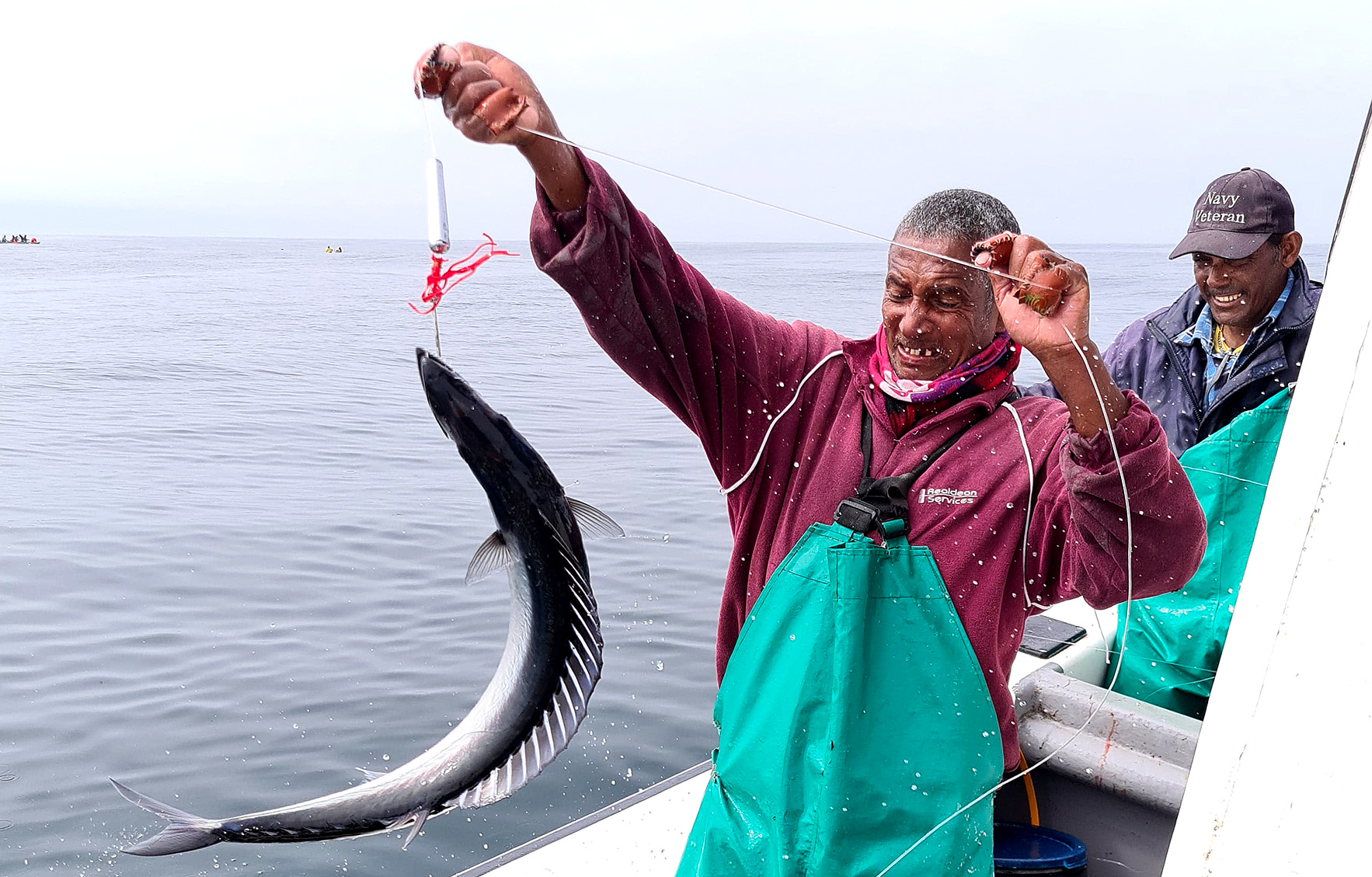
 A fisherman with a freshly caught snoek. Small fishers and those labelled as poachers highlight the struggle against a system that often favours bureaucratic data over traditional knowledge, leading to social exclusion and illegal fishing. (Photo: Travis Daniels)
 /file/attachments/2985/TroubledWaters_405609.jpg)
From industrial trawlers to hand-line fishers, from scientists modelling biomass to officials trying to enforce the law with thinning budgets, everyone is working on the same ocean, but from very different angles.
What follows is not a verdict, but a synthesis: what we’ve learned by listening across the spectrum, where the real sticking points lie, what has worked and where there’s genuine room for optimism about the future.
A system under strain
One of the most important lessons is that SA does have a fisheries management system that works – at least on paper.
The country pioneered sophisticated, science-based approaches to setting catch limits, particularly through feedback-driven management procedures that adjust Total Allowable Catches (TACs) in response to changing stock indicators. Internationally, South African fisheries science is still highly respected, especially in sectors like hake, where long-term management has prevented collapse and enabled recovery.
This counters a common perception that “there’s no plan”. There is a plan. The real problem is consistency: keeping the machinery running year after year, through political churn, fiscal pressure and environmental volatility.
/file/attachments/orphans/DFFE-3_757651.jpg "The ageing research vessel SA Africana. (Photo: Department of Forestry, Fisheries and the Environment)")
That inconsistency is felt most acutely when science falters, not because the models are wrong, but because the inputs are compromised.
Delayed or missed research surveys – often resulting from an ageing research vessel and budget bottlenecks – force scientists to apply precautionary cuts. Those cuts may protect fish stocks, but they also shut factories early, leave boats idle and send seasonal workers home months before schedule.
Conservation succeeds, but livelihoods absorb the shock.
People need predictability
A second, recurring theme is mismatch. Fish populations are dynamic – especially small pelagic species like sardine and anchovy, which respond quickly to climate shifts, currents and plankton blooms. Businesses and communities, however, need predictability.
Large, vertically integrated companies can usually absorb volatility. They diversify species, add value through processing and ride out bad seasons. For them, quotas – however imperfect – are the only defence against a free-for-all that would destroy the resource for everyone.
Smaller operators sit in a more precarious position. Medium-sized canneries and independent vessels often live season to season. When allocations are halved because of delayed surveys, the consequences are immediate and local: closed plants, lost wages, hollowed-out coastal towns.
This is not an argument against precaution, but a reminder that weak state capacity pushes risk downstream – to those least able to carry it.
Knowledge without security
No voices are more emotionally charged than those of small-boat and hand-line fishers. Their stories are rich with skill, memory and place-based knowledge – reading birds, currents, reefs and seasonal patterns that no satellite can fully capture. Yet many feel erased by a system that recognises data more readily than lived experience.
/file/attachments/orphans/BringinthedayscatchTravisDaniels_640714.jpg "Bringing in the day’s catch. (Photo: Travis Daniels)")
What we’ve learned is that this is not simply a science-versus-tradition conflict. Scientists themselves are clear that local knowledge is valuable – but it cannot substitute for population-level monitoring. A reef that feels “full” to one fisher may still be biologically overexploited when scaled across an entire coastline.
The real problem is structural. Small-scale commercial fishers often fall into a “missing middle” too large to qualify for community co-operatives, too small to compete with industrial fleets and granted fragmented, single-species rights that make year-round survival nearly impossible.
Boats sit idle, not because fishers lack skill, but because licences arrive late, quotas are too narrow, or fuel costs outweigh potential earnings.
When exclusion becomes criminalisation
Perhaps the toughest testimony comes from listening to those labelled poachers. Inshore resources like abalone and rock lobster have become flashpoints where ecological collapse, organised crime and social exclusion collide. Here, the line between conservation and criminalisation blurs.
Several former legal fishers describe being pushed out of the rights system through complex applications, point-scoring criteria and administrative hurdles they were ill-equipped to navigate. With skills intact but permits denied, many turned to illegal harvesting – not out of defiance, but survival.
This doesn’t excuse the damage caused by poaching syndicates, which have devastated reefs and fuelled violence and drug trafficking. But it does complicate the narrative. Enforcement alone cannot solve a problem rooted in exclusion. Where legitimate access disappears, black markets rush in.
Enforcement: visibility without reach
On the regulatory side, officials are candid about the gap between what the state can see and what it can stop. Satellite tracking, vessel monitoring systems and data analytics mean authorities often know exactly when and where violations occur. The bottleneck is response: too few patrol vessels, too few trained officers and procurement systems that move slower than organised crime.
This is particularly stark in Marine Protected Areas (MPAs). The science is clear: where fishing stops, fish rebound. South Africa’s expanding MPA network has delivered real ecological gains, including larger, older breeding fish and spillover benefits to adjacent fisheries. But MPAs only work if rules are enforced. Illegal incursions – especially in deep-water protected zones – risk turning hard-won conservation victories into “paper parks”.
/file/attachments/orphans/MPAzonesaroundSouthAfricaDFFE_199033.jpg "MPA zones around South Africa. (Source: Department of Forestry, Fisheries and the Environment)")
What is working
Amid the tension, there are genuine successes worth holding onto:
Hake stocks are stable and internationally certified, a testament to long-term, science-based management.
Marine Protected Areas have demonstrably rebuilt biodiversity where compliance is strong.
Fisheries science, though under-resourced, remains globally respected and methodologically robust.
Transparency in recent rights allocation rounds has improved, with greater scrutiny of “paper quota holders” and clearer performance criteria.
These are not small achievements. They show that recovery is possible when policy, science, and enforcement align – even imperfectly.
A way forward: fewer false choices
The loudest debates in fishing often frame issues as binaries: conservation or jobs, science or tradition, big companies or small fishers. Our conversations suggest those are false choices.
A more hopeful path would include:
Reliable science infrastructure, even if it means co-funded surveys or chartered research vessels to ensure data continuity.
More flexible access models for small and medium operators – multi-species rights, longer horizons and incentives to invest in safety and skills.
Real pathways back into legality for displaced and now illegal inshore fishers, paired with firm action against organised syndicates.
Value-adding over volume, recognising that future growth lies in processing, quality and local employment – not higher catches.
Shared stewardship, where fishers are paid not only to extract, but to monitor, patrol and protect the resource they depend on.
Don’s Take
SA’s fishing industry is often described as “in crisis”. That’s true – but incomplete. It’s also a sector full of knowledge, resilience and people who care deeply about the sea. The ocean is not yet exhausted. Nor is the social imagination needed to manage it better.
What this series has shown is that the future of fishing will not be decided by any single group. It will emerge – messily, contested and slowly – from how well science, policy, industry and communities learn to trust one another again.
There are still fish in the water. There is still skill on the boats. The task now is to build a system that keeps both there for generations to come.
DM
Previously
Setting up the series: Untangling SA’s fishing industry
Mark Wiley: South Africa’s vanishing fish
Tim Reddell: Steering Viking Fishing through SA’s troubled waters
Deon van Zyl: ‘We’re crippled by government inefficiency’
Doug Butterworth: Seafood’s balancing act and the science of sustainable catch limits
Colin Attwood: Counting the uncountable and the science of tracking fish
Kobus Poggenpoel: ‘These traditions will die with my generation’
Travis Daniels: at one with the sea
Aunty Val: being a woman trek netter on the Cape coast
Neels Loff: ‘They call us poachers’
Marine Protected Areas are the sea’s second chance
Inside the struggles of South Africa’s fisheries enforcement and science teams