




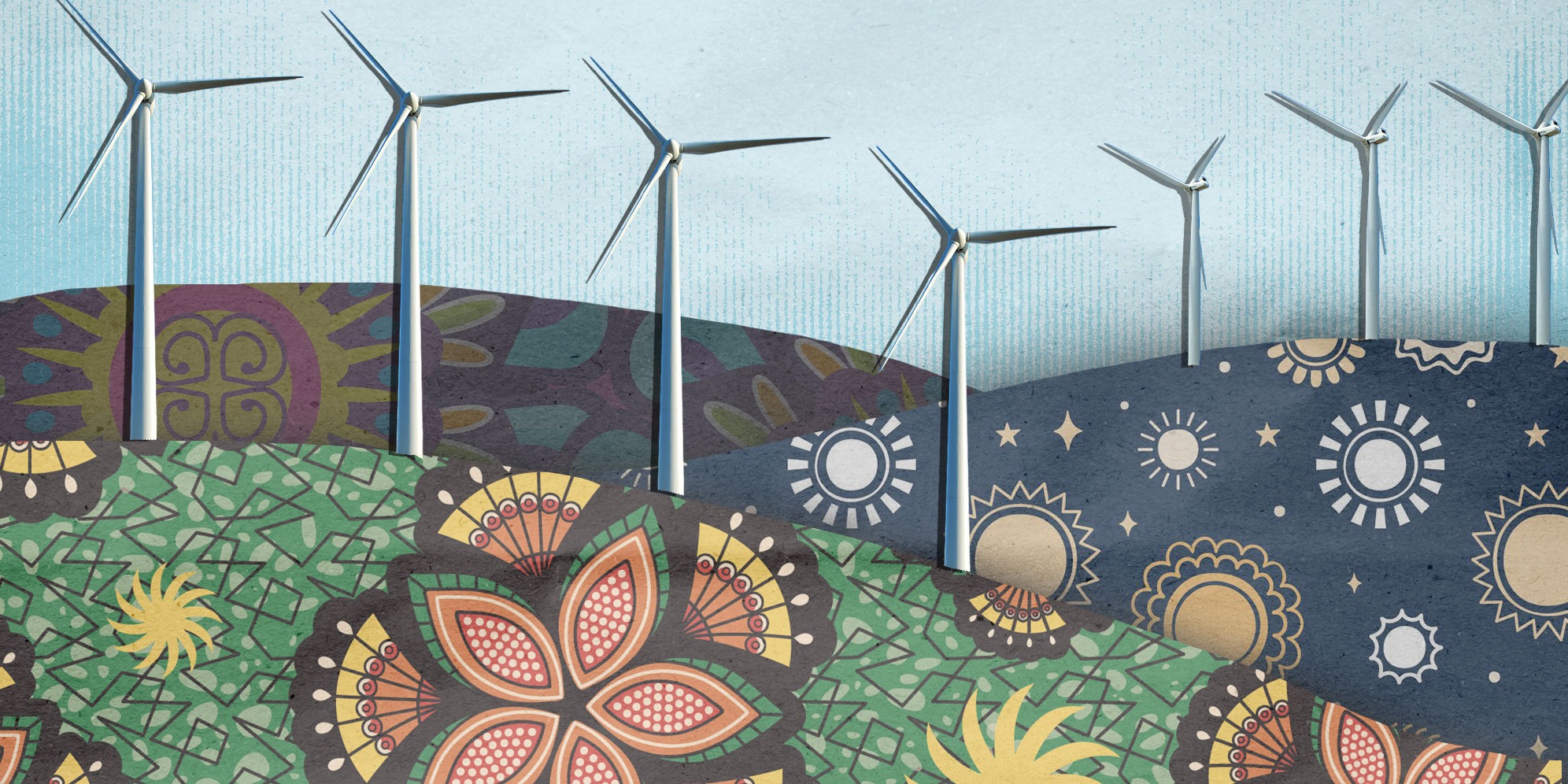
 Illustrative Image: Shweshwe fabric. (Image: Freepik) | Windmill. (Image: Istock) | (By Daniella Lee Ming Yesca)
 /file/dailymaverick/wp-content/uploads/2025/10/label-Op-Ed.jpg)
The 2026 International Clean Energy Day theme “Clean Energy for People and Planet” necessitates a reflection on United Nations Secretary-General António Guterres’ five actions needed to jump-start global renewable energy transitions. “Glocalising” the clean energy agenda in Africa requires shying away from an isolationist approach that secludes and problematises energy sources without recognition of indigenous energy systems in Africa.
For Africa, the clean energy agenda cannot be framed as a matter of global urgency translated into continental compliance. It must be glocalised, by adapting to local political economies, governance realities, historical trajectories of (under) development, and importantly, a consideration of indigenous energy systems.
Africa faces a deep energy paradox: despite being home to nearly 60% of the world’s best solar resources, the continent receives roughly 2% of global clean energy investment, yet about 600 million Africans lack access to electricity. The challenge is largely structural, political and economic.
Guterres lists five critical actions to jump-start global renewable energy transitions.
Make renewable energy technology a global public good
Guterres’ call to treat renewable energy technologies as a global public good reflects an acknowledgement of the longstanding inequality and inequity in climate change governance discourse. The argument is that renewable energy technologies should be freely accessible, enabling faster and equitable deployment worldwide.
While this is indeed ideal, questions around technology sovereignty, investment returns and knowledge-power dynamics remain unanswered.
According to the International Energy Agency’s (IEA’s) 2023 Energy Technology Perspectives report, China dominates the clean energy technology sector, while Africa remains a major supplier of critical mineral resources for tech production. Energy technologies must come with credible (and enforceable) commitments on intellectual property reform, capacity building and regional manufacturing ecosystems.
Improve global access to components and raw materials
This call acknowledges the importance of a secure, robust and diversified supply of critical raw materials such as lithium, cobalt and rare earth elements to produce renewable energy technologies like solar panels, wind turbines and battery storage. Guterres notes that it will take significant international coordination to expand and diversify manufacturing capacity globally. But resolving the coordination problem requires an alignment in interests.
As energy professional Fahd Isa argues, coordination across borders, markets, and institutions that were never designed to move at the same speed is at the core of the coordination challenge. Africa houses large reserves of critical minerals. It is home to 21.6% of natural graphite, 5.9% of copper, 55% of cobalt deposits, 48% of manganese deposits, 5.6% of nickel and 1% of the global lithium reserve.
SA alone is home to roughly 80% of global platinum group metals and more than 70% of global chromium and manganese resources, which are crucial for renewable energy technology production. Despite the abundance of critical mineral resources, Africa’s relationship with global energy value chains has been more parasitic than symbiotic. Also, global resource governance frameworks, including the Publish What You Pay initiative, failed to address the complexities surrounding mineral trade such as corruption, rent-seeking behaviour and various imbalances.
This raises questions on the potential continuity or replication of the resource curse and extractivism in the new scramble for critical mineral resources, while leaving local communities with degraded environments and minimal (socio)economic benefits. While continental mechanisms like Africa’s Green Minerals Strategy centre Africa’s beneficiation in the value chain, implementation remains a challenge.
Level the playing field, and shift subsidies from fossil fuels to renewable energy
Actions 3 and 4 emphasises the role domestic policies play in creating an enabling environment for an effective transition to renewable energy. In levelling the playing field, Guterres emphasises the need for governments to streamline bureaucratic processes, fast-track approvals for renewable projects, modernise grids, and set renewable energy transition targets to attract investment and reduce bottlenecks and red tape. Subsidies are highly political in most African economies.
In SA, pro-coal supporters in industry trade unions continue to resist the renewable energy transition, citing job losses and costs. Irrespective, SA has successfully procured more than 6,000 MV of renewable energy through the Renewable Energy Independent Power Producer Procurement Programme established in 2011. Also, the rise of “prosumers” across Africa is a testament to how renewables can bridge access and reliability gaps, if done right.
Thus, a successful global energy transition is dependent on the alignment of interests and coordination between domestic and international strategies.
Local political economy challenges permeate this industry and time is needed to phase out fossil fuels – a true transition, which connotes incrementalism at its core, as opposed to an immediate push to shift energy sources.
Triple investments in renewables
It is argued that at least $4-trillion a year in investments until 2030 is needed to facilitate the transition and meet the broader net-zero emissions by 2050 goal. Guterres emphasises the importance of alignment in the lending portfolios of key public and private financial institutions to accelerate the renewable energy transition.
The investment gap is evident, however the key challenge for many African economies is how capital flows. High financing costs, risk premiums and debt vulnerabilities imply that these countries pay more to borrow for clean energy transition than they do for fossil fuel projects.
Closing the gap requires more innovative financing mechanisms like the debt-for-climate swaps. This allows for debt repayments to be invested in climate adaptation and mitigation strategies in the borrowing country.
For some African countries, financing the transition stands in stark competition with “bread and butter” issues compounded by poor governance and accountability mechanisms, gaps between policy and implementation, and capacity and capability issues.
Glocalising the ‘clean energy’ agenda for sub-Saharan Africa
Glocalising the clean energy agenda requires African countries to take ownership of the transition process – it cannot be externally designed and enforced sans local co-creation, ownership, and credible commitment. In addition, the energy transition discourse for Africa must be framed within the confines of indigenous energy systems.
Ones that acknowledge the symbiotic relationship between people and the planet in most rural areas. The dependence on natural energy sources for survival, including food and water storage, must not be erased when prioritising “clean, modern” energy sources.
Thus, the clean energy agenda for Africa must, as a priori, assess gaps in indigenous energy systems and use renewable energy technologies complementarily. DM
Ekeminiabasi Eyita-Okon is a Senior Lecturer at the Wits School of Governance.