




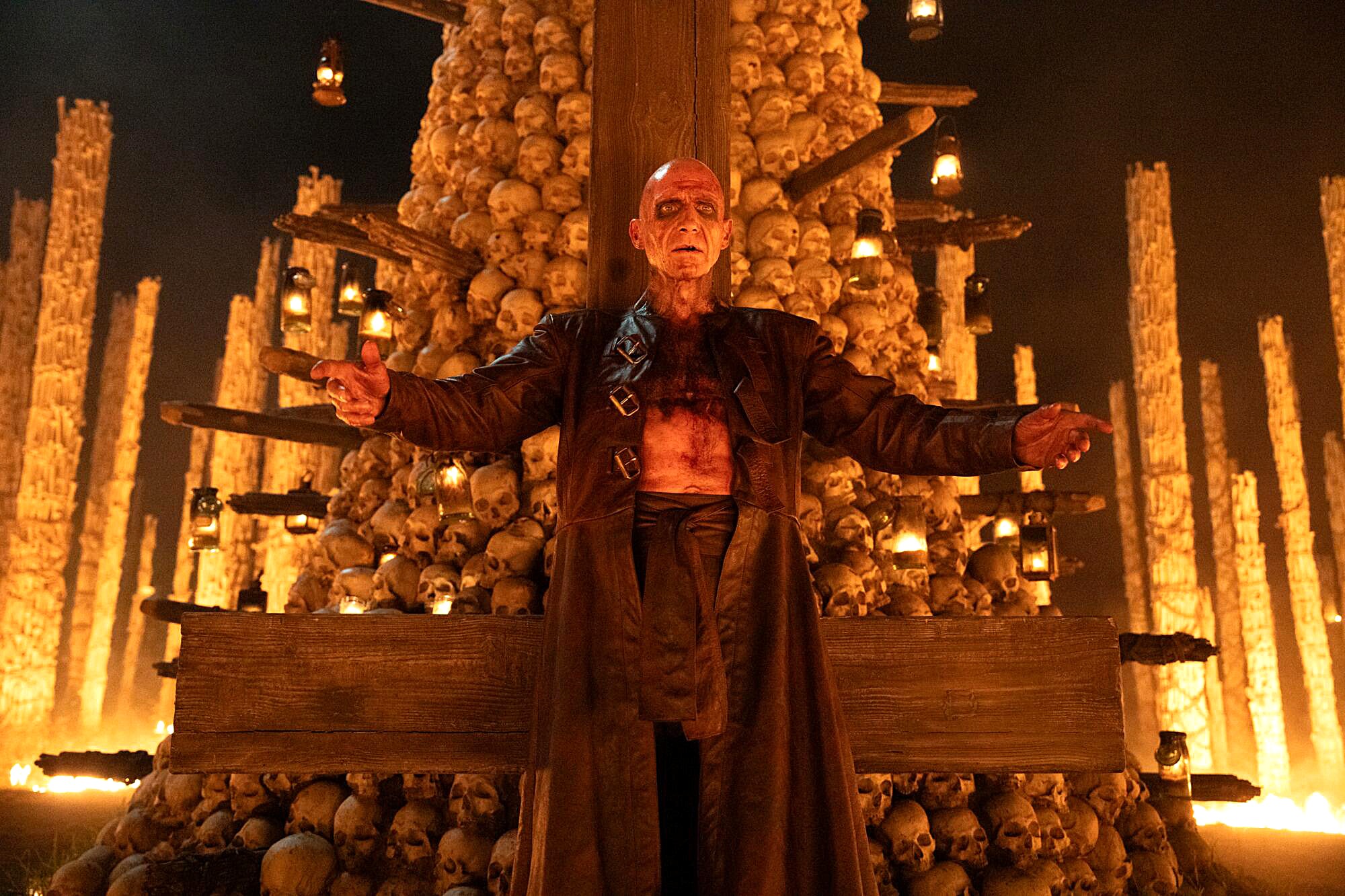
 Ralph Fiennes in 28 Years Later: The Bone Temple. (Photo: Sony Pictures)
 As is the case with any sequel, the immediate question is whether the new film is as good as its predecessor. In the case of 28 Years Later: The Bone Temple, it depends on your wants as a viewer, because it and 2025’s 28 Years Later are quite different beasts, despite being set in the same post-apocalyptic horror universe, and despite being filmed back-to-back.
Equal parts kinetic zombie horror, poignant coming-of-age tale, and dissection of crippling stagnation that comes from Brexit isolationism, 28 Years Later – under the creative leadership of original 28 Days Later director Danny Boyle and writer Alex Garland – was an emotional roller coaster, provoking tears as much as it triggered smartwatch warnings about stress levels. The latter stemmed from the film’s numerous nightmarish attacks by the franchise’s hyper-aggressive “Rage Zombies”, also known as the infected.
Despite the film’s divisive closing moments suggesting its sequel would be even wilder, in reality it isn’t. With the directing reins passed to Candyman and The Marvels’ Nia DaCosta, and script duties still filled by Garland, there’s one enjoyably over-the-top scene in 28 Years Later: The Bone Temple.
However, it’s announced beforehand, while the breathless zombie chases are dialled back overall. No, 28 Years Later: The Bone Temple’s greatest surprise is how cerebral it is; how it goes out of its way to hold a mirror up to audiences’ contemporary reality, stripped as it is of stabilising certainties.
Garland may have made Civil War, but The Bone Temple has considerably more to say about the “interesting times” we’re living in, and how we got here. The Bone Temple has a tighter narrative and terrestrial scope than 28 Years Later, splitting its 109-minute running time between adolescent Spike (Alfie Williams), who has been forcibly recruited into the gang of sadistic Sir Lord Jimmy Crystal (Jack O'Connell), and Dr Ian Kelson (Ralph Fiennes), who continues to nurture a relationship with the region’s Alpha infected, dubbed Samson (Chi Lewis-Parry).
28 Years Later: The Bone Temple doesn’t tread new narrative ground in showing humans as being more monstrous than the actual monsters. A warning now that the home invasions by Jimmy and his henchmen – styled and named after their Jimmy Savile-lookalike leader – are disturbing, coming across like something out of The Strangers with their graphic depictions of torture and degradation.
This said, The Bone Temple is immensely contemplative, using its world to explore such topics as why people would fall in with a vicious madman, and what it takes to shake off blind, unthinking hatred.
/file/attachments/orphans/ChiLewis-Parryin28YearsLaterTheBoneTemple_SonyPictures_734919.jpg "Chi Lewis-Parry in 28 Years Later: The Bone Temple. (Photo: Sony Pictures)")
/file/attachments/orphans/RalphFiennesin28YearsLaterTheBoneTemple_SonyPictures2_901514.jpg "Ralph Fiennes in 28 Years Later: The Bone Temple. (Photo: Sony Pictures)")
The parallels aren’t veiled, to be fair, but they do require some work on the viewer’s part to put in place. Meanwhile, adding to the complexity is a welcome nuance in character depiction. Jimmy Crystal, who could be dismissed as a malicious cartoon villain, is given quieter moments where audiences see behind the bravado to a childlike ignorance that has gone unchecked, and dangerously warped his worldview.
At the same time, despite his growth and resourcefulness in the first film, The Bone Temple acknowledges that Spike is still just a child in an extremely dangerous world, and there is only so much he can do in certain situations.
In a smart creative decision, 28 Years Later: The Bone Temple isn’t relentlessly dark either. Helping to balance out the heaviness of its themes, and inject a little hope, is the character of Kelson, and his portrayal by Fiennes. Immensely likeable, the avuncular Kelson is a voice of reason, decompressing with old Duran Duran LPs and cracking jokes as he treats Samson’s wounds.
While it’s still perilous, the dynamic between Kelson and Samson – which calls to mind Frankenstein and the Creature, and Robinson Crusoe and Friday – provides warmth missing elsewhere in the movie, where individual survival almost always takes precedence over compassion.
28 Years Later: The Bone Temple does feel like the middle portion of an intended trilogy. It skips the world-building of its predecessor, clears the board of character clutter while leaving other plot threads loose, and wraps on a cliffhanger. Like 28 Years Later, The Bone Temple has a divisive ending too, one that may feel like fan service depending on which ending of 2002’s 28 Days Later you preferred to accept.
Regardless, though, at this point the resurgent 28 Days Later franchise has proven itself to be smart and full of surprises, even if it remains too gory and visceral for casual viewers. If you have a stomach for horror, Part 3 is clearly something to look forward to. DM
28 Years Later: The Bone Temple is in cinemas now. Its predecessor, 28 Years Later, can be watched on Netflix. This review was first published on Pfangirl.