




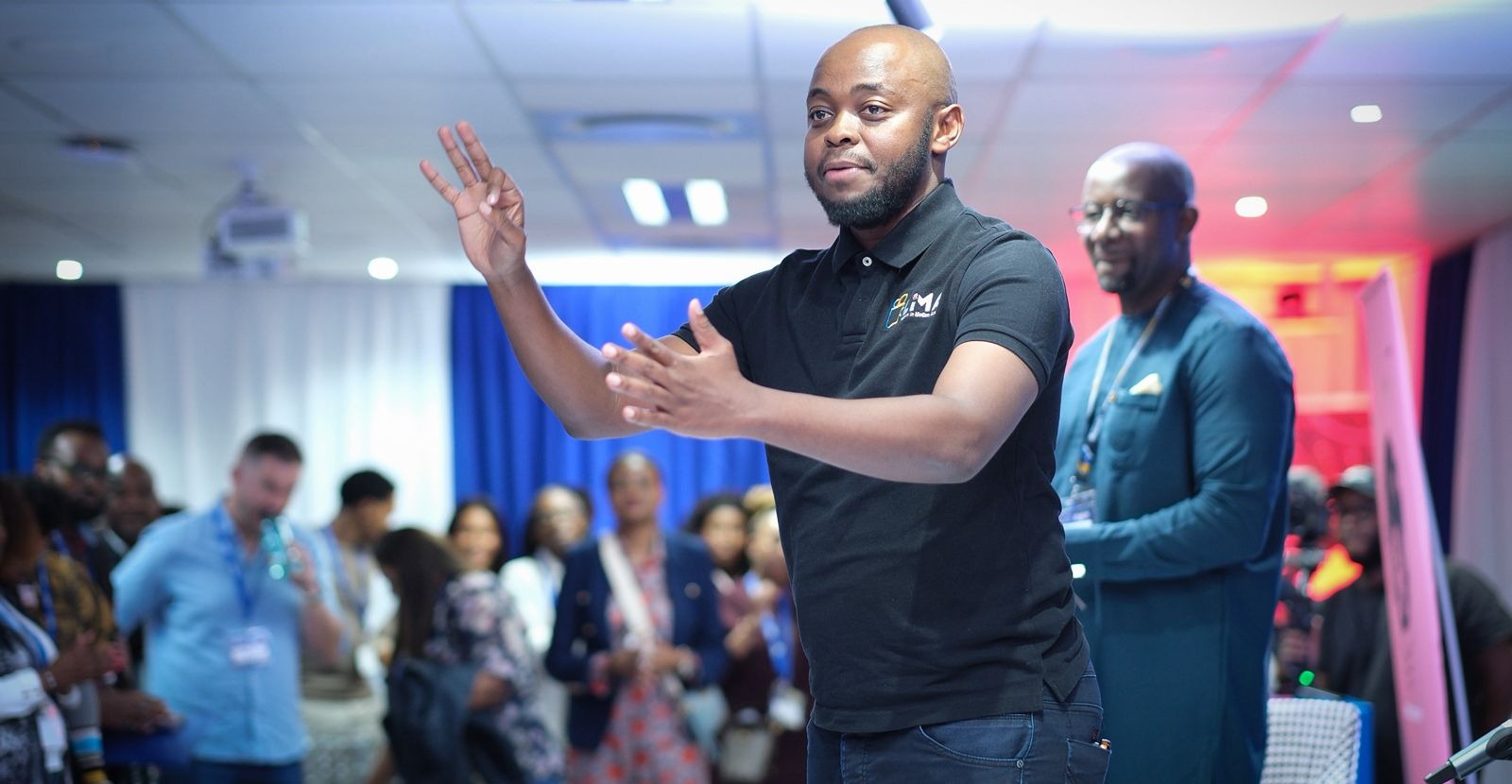
 LiMA founder and CEO Thato Moraka at the launch of The Creative Universe in partnership with Henley Business School Africa.
 Every day, millions of South Africans consume digital content – animations, mobile games, films, VR experiences – often without realising just how enormous the global creative economy has become. It is a sector now valued at over $3 trillion worldwide. Yet despite Africa being the second-largest consumer of gaming globally, our contribution to this trillion-dollar industry remains painfully small.
The irony is stark: we are a continent rich in creativity, storytelling, innovation and cultural capital. But we are not yet rich in the infrastructure, investment and coordinated systems needed to translate those assets into global-scale businesses.
South Africa today has more than 252 gaming and digital content studios, yet only about six generate real, sustainable revenue. These numbers tell a story of an industry that is bursting with potential but lacking the oxygen of investment and structured development.
This is not for lack of talent. It is for lack of investment, planning, infrastructure, and belief.
We applaud Amapiano when it takes over global charts. But that same appetite for global recognition has not yet been extended to our digital creative industries – gaming, animation, immersive content and film, could be some of South Africa’s most profitable export sectors if properly backed.
The talent exists. Access does not
One of the most pressing issues we face is the high barrier to entry into creative education. A year of film studies at a public university can cost over R140,000 – an impossible figure for most, especially for young people in rural or township communities who are brimming with talent but face staggering socioeconomic constraints.
Even worse, society still labels creative careers as “not real jobs.” Parents discourage their children from entering the field. And the educational system rarely exposes young people to digital creative skills early enough.
If we are serious about competing globally, then gaming, animation, and digital content development need to be introduced at primary and high school level. Talent must be nurtured long before matric. Exposure must be the rule, not the exception.
To move from fragmented talent to scalable impact, we need structured pipelines that source talent from across sectors and combine creative capability with business and technical acumen. It is not enough for a young creative to be gifted. Creative entrepreneurs must learn not only to produce content, but to run sustainable ventures. They must know how to package, pitch, commercialise and export their creative product.
This is why partnerships between industry and business schools matter. Initiatives such as a proposed 12-month accredited creative enterprise programme – developed in collaboration between the Leaders in Motion Academy and Henley Business School Africa – aim to do exactly this: combine creative training, business education and incubation support into a single, investable pathway.
The ambition is bold because the challenge is big
Finance remains one of the sector’s biggest constraints. Development banks and commercial lenders still struggle to fund creative media companies, largely because intellectual property and intangible assets are poorly understood within traditional financing models. The result is a sector that creates enormous employment potential but receives a fraction of the funding afforded to more traditional industries. If we are serious about job creation, policy and finance frameworks must evolve to recognise creative enterprises as legitimate, scalable businesses.
We cannot ignore the infrastructure divide either. A CEO in the broadcasting sector recently remarked that South Africa may still be 20 to 30 years away from achieving widespread fibre connectivity. This gap multiplies the cost of entry, slows growth, and widens the global chasm we are trying to cross.
In a world where content creation depends on high-speed internet, powerful devices, cloud-based creative tools, and now AI-driven production workflows, South Africa’s infrastructure deficit threatens to keep us permanently in “catch-up” mode. Additionally, without coordination and awareness, it could just as easily marginalise local creators and erode African intellectual property.
But if approached responsibly, AI infrastructure has the potential to democratise production, lower barriers to entry and unlock new creative possibilities. South Africa has an opportunity to position itself as a thought leader in responsible AI within the creative economy, ensuring collaboration, protection and inclusion rather than displacement.
The Henley LiMA partnership’s vision is bold because the challenge is big. The long-term mission is to impact one million creatives by 2030 by supporting SMMEs to grow into sustainable businesses that create jobs. This is not about individual success stories; it is about building an ecosystem where creative enterprises can scale, employ others and compete in global markets.
The world won’t wait for us
To change the narrative, South Africa cannot afford to continue to rely on fragmented initiatives and siloed champions; instead, we need a unified national strategy backed by unified investment. Meaningful progress in the creative economy will require cross-sector collaboration – between educators, industry leaders, policymakers and creative entrepreneurs. This roadmap must start by expanding creative education at the school level and strengthening business incubation and training for entrepreneurs, while simultaneously updating government policies to better support digital IP and exports. Crucially, it requires building robust partnerships across the ecosystem – linking broadcasters, advertisers, and local studios – to ensure our creative industries are fully prepared to engage and compete in international markets.
Last year at Gamescom in Germany – an event attracting over 350,000 attendees – fewer than 40 African exhibitors were present. From an entire continent. That statistic alone should give us pause.
African stories belong on the world stage. African games, animation, VR experiences and films belong in global catalogues, app stores, festivals and streaming platforms. But belonging requires effort, investment, coordination and a deep belief in our own potential.
The creative economy is a necessity for any nation aspiring to compete in a digital world. We have the talent, the stories, and the cultural influence. What we lack is alignment, infrastructure and investment. These are things we can fix.
This challenge is not theoretical. South Africa already has a Creative Industries Master Plan, signed off in 2022 through the Department of Trade, Industry and Competition and circulated across government. The vision exists. What is missing are implementation partners. This is where industry, educational institutions and private capital can step forward, not as critics on the sidelines, but as patriotic partners willing to turn policy into practice.
South Africa’s creative economy is a sleeping giant. And if we wake it – properly, intentionally, collectively – we will not just create jobs, we will create industries, global brands, and a future where South African creativity is not just consumed, but celebrated, exported and monetised on a global scale.
Find out more about Henley’s ladder of learning from post-matric and undergraduate studies to the MBA and Doctor of Business Administration here. DM
Authors: Thato Moraka and Barry van Zyl
Thato Moraka is a media personality, and Founder and CEO of Leaders in Motion Academy (LiMA) and a current Global Executive MBA candidate at Henley Business School. Barry van Zyl is a South African musician and Programme Lead for the Global MBA at Henley Business School. The two also head up the Creative Universe, a collaboration between LiMA and Henley Business School that is championing a coordinated response to commercialising and scaling Africa’s creative sector.