




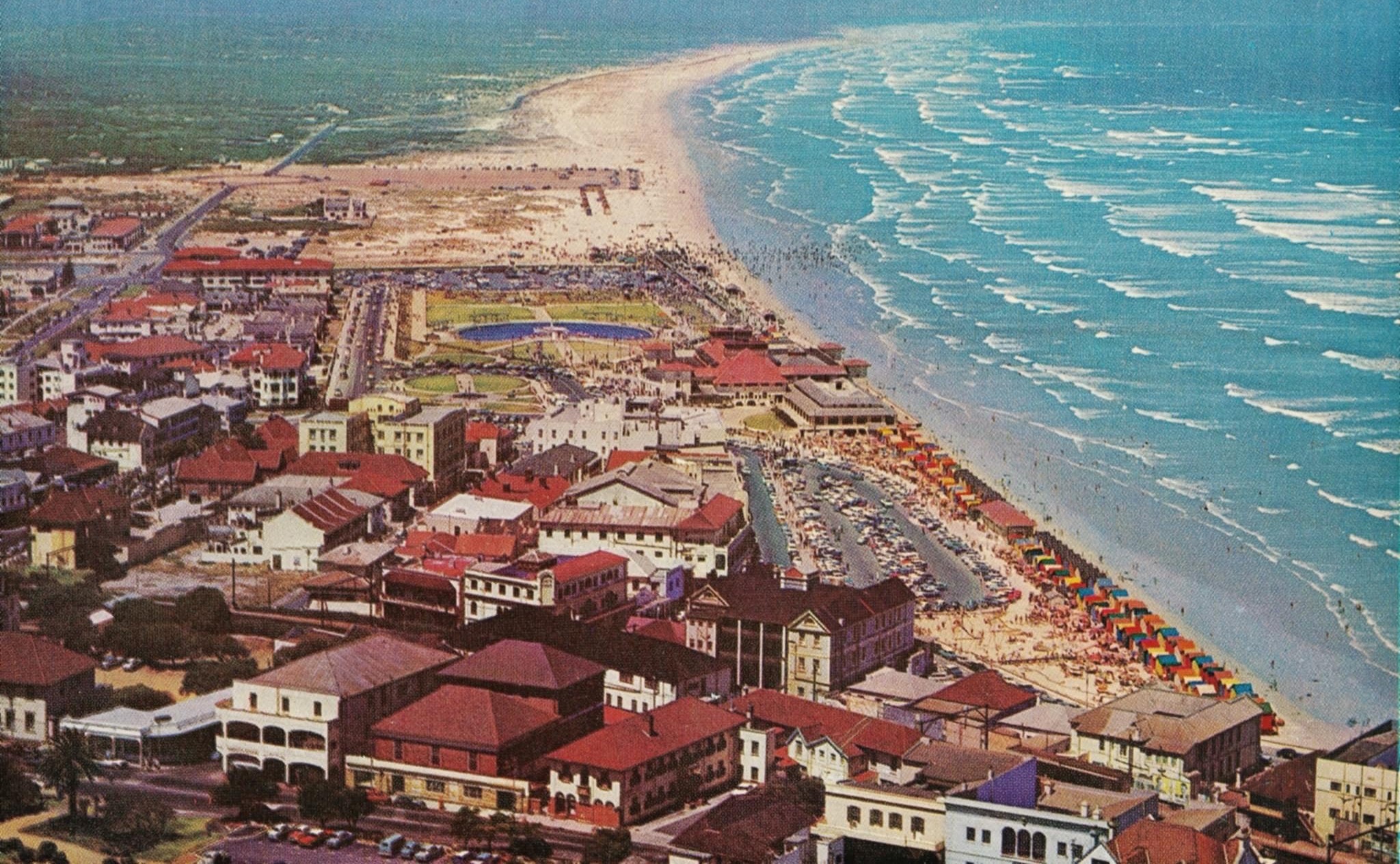
 An aerial vintage photograph showcasing the burgeoning suburb of Muizenberg during the mid-20th century.
 At the heart of this building was the Public Works Department (PWD) architect, W.B.T. Newham. A man so devoted to the idea that local art should be integrated into all public buildings (in particular ceramics) that he was affectionately known as “Potty Newham,” because of his intense passion for the Ceramic Studio at Olifantsfontein.
But Newham understood something profound, infrastructure shapes identity. If a community is to believe in itself, its buildings must reflect that belief. So, he insisted that this post office not only function efficiently but also speak to all those who use it.
/file/attachments/2987/IMG_84931_232848.jpeg "The burgeoning suburb of Muizenberg , showcasing a time when the area acted as a vital hinge between Cape Town and the deep south.")
Drawing from a specific collective of “heritage circle” influences, Newham constructed the prominent and impressive sea-facing second post office building in Muizenberg. From the “Herbert Baker-style” elements of heavy, grounded, unmistakably local Hammer-dressed sandstone, the arched windows, and Cape-vernacular-meets-Art-Deco proportions. To the ceramic panels beautifully crafted by Isa Cameron at the Ceramic Studio in Olifantsfontein and inlaid into its bones to reflect a landscape and local culture. Newham gave the building a role, a heart and a meaning.
/file/attachments/2987/153Main_396766.jpg "The main road façade, built in 1934.")
The two great ceramic murals on the Main Road façade were intentional, fired into the stone as a permanent tribute to a time when communication was an act of faith, when connection depended on wind, water and trust. Even now, after nearly a century of salty air and sea mist, their colours remain soft and alive. The tall multi-masted ships sail over stylised Art Deco waves beneath compass roses and maritime symbols that carry stories of Muizenberg’s shoreline as part of an early communication network. Their blue-and-white glaze echoes the Delft and Dutch heritage of the Cape, while their clean, modern geometry speaks to a nation stepping into a new era of that time.
Inside, the building lived up to its promise, a flurry and urgency of communication, delivered by bicycled telegrams, letters and postcards, while telephone calls were plugged in at exchange boards. The efficiency is left etched into its interior today, with its pigeonholed mailboxes built into the entrance wall and the old mail sorting table spread across its main hearth. There is a human soul that lingers today in its cornices, Art Deco fittings and parquet-laid flooring, one that floods through large leaded windows, letting natural light fill the space.
/file/attachments/2987/MuizenburgPO30_866013.jpg "Designed by W.B.T. “Potty” Newham, the building was intended as a civic statement rather than a utilitarian box.")
As technology changed, so too did the tools of communication; letters became emails, telegrams became texts and plugboards became servers. For a long time, the building’s role shrank until it seemed almost obsolete, but heritage buildings do not become antiquated when their purpose disappears; they wait. And because this building’s intent was never merely about mail but more so about the exchange of ideas, the movement of people and the weaving of community into the world, its wait is finally over. The building’s natural continuation, as its new designation, is a Workshop17 collaborative workspace.
Today, as the current architect and design team, Hoven Designs work hand in hand with property owners, Flip Floppers Pty Ltd (Mark Forrester, Chris Vella and Ant Saunders) and building contractors, W30 to repurpose the old Muizenberg Post Office, its core job remains the same - To connect people. Workshop17 Muizenberg is aligned with its predecessor’s purpose, a place that brings people, businesses, and ideas into conversation. As the space is meticulously re-stitched for a new generation of work, the underlying fabric of exchange, collaboration, and shared momentum that has always defined it is merely being given a modern form, carefully preserving the artefacts and memories of the past.
/file/attachments/2987/1958060_H_65_761880.jpg "Once a center for sorting mail and plugging in telephone calls, this space features original parquet-laid flooring and Art Deco fittings.")
James J. Hallinan, an independent heritage practitioner, understands what this transformation means: “This is a textbook example of how a redundant and even derelict heritage resource can be repurposed while preserving its intrinsic heritage qualities. It is further proposed that this will not only bring new life to this historical structure but infuse a highly interactive revenue generating element into this Heritage Protected Overlay Zone and thus, support the general economic empowerment and renewal of historical Muizenberg, more widely."
With the ships on the walls still sailing and the compass roses still pointing outward, the long pause between the building’s past and its future is finally complete. DM
For all your Workshop17 Muizenberg workspace solutions, contact Antonette Benting antonette@workshop17.com