




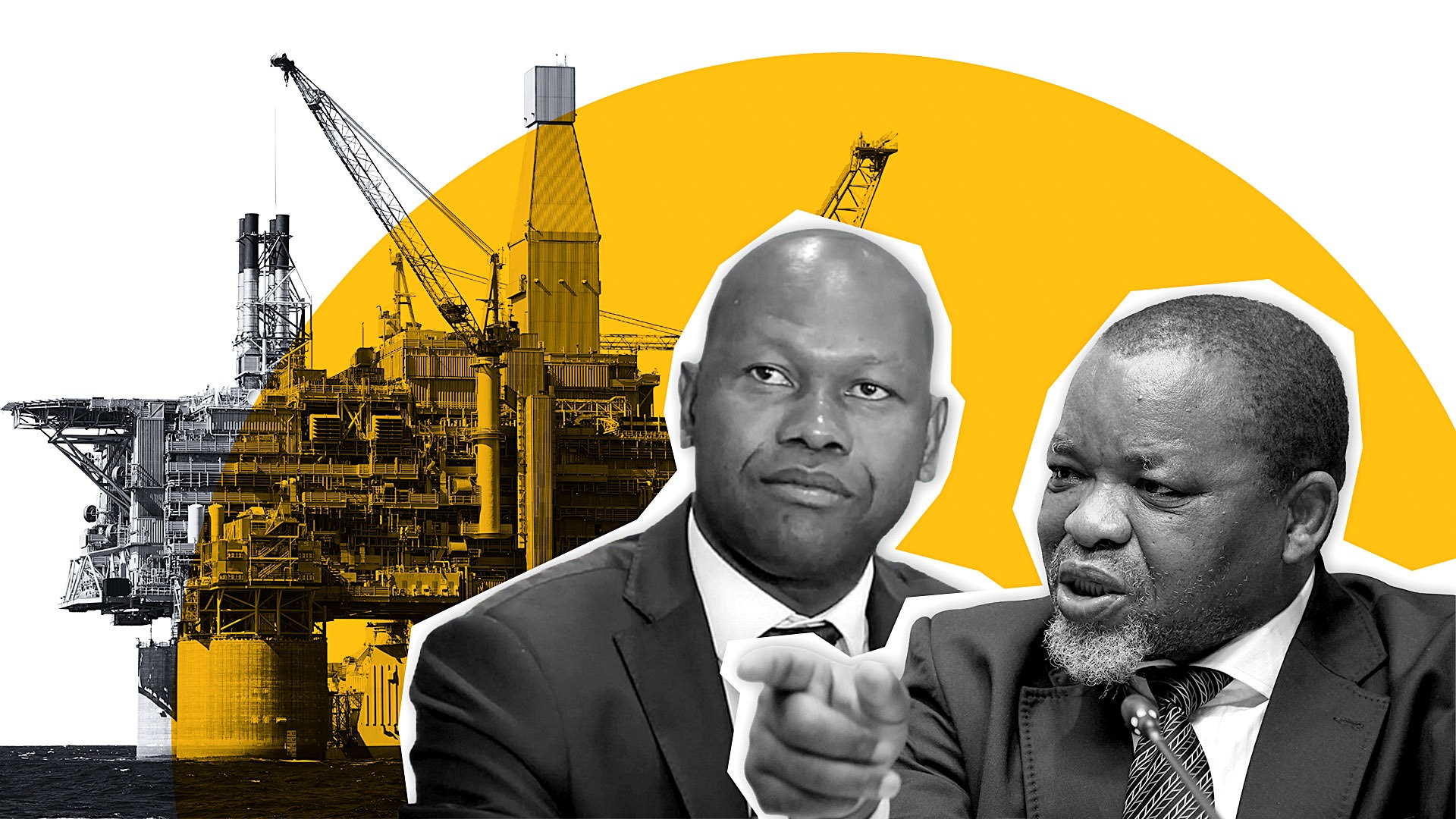
 Minister of Minerals and Petroleum Gwede Mantashe (right) oversees PetroSA, the ailing state-owned entity that partnered with businessman Lawrence Mulaudzi (centre) in an apparent attempt to raid a skills training fund for unemployed youth. (Image: GCIS / Canva)
 As universities open their doors, one in three young South Africans will be left behind at home – 34% (age 15 to 24) are not in employment, education or training, according to Stats SA.
Yet ANC chair Gwede Mantashe has suggested that these unemployed young people have only themselves to blame.
“The ANC has given you a fishing rod – must it now catch fish for you?” Mantashe, who is also minister of minerals and petroleum, said during a recent SABC interview.
“I’m now over 70, I’ve never had government looking for a job for me, never. The difference is that today, because we have a progressive government, people expect government to go and give them jobs…”
Yet an amaBhungane investigation has uncovered how PetroSA – a state-owned entity in Mantashe’s portfolio – attempted to divert R1.2-billion from a fund earmarked to provide training to unemployed youth.
The National Skills Fund (NSF), which is financed by a 1% tax on every employer’s salary bill, is meant to fund training for unemployed youth, provide bursaries to students and build technical and vocational education and training (TVET) colleges to train artisans.
The R3.5-billion grant that PetroSA requested from NSF in May 2024 would have paid for an opaque scheme to train 5,500 artisans who would supposedly become the future workforce for the oil and gas industry. But documents show that R1.2-billion would have been used to fix PetroSA’s ailing offshore oil rig.
The scheme was the brainchild of political operator and soccer club owner Lawrence Mulaudzi, whose company, Equator Holdings, had been awarded a contract to secure funding to pay for PetroSA’s offshore infrastructure revamp.
The project was ultimately never funded after both PetroSA and the NSF pulled out of the deal.
But what it illustrates – and why we’ve taken the time to write about a deal that failed – is how it is possible for the well-connected to extract billions of rands from the NSF, while desperate students and unemployed South Africans are left out in the cold.
Mantashe dodged the question of whether he had been aware of the PetroSA and Equator proposal: “Whether I’m aware or not, it doesn’t matter. I am not an operator, I’m doing political oversight,” he told us.
Asked whether he thought it was appropriate to use R1.2-billion, intended for training, to repair a piece of infrastructure that would primarily benefit the oil and gas industry, he said: “The amount is an operational matter. But if they are training artisans, I would support them.”
Equator was desperate
PetroSA is not officially bankrupt, but it is effectively insolvent, with its debts exceeding its assets and creditors going unpaid. The depth of its crisis was laid bare in December, when SARS moved to attach its Mossel Bay refinery over unpaid tax bills.
With the company’s assets largely idle, its only hope of being resuscitated is to breathe life back into its offshore oil and gas wells and, in turn, the Mossel Bay refinery.
In 2023, PetroSA signed a series of deals to do just that. The biggest had appointed an obscure company, Equator Holdings, to secure up to R22-billion in funding to refurbish PetroSA’s deep-sea platform and build new oil and gas infrastructure.
The controversial agreement acknowledged that Equator had neither the expertise nor the money for a project this weighty, but PetroSA gave the company six months – until June 2024 – to come up with the goods.
By May 2024, Equator was desperate. A long line of suitors had been presented to PetroSA, but none had stuck around.
The first had been the Industrial Development Corporation (R1-billion), then Corban Energy ($200-million), followed by Hong Kong’s Hilong Petroleum Engineering Company, but none were willing to actually commit.
If Equator couldn’t secure funding by 10 June 2024, it would lose the entire offshore gas deal. What it needed was someone with a large pot of money who was equally desperate.
Enter the National Skills Fund
The National Skills Fund is one of 26 entities that report to the Minister of Higher Education. While NSFAS – which provides student bursaries – is often in the news, the NSF mostly flies below the radar.
But with 58% of the country’s youth unemployed, there is pressure on the fund to do more.
Over the next five years, the fund plans to spend R34-billion on training. Counterintuitively, the problem isn’t finding the money for this ambitious target – SARS collected R24-billion from the skills development levy last year – it’s finding worthwhile projects to fund.
Last year, the fund had a budget of R5.8-billion, but managed to spend only R4.6-billion because, among other reasons, projects that were approved couldn’t meet milestones to justify releasing more money.
“This resulted in under expenditure of R1.2-billion,” Director-General of the Department Nkosinathi Sishi wrote in the annual report. “This shortfall remains a serious concern, as it represents missed opportunities to deliver impact at the scale envisaged…”
The pattern is familiar: in 2023/24 the fund underspent its budget by R3.7-billion. This, Tebogo Letsie, the chair of Parliament’s portfolio committee on higher education noted, was contributing to “growing despair among young people about their future prospects”.
In response, acting CEO Melissa Erra said that the fund was struggling to approve proposals, some dating back to 2023. The fund was short-staffed, she admitted, and the due diligences had become complex, which only made it harder to get money out the door.
To deal with the bottleneck – and achieve government’s goal of training 30,000 artisans a year by 2030 – the fund has adopted a “massification” strategy to scale up successful projects and approve “fewer but larger programmes”.
So, when Equator placed a phone call in May 2024, offering to take a few billion rand off the fund’s hands, officials were seemingly delighted.
A catalogue of fraud
The fund’s desperation to give away billions had already made it a target for fraud. Years of forensic investigations, audit warnings and unanswered questions have exposed a pattern of corruption, mismanagement and missing money.
In 2021, the department commissioned Nexus Forensics Services to investigate 10 projects after the Auditor-General discovered that R2.5-billion couldn’t be accounted for over the preceding two financial years.
The report reads like a catalogue of fraud and embezzlement. A R39-million project in KwaZulu-Natal was supposed to train 250 students to farm rabbits. The project promised to deliver 10,000 rabbits, but when investigators arrived, they found only 450 rabbits and a top-of-the-range Nissan Navara bakkie parked outside.
The revelations from the Nexus report should have made the fund’s officials hyper-vigilant to any whiff of scandal, which, in Mulaudzi’s case, is not hard to sniff out.
Instead, the written record shows that Tendani Moila, the fund’s acting director for Skills Development Implementation for the Western and Northern Cape, was enthusiastic.
In an email, sent six days after Mulaudzi’s phone call, Moila asked him to “facilitate a meeting between the NSF and PetroSA to formalise the partnership”.
We managed to reach Moila earlier this month and asked why, on the basis of one phone call, she had been so keen to rush into a deal with PetroSA and Equator.
“NSF did not go to PetroSA for the Equator proposal, not at all,” she told us. “Whether it has been submitted to the National Skills fund or not, the intention here was that a stakeholder – which is PetroSA – was identified. Even if it came through a particular individual or service provider, our role is to engage a state-owned entity.”
She added: “We don’t have any business with Equator. We didn’t go to PetroSA to discuss the application for Equator.”
The proposal
At 9pm, the night before the meeting, Mulaudzi’s 42-page proposal landed in Moila’s inbox – “as promised”. Together, Equator and PetroSA planned to offer:
- 2,000 apprenticeships (three years),
- 1,500 spaces for graduates-in-training (two years), and
- 2,000 spaces for students who required practical, in-service training to complete their qualifications (two years).
But only if the fund agreed to give Equator and PetroSA R3,486,795,541.
Despite the audacity of the request – R3.5-billion was double what the fund had spent in the previous financial year on all its training programmes combined – there was very little information about what training PetroSA and Equator planned to offer.
The closest the proposal came to firm commitment was: “PetroSA & Equator Holdings will ensure that trades that are in demand for the economy … such as diesel mechanics, instrument technicians, riggers, auto electricians and millwrights are prioritised.”
Equator had no experience in offering training. PetroSA’s own due diligence from six months earlier identified the company as “a special purpose vehicle” and “an investment holding company”.
PetroSA’s own training facility, the Centre of Excellence, was registered to provide NQF level 4 training for mechanics, electricians, riggers and several other trades, but it had never provided training on this scale.
In 2024, it had offered just 93 apprenticeships. Now, Equator was offering, on behalf of PetroSA, to recruit 5,500 students before the end of the year.
Sesakho Magadla’s pet project
Despite being PetroSA’s then CEO, Xolile Sizani had no idea that the company he ran had offered to open its doors to 5,500 students. That news reached his desk only on 23 May 2024, when Moila and a delegation from the NSF turned up at PetroSA’s Mossel Bay plant.
Emails show that the visit had been co-ordinated by Sizani’s predecessor, Sesakho Magadla. An email, sent by Magadla to Moila, suggests that she had given the Equator proposal her full support:
“One of the critical partnerships is the development of Block 9, Offshore Production Rig (FA Platform) and Gas Processing Infrastructure development in Mossel Bay. Equator Holding has entered into an agreement with PetroSA [for] Gas and Gas Finance and Redevelopment. This will require thousands of technical skills during construction and post construction,” she told Moila in the 13 May 2024 email.
/file/attachments/orphans/GRAPHIC11_941423.jpg "(Source: African Energy Chamber / Canva)")
But by the time Equator’s proposal landed in Moila’s inbox on the night of 22 May 2024, Magadla had been shown the door.
Magadla had briefly been acting CEO, but was moved to the acting COO position in April 2024, when Sizani was appointed.
The demotion had created a toxic work environment, according to Sizani. In a subsequent letter to the board, he wrote: “I found her to be a very difficult person to work with and, unfortunately, extremely insubordinate and condescending … Our relationship had reached a stage where she did not respond to some of my emails or brief PetroSA GCEO [me] about certain meetings and events she was attending or attend hand-over meetings.”
One of the projects that Magadla had seemingly failed to mention: the potential R3.5-billion grant from the NSF.
Logistical flaws
A midday email shows that while officials from the fund were being given a tour of the Mossel Bay plant, PetroSA’s new CEO was scrambling to get up to speed.
“Please have [a look] at the attached document in the context of training and whether it is aligned with our training strategy and budget,” he wrote, forwarding Equator’s proposal to executives in the legal, human capital and capital projects departments. “I am not sure if we have the infrastructure and human capital to train thousands of artisans in our training centres.”
PetroSA has a training campus in Mossel Bay – the Centre for Excellence – but as the head of human capital, Tumelo Mokwena, pointed out in a reply: “The upper limit of our own capacity is 120 learners per annum.”
PetroSA has previously put the number at between 150 and 300, but still far short of the 5,500 envisaged. So where, we asked, would these students be trained?
This was one of 39 questions that amaBhungane recently put to PetroSA. Despite the damning implications, the company chose not to answer.
Sizani has been on suspension for more than a year, and in his place, Magadla has returned to her position as interim CEO. “We will not be commenting on the questions shared,” a PetroSA spokesperson said in response.
Equator declined to comment as well. Instead, they sent their lawyer to tell us: “[T]hey do not wish to respond to the enquiries. They are of the view that regardless of any response the intended article will nonetheless be unfair and misleading.”
R634,000 per student
At R3.5-billion – or R634,000 per student – the Equator and PetroSA training programme would also be one of the most expensive on the market. To train as a boilermaker or rigger generally costs around R200,000 for a three-year apprenticeship.
But this course would include some expensive extras.
To administer the project, Equator and PetroSA would pay themselves R242-million as a project administration fee. This was on top of the R363-million that would be spent on training, R780-million on accommodation and R826-million that would be distributed to students as a monthly stipend.
But the biggest single line item was the R1.2-billion earmarked for repairs to the FA platform, a deep-sea rig that is built on top of its now-defunct gas wells. And it’s here, at least, where alarm bells should have gone off.
/file/attachments/orphans/GRAPHIC2_715178.jpg "A supply boat leaves PetroSA’s deep-sea rig, the FA Platform, south of Mossel Bay.
<br>(Source: PetroSA)")
(Source: PetroSA)
Trickle-down training
The NSF can fund infrastructure projects: over the next five years, it plans to spend R4.2-billion on major upgrades to six TVET colleges, four of which are in the Eastern Cape.
But the FA platform isn’t a TVET college where generations of students would benefit from the investment in its infrastructure. The platform is 80km offshore and can be reached only by boat or helicopter.
Currently, PetroSA spends around R100-million a year on the helicopter flights that rotate the roughly 100-member crew on and off the platform, and another R160-million a year on supply boats, making it impractical as a training facility for thousands of students.
Despite this, Equator told the NSF that its goal would be “to provide... apprentices with practical training experience in the offshore refinery during the refurbishment and planned maintenance”.
In addition to this, Equator argued that the investment in the FA platform would eventually trickle down to students: “This will accelerate production and optimise the operation [of the Mossel Bay on-shore refinery], which in turn will benefit the graduates and students with access to opportunities like employment and further training,” it wrote.
The maths isn’t math-ing
Aside from being light on detail, the proposal that Mulaudzi sent to Moila the night before the site visit was also light in other ways.
In the 42-page proposal, R1.2-billion had been earmarked for the FA platform to repair items such as fire suppression systems, life rafts and turbines. But the individual line items added up to only R894-million, with no explanation for how the other R324-million would be spent.
The FA platform needed the full R1.2-billion, according to PetroSA’s own internal estimates, but Equator’s proposal shows that it had drastically underbudgeted for the work required.
/file/attachments/orphans/GRAPHIC3_880079.jpg "The R3.5-billion proposal from Equator and PetroSA was intended to train artisans
<br>but a large chunk would have gone to repair PetroSA’s deep-sea platform.
<br>(Source: PetroSA)")
but a large chunk would have gone to repair PetroSA’s deep-sea platform.
(Source: PetroSA)
There were smaller errors in Equator’s proposal as well: a stipend of R5,000/month for 24 months was recorded as R132,000 per student, when the number should have been R120,000. This was a minor difference of R500/month for each student, but which padded the budget by another R24-million.
A later version of the proposal corrected some of these mistakes, but the question left lingering is: why did officials from PetroSA and the fund entertain a proposal that had the potential to spirit almost R350-million away from taxpayers?
Moila’s version
Moila maintains that the fund never had any intention of approving the R3.5-billion proposal that had been submitted in Equator and PetroSA’s name.
“We don’t fund anyone that it is not in the training space,” she told us when we spoke to her recently. “PetroSA is the custodian of the training centre … and that is the one NSF is interested in, not Equator.”
She continued: “Even if it’s a partnership, we expect PetroSA to apply, and we are not going – I promise you this – we are not going to entertain Equator.”
As for the R1.2-billion for the FA platform? “The NSF does not fund infrastructure – it is not our responsibility to fund infrastructure. We only fund infrastructure that is focused on post-school education and training.”
She could not, however, adequately explain why “infrastructure” and “refinery in the sea” were topics on the agenda she prepared for the visit, or why she asked Mulaudzi to organise a tour of “the training centre and the FA platform so that we understand the nature of support required from us on infrastructure”.
Regardless, Moila told us that she left Mossel Bay having delivered a very clear message to PetroSA and Equator: “We said, ‘PetroSA, here is your Centre of Excellence, we expect an application from PetroSA … not from Equator.”
Yet seemingly, neither PetroSA nor Equator got that message.
‘Huge appetite’
Two weeks after Moila’s visit, Mulaudzi wrote to senior PetroSA executives, thanking them for welcoming the NSF – “Our Potential Funder” – to the Mossel Bay facility.
“We would also like to put it on record that we have been working tirelessly to secure funding for the Refurbishment of the FA Platform in order to fulfil our Conditions Precedent as stipulated in our Gas Infrastructure Financing and FA Platform Refurbishment Agreement.”
“We are also ex[c]ited that our potential funder has express[ed] a huge appetite to finalise our application which is on the Due Diligence stage at the moment,” he wrote, copying Moila on the email.
The funders, he added, “also express appetite to avail some more funding for the benefit of the project to both Equator and PetroSA to further finance the training of Artisans”.
A new draft of the proposal had actually reduced the size of PetroSA and Equator’s request, from R3.5-billion to train 5,500 artisans to R2.7-billion to train 3,500 – less money overall, but the cost to train one artisan would go up to R771,000.
Tumelo Mokwena, PetroSA’s head of human capital, later told the new CEO (Sizani): “For the past three years we have undertaken very limited training because of lack of funds … we have been pursuing external funding opportunities from credible sources albeit with limited success. The apprenticeship training we offer is entirely sponsored by CHIETA (Seta) again due to lack of funds.”
It’s unclear why PetroSA, a state-owned entity and member of the department’s artisan development committee, needed Equator to unlock this bounty. But Mulaudzi’s email made it clear that he felt responsible.
In bold capital letters, he wrote:
“NB: PLEASE TAKE NOTE THAT THIS IS EQUATOR HOLDINGS INITIATIVE AND WE WOULD APPRECITE [sic] PETROSA TO LIASE [sic] THROUGH US TO AVOID CONFUSION THAT MAY HAMPER PROGRESS THAT HAS BEEN MADE SO FAR…”
Staying quiet
If Mulaudzi was lying about the fund having “huge appetite” for the proposal, this would have been a good time for Moila, who was CCed on the email, to put up her hand.
In her version, she had told PetroSA and Equator quite clearly that the fund had no interest in the Equator or its proposal. Yet here was Mulaudzi, not only claiming that the fund was interested, but that the proposal was being fast-tracked for approval.
Why, we asked Moila, did she not set the record straight?
“I was with them in the meeting … I spoke to them physically. So why was there a need for me to emphasise that in an email?” she told us.
Without being officially assigned to assess Equator’s proposal, she added, she had no mandate to respond, one way or the other: “We had a meeting with PetroSA, Equator was there. Our stance was clear, we told PetroSA. And what Equator and PetroSA want to communicate, it is their business. NSF is not party to those politics – it is their politics.”
A letter attached to Mulaudzi’s email shows that the R3.5-billion version of the proposal had also been sent to the fund’s then acting CEO David Mabusela, who confirmed that the project would be evaluated.
But the fund told us that, according to its records, there was no evidence that Equator’s proposal had progressed to a due diligence, as Mulaudzi had claimed: “The Equator PetroSA proposal did not advance to the point of administrative compliance, technical evaluation, due diligence, Funding [and] Recommendation Committee nor Memorandum of Agreement and accordingly, it could not and did not receive approval,” NSF spokesperson William Somo confirmed in a written response.
“These stakeholder engagements do not constitute an approval… recommendations are not processed on the basis of one official’s recommendation evaluation.”
We went back to Mulaudzi to point out that Moila and the fund were essentially saying that he had misled senior PetroSA executives when he claimed there was an ongoing due diligence and that the fund had “huge appetite” to finalise the proposal.
He is yet to respond.
The politics of the NSF
Last year, Parliament asked the fund to explain how projects were approved for funding.
According to acting CEO Melissa Erra, unsolicited proposals – such as Equator’s – were only supposed to be considered by the fund after “engagement by [the] Minister of Higher Education and Training and/or the Director-General”.
If they give a green light, the proposal is supposed to undergo a six-stage assessment by at least 10 officials. But as officials confessed to MPs last year, the fund is operating with critical staff shortages, with about 40% of its own job posts vacant.
Adding to these concerns, CFO Zama Kubheka explained that the fund’s financial reporting system relies heavily on a manual process. The reliance on manual processes – including to track expenditure – combined with too few staff and vacant deputy director positions, resulted in frequent errors, he said. In some instances, he added, a single assistant director was required to perform tasks that ordinarily should have undergone several levels of review.
Finally, the projects that make it through go back to the director-general for approval and, for any project above R1-million, the minister as well.
If Equator’s project had passed the evaluation, the final handshake on the R2.7-billion grant would have to come from the minister of higher education and training. The proposal had been submitted to Moila a month before the May 2024 elections, when Blade Nzimande was still the minister, a position he had held for an almost unbroken 15-year stint since Jacob Zuma became president in 2009.
When Nzimande was briefly removed as higher education minister in 2017, Gwede Mantashe had publicly risen to his defence. This wasn’t surprising: as members of the South African Communist Party’s (SACP) top six, Nzimande and Mantashe were close, and the SACP as a collective had become vocal critics of Zuma.
After the May 2019 election, President Cyril Ramaphosa reinstated Nzimande at the Department of Higher Education.
If Equator’s proposal had passed through Nzimande’s hands, he may have been well-disposed to greenlight it: a year earlier, in 2023, Ramaphosa had appointed Kgosientsho Ramokgopa as minister of electricity, essentially cuckolding Mantashe and his department.
With the all-important electricity portfolio gone, Mantashe’s job was to oversee the increasingly odious collection of state-owned oil, gas and mining assets, including PetroSA.
By 2024, PetroSA needed a bailout, and as minister of higher education, Nzimande was, in theory, well-placed to deliver one. Yet when we asked Nzimande about Equator’s proposal, his spokesperson told us the minister had never seen it.
After the May 2024 election, Ramaphosa split the ministry and reassigned Nzimande to the new Department of Science, Technology and Innovation, a demotion in budgetary terms from R142-billion to R9-billion.
His replacement, Nobuhle Nkabane, was not from the SACP, but had served as Mantashe’s deputy in Minerals and Energy. But whether this would have given her “huge appetite” for Equator’s proposal was never tested: by the time she was appointed as the new minister of higher education, the plug had been pulled on the deal – from within.
Pulling the plug
Equator’s proposal should have failed on its merits. The fact that it was even entertained should raise eyebrows.
When Sizani, the new CEO of PetroSA, caught wind of it, his question was: when did we appoint Equator to run our training?
The Gas Infrastructure Financing and Reinstatement Agreement that PetroSA and Equator had signed in December 2023 included a long list of potential projects, including pipelines and infrastructure to help PetroSA monetise gas, ammonia and carbon capture.
The one thing it didn’t include was training.
In a draft response to Mulaudzi, circulated to colleagues, Tšiea Morojele, PetroSA’s acting head of capital projects, wrote: “Our agreement with Equator Holdings … does not include the skills training and development in its scope. As a friendly reminder we advise … Equator Holdings to pay particular focus on the Condition Precedents (CPs) in the aforementioned agreement in order to meet the deadlines.”
The most important condition: find a funder by 10 June 2024 or lose the entire R22-billion deal. And with just four days until the deadline, PetroSA had just rejected the “potential funder” that Equator had put forward.
No approval, no agreement, no disbursement
When we first approached the fund in October, it told us: “The NSF has not entered into any funding agreement with either Equator Holdings nor PetroSA, nor has it released any funds.”
But after we sent more questions, the fund came back to us with further developments: “The National Skills Fund obtained approval … in December 2025 to institute an investigation into the Equator Holdings proposal, noting the media enquiry. Due process is under way in line with applicable legislation and governance frameworks.”
Moila, who has since been promoted to Deputy Director: Initiation for Gauteng, North West and the Free State, told us that she was unaware of the investigation. DM