
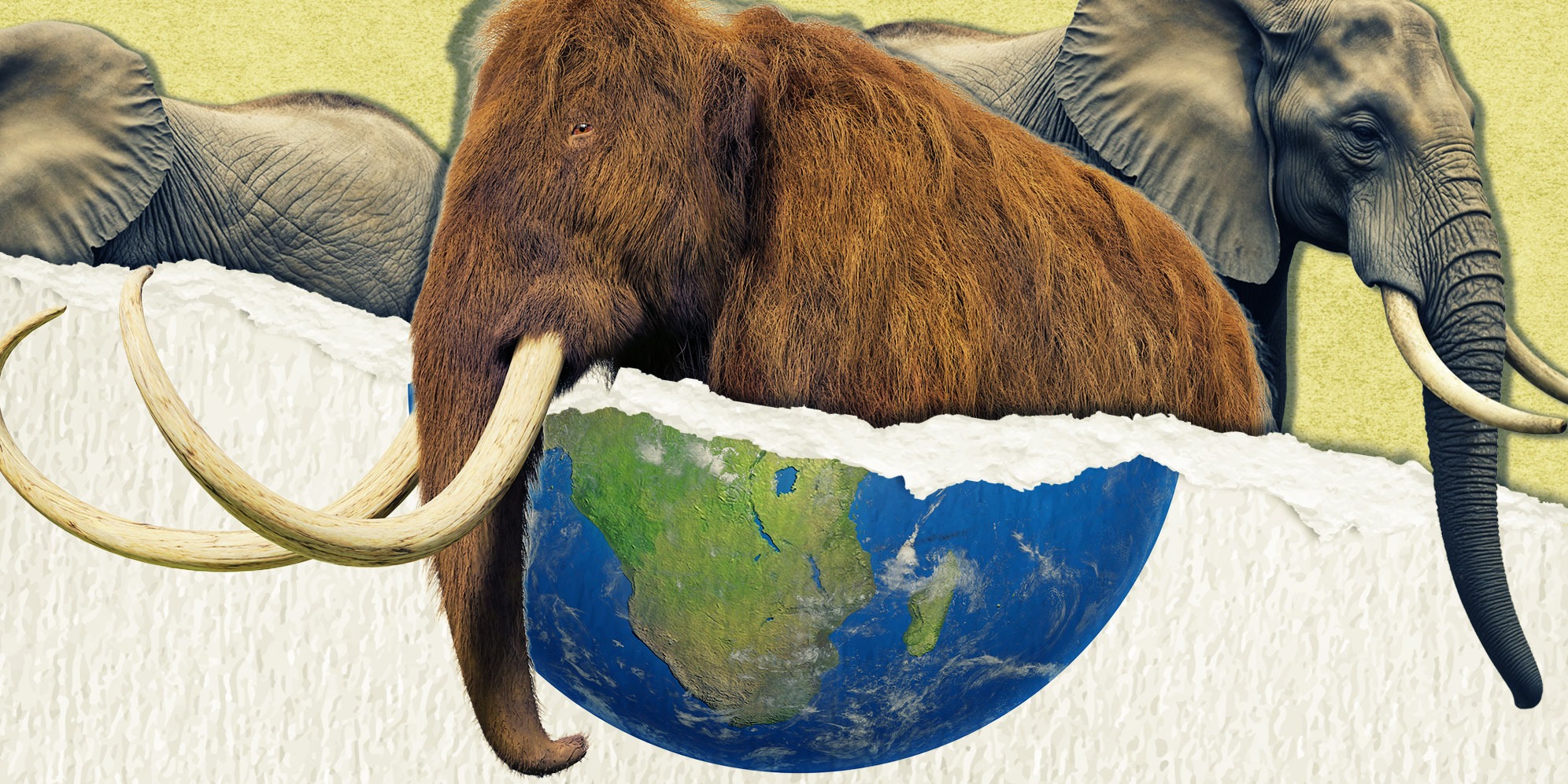
 Illustrative Image: Mammoth. (iStock) | Elephant. (Image: Freepik) | Earth. (Image: Freepik) | Torn paper. (Image: Freepik) | (By Daniella Lee Ming Yesca)
 /file/dailymaverick/wp-content/uploads/2025/10/label-analysis-2.jpg)
The “overkill” hypothesis postulates that dozens of species outside of Africa were wiped out during the Ice Age by human hunting, which begs the question: Why would ancient humans have devoted so much time and energy to eliminating megafauna?
Paul Martin — who first developed the hypothesis in the 1960s — portrayed it as a “blitzkrieg”, with megafauna in North America being overwhelmed by this formidable new predator and wiped out within 1,000 years of first contact.
Scientists currently see the process unfolding at a slower rate, over thousands of years. But few have attempted to really address the vital question of “why”.
One 2006 study did address this issue — the only one that I am aware of — asking: “If overkill was the cause, why did it happen?”
The authors asked why humans would have survived after the megafauna populations they presumably relied on collapsed.
“We propose the cause was ... small animals or ‘mini-fauna’. As people allocate more effort to hunting mini-fauna, more opportunities for chance encounters with megafauna arise, which leads to more megafauna harvests,” the authors wrote in the Journal of Economic Behaviour & Organisation.
This thesis flounders on its focus on “harvests”, which is premised on the notion that megafauna hunting must have primarily been aimed at providing sustenance for pre-historic humans.
But that is not the only motivation for hunting — or killing. This speaks to why humans survived the megafauna extinctions — the big animals were not a primary food source.
Some experts have speculated that extinct megafauna species were sought because the danger involved raised the social status of the hunters. Like modern trophy hunting, this would have presumably been selective and not driven any species over the cliff of extinction — contrary to the spurious claims made by some current campaigners seeking to ban the practice.
But the dangerous element of such hunting — and the danger posed to humans by the big animals that were hunted to extinction — are surely telltale signs that have been curiously missed.
The fact of the matter is that most species of terrestrial megafauna — those that went extinct during the Pleistocene and early Holocene and the survivors — were, and are, dangerous from a human perspective.
Elephants and their kin offer an arresting example.
Mammoth kill sites
More than a decade ago, Pat Shipman, now retired from the Department of Anthropology at Pennsylvania State University, noticed a startling new trend in mammoth kill sites unearthed in central and eastern Europe. She dubbed these “mega-sites,” and there are more than 30 of them, dating from 40,000 to 15,000 years ago.
Yielding up to 10,000 bones, the clearly human-made sites contained up to scores of individual mammoths. Not all of the mammoths would have been from a single kill, but they demonstrate that over a period of time, Paleo hunters could dispatch many of the animals.
/file/attachments/orphans/GettyImages-114949370_724081.jpg "Two replicas of mammoths at the Giganten Der Eizeit exhibition, which opened on 31 May 2011 in St Peter-Ording, Germany. (Photo: Krafft Angerer/Getty Images)")
One site of particular interest is in the Polish city of Krakow. A mega-site has been unearthed there that contains the remains of 86 mammoths, representing an estimated 14 maternal herds. The different ages and the presumption that both sexes are among the remains indicate that family groups were probably being hunted — a strategy that could clearly contribute to extinction.
If modern elephant behaviour is anything to go by, taking on a family group would have greatly raised the stakes. Females are aggressive in defence of their young, and any survivors of such a hunt will in future become a menace to humans. They say an elephant never forgets, and an elephant will not forget the creatures that terrorised it and massacred its family.
This is why the entire family is typically eliminated in modern culls of African elephant herds, because the ones that get away will become hazardous to humans. This would not have escaped early hunter-gatherers with their intimate knowledge of animal behaviour.
So the motive for a mammoth family cull could conceivably have been the liquidation of potential threats in response to the agency displayed by the pachyderms.
Intriguingly, two canine fossil skulls from a pair of the mammoth mega-sites in Ukraine, and another found in Russia, were probably dogs rather than wolves, according to an analysis by researchers. Shipman speculated this was because the human hunters were aided by dogs, or what she referred to as wolf dogs.
Humans, it seemed, suddenly had a new hunting technique.
This is but one of many examples that point to the possibility that human-wildlife conflict was among the driving forces behind the megafaunal extinctions.
Mega-carnivores
The extermination of the mega-carnivores also casts a spear in that direction — a case perhaps of kill or get eaten. Humans are protective of their children, who have prolonged stages of infancy and childhood, making them particularly vulnerable to predation.
As I noted in the first part of this series, the megafaunal extinction list was not limited to mammals. In Australia, it included monstrous crocodiles, snakes and lizards, which, one imagines, would have included humans on their menu.
Jens-Christian Svenning, a leading proponent of the overkill hypothesis whom I referred to in Part 1, told me in an interview that human-wildlife conflict was a plausible factor in the elimination of the big predators.
“Carnivores, it makes sense that people probably tried to get rid of them. For my PhD work, I worked in the Amazon, and there was one place where we worked, and there was a big anaconda that always came out to sunbathe by the water pump, a huge snake five metres long. And at some point, the nearest indigenous community heard about it, and they lived like 10 kilometres away. Then they actually came to kill it, and they killed it. It’s a dangerous animal, they don’t like them,” he said.
/file/attachments/orphans/GettyImages-1153687442_866313.jpg "A sabre-toothed cat fossil on display at the Smithsonian National Museum of Natural History in Washington, DC. (Photo: Win McNamee/Getty Images)")
“I can imagine that American lions and sabre-toothed cats are animals that no one wants to live around so people tried to get rid of them. Some of the [gigantic] ground sloths in South America must have also been really dangerous.”
Much — though certainly not all — of the surviving megafauna outside of Africa and south Asia are also generally less dangerous to humans than the large species driven to extinction when our ancestors appeared on the scene.
Regional Pleistocene extinctions also throw light on this issue. Hippos, for example, once swam in the Thames but vanished from its waters around 125,000 years ago — well after the arrival of Homo heidelbergensis, a species of our ancient kin. And the hippo’s disposition is certainly ornery.
Modern response
It is surely revealing to consider how modern humans typically respond to this archaic threat. They often respond in the way that the local people did in Svenning’s anecdote when they learned there was a big anaconda in the area.
People who still live in proximity to big, dangerous wildlife in Africa — generally among the poorest of the poor who live below what I have previously framed as the “faunal poverty line” — often react by killing what they regard as the monsters in their midst.
The bottom line is we really don’t like living around wildlife that is big and dangerous — this is not a head-scratcher. This was the case 30,000 years ago and is a trait we share with our distant ancestors.
“Human-wildlife conflict could certainly have been a factor in these extinctions — prehistoric humans were basically us, and we don’t like living around those animals. They clearly had the skills to take those animals, and security is arguably one of the strongest motivators,” Adam Hart, a conservation biologist at the University of Gloucestershire and author of a book on modern human-wildlife conflict, told me.
Read more: A most overlooked perspective - predators and people, how poverty makes you prey
Big critters are also not fond of us. This mutual enmity is hard-wired into the DNA and culture — animal culture is another emerging offshoot of the animal history branch — of all involved in this long-running conflict.
This is also surely a more convincing explanation than simplistic portrayals of humans as “natural-born killers”.
In her otherwise excellent 2014 book, The Sixth Extinction: An Unnatural History, the New Yorker writer Elizabeth Kolbert wrote that the Overkill theory meant that “man was a killer — to use the term of art, an ‘overkiller’ — pretty much from the start”.
One of the justifications for using ancient DNA to bring creatures such as woolly mammoths or dire wolves back to life is to atone for the extinction of these species at human hands.
But we cannot judge Pleistocene humans with our high-falutin’ 21st century sense of morality. And this condescending stance excludes the role and agency that these extinct species played and displayed in their own demise.
One framework that provides meat to these bones is the concept of a “landscape of fear”.
First introduced in 2001, it “has been widely adopted to describe spatial variation predation risk, risk perception, and response”.
Our ancestors conceivably tried to tame their landscape, which was defined by faunal fear.
A multispecies drama
It’s also of more than passing interest to note that conflict with other wildlife has long been regarded as one of the driving forces of hominid evolution in Africa, which ultimately gave rise to Homo sapiens.
/file/attachments/orphans/507035_571251.jpg "US professor Lee Berger holds a model of the Taung child skull in Johannesburg, on 12 January 2006. (Photo: Kim Ludbrook / EPA)")
As the skull of the famed Taung Child has demonstrated, our ancestors were even once prey for birds, and the fossil record unearthed at sites such as the Sterkfontein Caves near Johannesburg — a World Heritage Site known as the Cradle of Humankind — points to the terrifying realm inhabited by the primate species that would evolve into modern humans.
Before we climbed to the top of the food chain as the alpha predator, armed with our big brains, sophisticated tools, weapons and the use of fire for cooking and to ward off nocturnal predation, we were basically on the menu — a state of affairs that pushed hominid evolution down the path it took.
Otherwise, we could have conceivably been eaten to extinction before venturing out of Africa.
Yet when it comes to the subsequent extinction of so much of the planet's megafauna — by an alpha predator that had evolved in a very rough and unforgiving faunal environment — this obvious dot is not connected in the discourse around overkill.
It is the missing link.
Surely the extinction of species at the hands of human hunters can only be seen as an example of interspecies conflict.
And if this was a pivotal factor in the Anthropocene’s origin story, then human-wildlife conflict — involving agency on both sides — points to a multispecies drama, with animals active actors and not dull-witted beasts annihilated by bloodthirsty humans.
Viewed through this prism, it is perhaps even a conceit use the term “Anthropocene”, as its roots bear tooth and tusk marks. But it remains useful for describing the aftermath of the Sixth Extinction’s first act.
That aftermath includes the subsequent course of human and natural history.
We will explore this landscape in the final part of this trilogy, with an eye to the ecological consequences that cascaded across the globe from these mass megafaunal extinction events — consequences that must have shaped the paths that history would follow. DM