




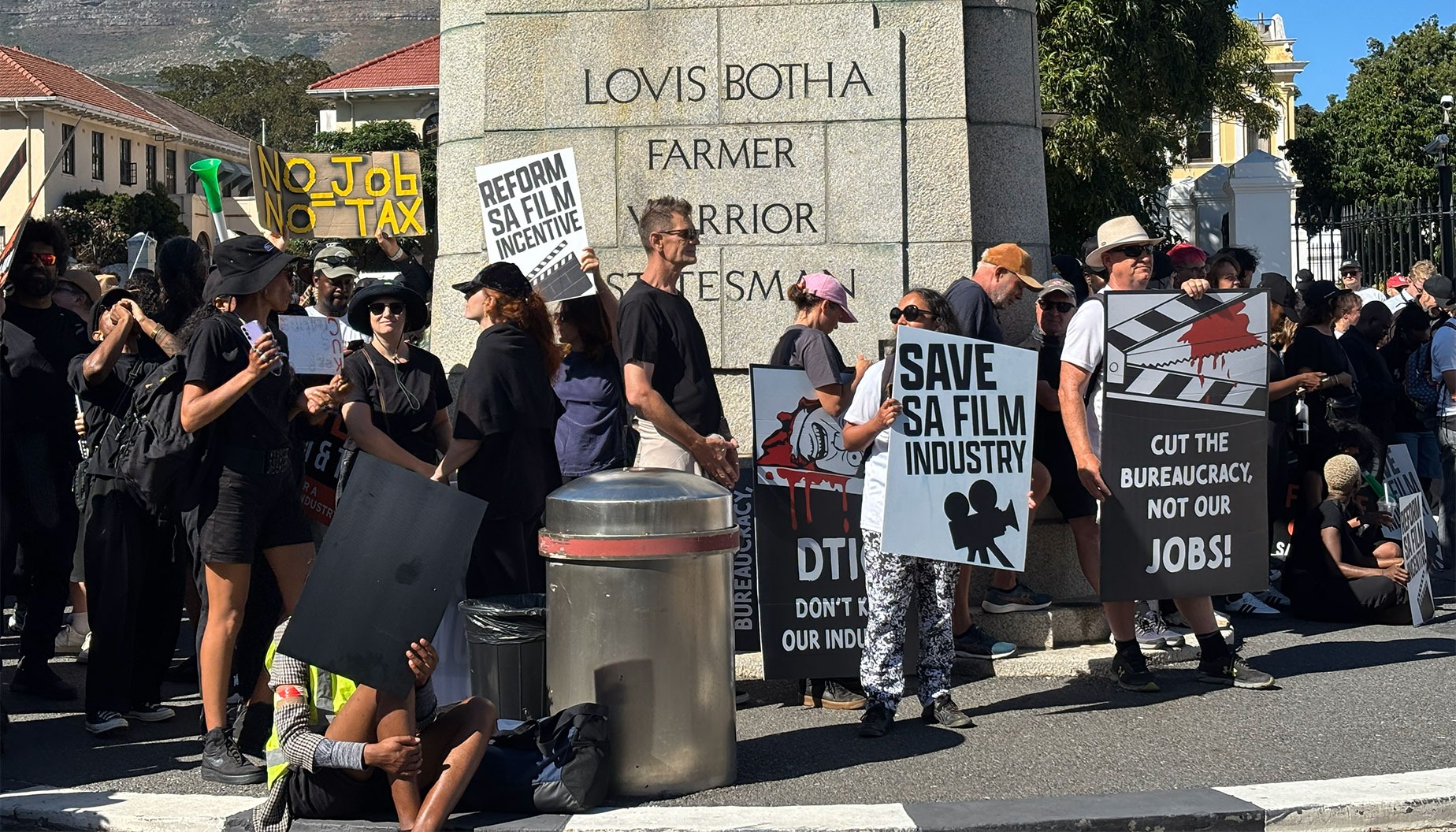
 Film and television professionals protest in Cape Town on 28 January 2026. As productions collapse and income is lost, creative professionals in South Africa’s TV and film industry are appealing for urgent government intervention to protect their livelihoods. (Photo: Kara le Roux)
 Hundreds of South African film and television workers gathered outside Parliament in Cape Town on Wednesday, 28 January, to protest against the industry’s decline. Marching under the Save SA Film Jobs banner, the group called for immediate government intervention to address the sector’s current instability.
Actors, producers, technicians, writers, crew members and other professionals across the industry value chain arrived clad in black, assembling to face a flatbed truck repurposed as a stage in front of the Parliament building on Plein Street.
The protest was called in response to what the Save SA Film Jobs coalition described as “paralysis” inside the Department of Trade, Industry and Competition (DTIC), which it said had crippled the Film and Television Production Incentive and triggered a collapse in production activity across the sector.
For several hours, however, the anger of the crowd was more focused on the absence of the person meant to receive their demands.
Waiting for the chair
Frustration grew as the crowd, waiting for hours in the heat, learnt that the chairperson of the Portfolio Committee on Trade, Industry and Competition, Mzwandile Masina, was allegedly engaged in another meeting. One protester’s demand for Masina to appear in person sparked chants of “useless suits” from the crowd.
/file/attachments/orphans/Image-5_652888.jpg "Protesters outside the Parliament building on 28 January 2026. After nearly two years of silence from the Department of Trade, Industry and Competition, the coalition demands transparency, accountability and a swift resolution to the red tape that has brought the sector to a standstill. (Photo: Kara le Roux)")
Eventually, committee members Toby Chance and Mlondi Mdluli addressed the crowd from the truck bed without Masina.
Chance and Mdluli, both in suit and tie, looked visibly out of place in the Cape Town sun, standing above a crowd of creatives.
R663-million and a broken pipeline
Chance laid out the scale of the financial backlog facing the industry.
“The question that I put to [Minister Parks Tau] receives the answer that you are owed R663-million by the department’s incentive scheme,” Chance told the crowd. “We know that the rebates meeting has not taken place since March 2024, and that is a serious oversight by the department.”
Read more: DTIC blamed as rocky times hit South African film industry
What is the DTIC’s Film and TV Incentive?
🎬The DTIC film incentives are cash rebates of 25% to 50% on local spending, designed to boost employment and industry transformation;
🎬Tiered support includes 25% for foreign projects, 35% to 40% for local co-productions and 50% for emerging black filmmakers; and
🎬Eligibility requires meeting B-BBEE standards and minimum spending thresholds.
According to Chance, Parliament’s portfolio committee only became fully aware of the depth of the problem late last year. However, the coalition noted that adjudication meetings have been stalled for two years, leaving the industry in a state of collapse despite protests in early 2025.
Investment and instability
The South African film and television sector is recognised as a global competitor and was ranked as the third-largest film industry on the continent by the African International Film Festival in 2023.
According to a December 2024 report by the South African Cultural Observatory, the sector generated an economic impact of R7.2-billion and created 31,444 jobs in the 2019/2020 financial year.
Read more: In the spotlight: The struggle to juggle fame and money in SA’s entertainment industry
Although South Africa attracted R2.52-billion in foreign film investment between late 2023 and mid-2024, the report warns that the domestic industry’s reliance on public funding leaves it dangerously vulnerable to administrative bottlenecks.
A Netflix polo and a promise
Masina eventually emerged from Parliament and stepped onto the truck bed to accept the memorandum. He was wearing a black polo shirt sporting a Netflix logo – a detail not lost on the crowd.
Addressing the protesters, Masina apologised for his late arrival and acknowledged the seriousness of the crisis.
He committed Parliament to convening an urgent meeting between industry leadership and the executive. “We are undertaking that within the next 10 days we will arrange a meeting between the leadership of the sector from the different organisations that were listed here, and the minister and the ministry, together with the DG (deputy general), the deputy ministers as well as the minister,” he said.
/file/attachments/orphans/Image-2-1_284712.jpg "Chairperson of the Portfolio Committee on Trade, Industry and Competition Mzwandile Masina signs the industry’s memorandum outside Parliament on 28 January 2026. From left: Save SA Film Jobs representatives, Masina and portfolio committee members Mlondi Mdluli and Toby Chance. (Photo: Kara le Roux)")
Masina added that the meeting would take place in Cape Town and would be preceded by formal correspondence from Parliament.
In a pointed admission, he told the protesters that Parliament had previously been reassured by the department that no crisis existed in the sector. “On a few occasions where we’ve engaged the department as the oversight committee, they’ve assured us that all is well. But looking at what is happening here, we want to make sure that we work together to correct the wrongs in the sector,” Masina said.
How this affects you
🎬 Fewer local productions mean fewer South African stories, languages, history and lived experiences on your screens and in mainstream media;
🎬 The slowdown affects hotels, catering companies, drivers and small businesses that depend on film shoots;
🎬 The crisis threatens one of the country’s largest youth employment pipelines; and
🎬 The industry’s decline highlights how delayed state payments can wipe out entire income streams.
A workplace running out of options
The human cost of the bureaucratic deadlock was a central theme of the demonstration.
Actor Anya Human, speaking to Daily Maverick at the protest, described the devastating situation facing creative workers: “We are here to save the South African film and TV industry. It’s going under. Unfortunately a lot of people are losing jobs, a lot of people are losing their homes, people can’t afford medical [scheme cover].”
Human also pointed to the systemic neglect within the government. “There’s a general lack of taking care of artists and people who work in crew all over the country, people who work on sets in general.”
Read more: The government is making it difficult to keep film industry cameras rolling
She also described how administrative delays were driving international work away from the country. “So many projects that are given to South Africa don’t get done, they take it to other countries because it’s difficult to obtain permits; there are so many issues for people who want to shoot here.”
/file/attachments/orphans/Image-4_134850.jpg "With tens of thousands of jobs lost and foreign direct investment fleeing to competitor countries, the TV and film industry warns that the current mismanagement threatens the survival of South Africa's creative economy. (Photo: Kara le Roux)")
Fellow actor Beáta Bena Green voiced the same sense of urgency: “We’re at a stage where this isn’t something we’re doing lightly, it’s actually a crisis. And, if not managed properly, has the potential to impact the future of the industry very badly and the economy of South Africa by association.”
Green noted that while international companies filming in South Africa, such as Netflix, use local crews, the broader environment is deteriorating: “I would argue that it’s getting worse because people (international companies) have withdrawn.”
What the industry is demanding
The memorandum handed to Parliament reflects this economic argument. According to the document, stalled productions have caused a 50% contraction in industry activity. This downturn has jeopardised 100,000 indirect jobs across the value chain and significantly eroded investor confidence.
Save SA Film Jobs, representing organisations such as the Independent Producers Organisation, the South African Guild of Actors and Animation SA, presented a list of demands to end the impasse.
Among them is an urgent in-person meeting, specifically with the minister, Tau.
It also included immediate clearance of application backlogs, the establishment of joint working groups within 21 working days, the creation of a digital tracking portal for incentive applications and the appointment of an independent third party to investigate alleged mismanagement within the DTIC.
The memorandum also called for the National Empowerment Fund and the Industrial Development Corporation to establish a “specialised film fund” offering preferential interest rates.
In accepting the memorandum, Masina promised transparency. “We will request from [the department], before our meeting, to give us a full report, which is going to be shared with you about [what] has been happening in the sector,” he said.
After signing the memorandum, Masina invited representatives from the coalition into the Parliament building for a briefing.
The protest is set to continue on Thursday, 29 January at the DTIC head office in Pretoria. DM