
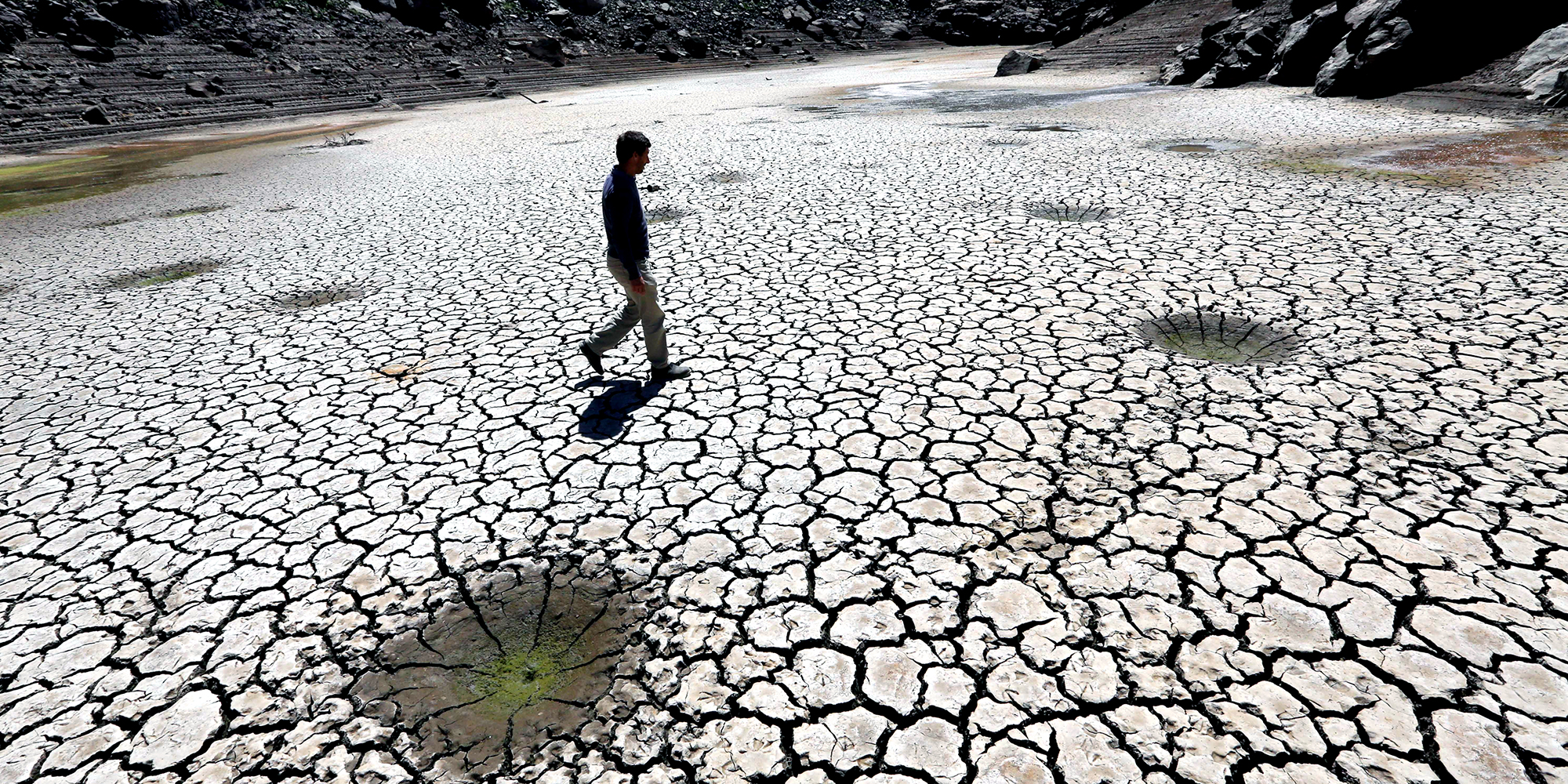
 The pattern is becoming clear, and the next El Niño could well be devastating. (Photo: Esa Alexander / The Times / Gallo Images)
With close to 40 people dead in the wake of catastrophic flooding in Limpopo and Mpumalanga, the subject of drought is not high on the radar screens of the South African public outside of a handful of regions.
Read more: Relief in the skies, ruin on the ground as deadly floods kill 37
But after deluge cometh drought.
The La Niña weather pattern, which typically drenches much of southern Africa, looks to have faded after a brief appearance and long-range weather forecasts are now calling for a return of El Niño in time for spring 2026.
And that will probably herald drought in an age when El Niño has been intensifying in the wake of accelerating climate change – a worrying prospect that SA needs to prepare for now.
“If we are heading for an El Niño in 2026 it will likely be very, very hot,” Johan van den Berg, a meteorologist specialising in agricultural weather, told an agricultural briefing on Wednesday, 28 January 2026, hosted by Nedbank.
Van den Berg said La Niña had now ended and that the global weather dance known as the El Niño Southern Oscillation (Enso) was entering its neutral phase.
/file/attachments/orphans/2026-01-2813_58_14-Greenshot_258066.jpg "(Source: Johan van den Berg)")
Major forecasters were now calling for a 50% chance of El Niño returning by June/July, rising to about 60% by September/October, Van den Berg said in his presentation.
The previous El Niño of 2023/24 was a scorcher of note, with production of Zimbabwe’s staple maize crop falling 60%, Zambia’s by half, and SA’s by more than 20%. According to Van den Berg, about 80% of the really poor seasons for SA’s maize crop over the past few decades coincided with El Niño events.
The last such event was followed by two consecutive La Niñas. But just as Enso can move from La Niña to neutral and then back to La Niña, it can also give rise to a double whammy El Niño.
The year 2024 was the warmest year on record – fuelled in part by El Niño – and 2025 was the third warmest globally. The pattern is becoming clear, and the next El Niño could well be devastating. And if it is followed by another, it will leave a massive trail of misery in its wake.
Preparation
So, what can farmers, the government and the public do to prepare for the next El Niño?
Van den Berg said that leaving sections of farmland fallow and clear of weeds was one fairly basic approach to conserving water in the soil in the event of a drought.
Livestock owners, big and small, also needed to consider the size of their herds and the grazing capacity of their fields if El Niño bared its fangs this year.
“Farmers must look at the number of cattle and compare that to the real grazing capacity,” Van den Berg said.
Wandile Sihlobo, the chief economist at the Agricultural Business Chamber of SA, told the briefing that the government needed to ensure it had funds available to secure feed and other resources that drought-stricken farmers and regions would require.
That means the Treasury needs to think about this now in its budgeting process.
Other things that come to this columnist’s mind would include showing some renewed urgency to complete phase II of the Lesotho Highlands Water Project. Gauteng’s key source of H2O lies high up in the Lesotho mountains, and the completion of phase II has already been delayed by almost a decade from 2019 to 2028, while costs have soared.
SA’s shambolic municipalities also need to get their act together, though the next El Niño looks like it may well set in before the next local government elections. Far too much water is lost as it is because of collapsing infrastructure, and this could reach a crisis point under an El Niño scenario.
Read more: After the Bell — Water, water everywhere, but not a drop for Gauteng
If there is not a major change in who runs our municipalities, hopes on this front will evaporate. As I write these words at my Johannesburg home I just realised that our suburb is suffering yet another water outage, sending my shower plans down the drain.
But hey, outages are one way to conserve water, I guess!
Preparations must also be made for the wild fires that will be sparked by the next El Niño. The Western Cape is already in the throes of a blazing fire season, and next summer’s infernos could be more intense and frequent.
It must be said that the private sector has been doing a lot to prepare for the next and subsequent El Niños – as well as state failure. Middle-class households that can afford the costs are installing water storage tanks or tapping into boreholes.
Tracy Davids, a director of the Bureau for Food and Agriculture Policy, pointed out at the Nedbank briefing that areas such as seed technology had improved hugely in recent years.
“Strong climate cycles like we’ve seen in the recent past tend to push more investment into those sectors. One advantage to that is a lot more resilience to an impact from El Niño,” she said.
/file/attachments/orphans/2026-01-2813_59_05-Greenshot_558733.jpg "(Source: Johan van den Berg)")
Indeed, the rise of technologies such as precision farming – which allows farmers with the use of GPS technology to precisely apply inputs – have also bolstered SA’s drought defences.
The sophistication of SA’s commercial farming sector goes a long way toward explaining why its output decline during the last El Niño was not nearly as severe as the catastrophe that befell neighbouring countries.
Ultimately, the global economy needs to drastically slash its use of fossil fuels.
And the bottom line is that El Niño is probably on its way again and South Africans need to be ready. We’ve seen this play before but the drama heats up with each new staging. DM