




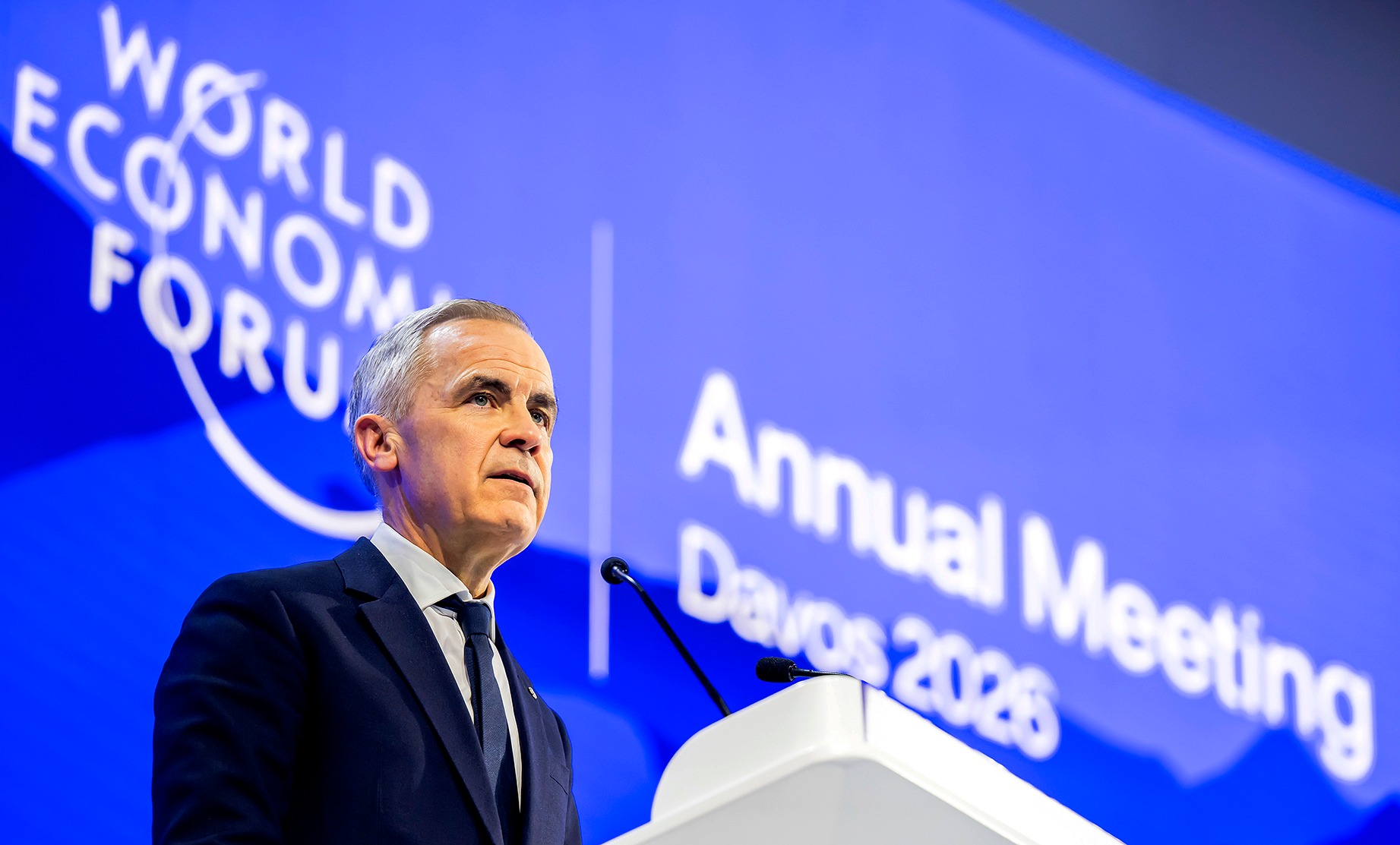
 Canadian Prime Minister Mark Carney speaks at the 56th annual meeting of the World Economic Forum in Davos, Switzerland, on 20 January 2026. (Photo: EPA / Gian Ehrenzeller)
 /file/dailymaverick/wp-content/uploads/2025/10/label-Op-Ed.jpg)
Given the dismal track record of global leadership over the past year, Davos promised what it usually does: posture. The theme, “A Spirit of Dialogue”, spoke optimistically of rebuilding trust and shaping a better future, even as dialogue itself has become increasingly strained. The US is calling most of the shots under a renewed “America First” doctrine. European leaders are still searching for coherence, courage and a shared voice as they absorb pressure from all sides. It has been quite a year.
And then something happened. In fact, someone did.
Mark Carney, sworn in as Canada’s 24th prime minister in March 2025 and barely a year into the job, delivered a masterclass in composure amid a geopolitical maelstrom of threats and promised recalibration. Without theatrics, he proposed something quietly radical: the possibility of an alternative order, grounded in realism rather than nostalgia.
The speech broke like a Mexican wave across newsrooms worldwide. Not because it was flawless or comprehensive, but because it refused the comfort of familiar language. Carney did not threaten anyone or perform outrage. He simply named what many in the room already understood but hesitated to say aloud. The balance is now deeply off kilter.
To make the point, he reached for Václav Havel’s image of the greengrocer who places a political slogan, “Workers of the world, unite!”, in his shop window despite not believing in it. He does so to avoid trouble, to blend in, to keep the peace. The system persists not only through force, but through participation in a shared fiction. When Carney spoke of taking the sign out of the window, he was not calling for rebellion, he was calling for honesty.
What gave the speech its weight was not its geopolitical diagnosis. Much of that is already well understood. Economic integration has become leverage. Supply chains have become vulnerabilities. Multilateral institutions are under strain. What mattered was the behavioural framing. Systems endure because people continue to believe in them, even after trust has quietly eroded.
I am not a political writer. My work focuses on technology’s impact on society. So why does this matter here?
Because that same logic of honesty, of finally acknowledging what sits uncomfortably beneath the surface, applies just as clearly to our relationship with Big Tech.
Technology companies did not come to dominate daily life through coercion. They did so by being useful. Devices slipped into pockets. Platforms became habits. Algorithms settled into routines. Over time, participation became normal and questioning became inconvenient. The sign stayed in the window.
We saw this laid bare in 2018, when the US Congress attempted to interrogate Big Tech leaders on child safety and data practices, only to reveal a profound imbalance of understanding. The companies knew the systems. The legislators did not. Children paid the price.
Most of us use these technologies. We benefit from them. Our workplaces rely on them. Our children are growing up inside them. This is not about assigning blame to individuals navigating powerful systems. It is about recognising that agency diminishes when awareness disappears. As a parent, that matters. As someone who understands that people need skills to work, adapt and earn a living, it matters even more.
Tristan Harris, a former Google employee turned activist, has long argued that choice inside a designed environment is never neutral. Defaults, incentives and attention engineering shape behaviour whether we acknowledge it or not. Frances Haugen exposed how Meta understood the harms its platforms caused and chose growth regardless. Jonathan Haidt has argued for a screen-free childhood, a movement now gaining traction globally.
Australia’s decision to ban social media for under-16s marked a rare moment of political courage, one that may embolden others, with Macron and Starmer finding their voice, a braver nation having made the first move to stand up and be counted.
Enter AI.
Unlike previous technologies, AI does not merely compete for attention. It participates in thinking itself, drafting, summarising, deciding, ideating. The tools are no longer peripheral. They are becoming the environment in which work and learning take place.
Warnings from Turing Award winners and “AI godfathers”, including Geoffrey Hinton, Yoshua Bengio and Yann LeCun, are increasingly visible, but they have yet to land with the clarity Carney achieved at Davos. Development has outpaced understanding. Education systems remain largely unchanged. Regulation lags behind capability. The law is static. AI is not.
The consequences show up quietly in workplaces and classrooms. Expectations shift faster than norms. Productivity rises, while agency thins. Ethics and privacy are promised, but rarely interrogated in practice. Even comprehensive frameworks such as the EU AI Act struggle to anticipate real-world misuse, such as Grok’s nudify function. The law is static; AI is dynamic.
Carney warned of a future in which countries may be forced to choose between hegemons. There is a parallel at the human level. A future where individuals and institutions feel compelled to choose between hyperscalers. Adopt without question or fall behind. Integrate or become irrelevant. That framing itself is part of the problem, because it presents participation as inevitability rather than choice.
The alternative is not withdrawal from technology, nor rejection of innovation. It is ownership. Ownership of who we vote into power. Ownership of who we partner with. Ownership of the values we are prepared to trade away for convenience, and those we are not. Ownership of whether we move, abstain or simply observe while others decide on our behalf.
Like social media, AI is likely to require several moments of honesty before meaningful guardrails emerge. One of my children will leave school in 2031. The other will leave university the same year. Today, many education leaders still appear dazzled by AI’s novelty rather than grappling with its implications.
Until the piercing honesty surfaces, and the critical guardrailing and decision turnarounds are made law, it asks us to examine our own digital values system. To decide where we sit on our screens and with our LLM colleagues. To ask whether we are comfortable with the sign we have left in our own window, or whether it is time to take it down. That’s why I can be the chief AI strategy officer but still rally for critical thinking at the same time.
One day, AI will have its Carney Moment. Let us hope it does not take as long as it did with social media. We might all agree the consequences have been visible in that regard. DM
Dean McCoubrey is co-founder of Humaine and MySociaLife.