




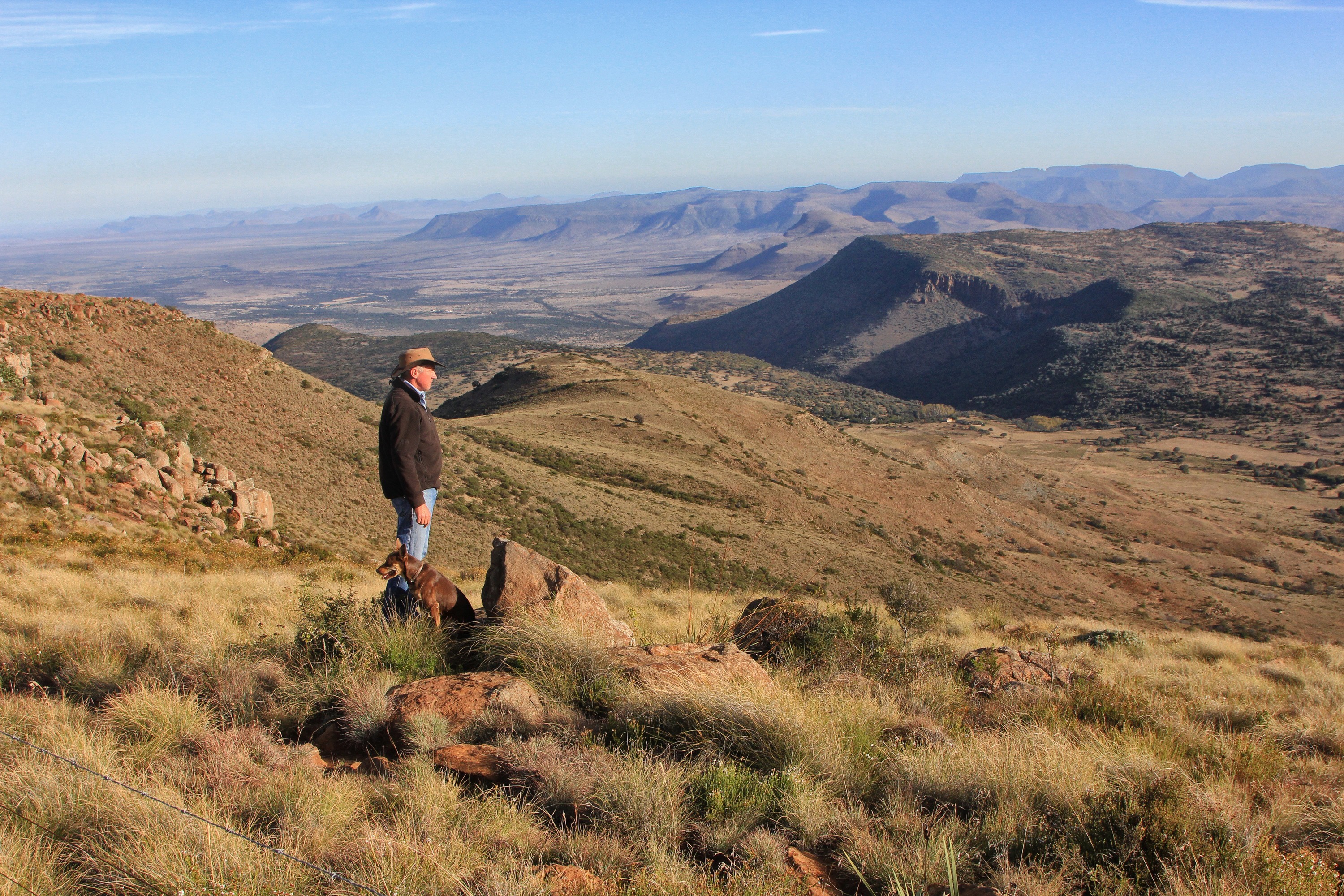
 James Brodie looks over the Sneeuberg heights with his three-legged Kelpie, Emma. (Photo: Chris Marais)
 We are on a thickly grassed high plateau west of Graaff-Reinet in the Eastern Cape Karoo. The late-summer sun glows on sandstone krantzes.
In the foreground are 2,000 sheep, 18 irritable alpacas, one lean man in a cowboy hat and a three-legged Kelpie called Emma.
Farmer James Brodie offers to move this carpet of sheep across the range to a spot where the light will be better for photographs. Chris and I can only nod. We find a comfortable rock to sit on and watch the krantzes turn pink as we wait.
Within five minutes, the flock moves steadily from left to right. The alpacas are swept along, towering above the massed sheep like indignant woolly giraffes.
“Haai, haai, haai,” James calls, his arms outspread. Emma tacks back and forth, bunching the sheep and bringing them closer as if moving thousands of bleating beasts in one go were simple child’s play.
This camp on James’s Doornplaats farm is 20 hectares, and in a day or so he will move all the animals to the next paddock, leaving the richly fertilised veld to recover for a year. Using this method of holistic veld management James has dramatically increased his farm’s carrying capacity over the years.
In a few weeks the first frost will be the signal to bring all the sheep down to lower altitudes, just as generations of Sneeuberg farmers have done when winter bites. Up here there are few diseases – no mosquitoes to spread Rift Valley Fever, no midges to spread horse sickness.
But in the snowy season the cold can kill.
Gin-clear
As with the rest of the world, South Africa’s rangelands have been eroding, quietly unravelling as topsoils wash away and grasses thin out. The experts call it desertification. For decades it was thought to be an irreversible process. But regenerative land management seems to have sunk its first and strongest roots in southern Africa – more specifically, on a few dozen farms around Graaff-Reinet and Nxuba (formerly Cradock).
/file/attachments/orphans/RolieKroonexaminesthegroundwherealocustswarmhasjustbeenIthasstrippedthevegetationbutleftbehindtonsoffertiliserfrass_ChrisMarais_226495.jpg "Rolie Kroon examines the ground where a locust swarm has just been. It has stripped the vegetation, but left behind tons of fertiliser (frass). (Photo: Chris Marais)")
Rolie Kroon farms on Excelsior Farm, under Nardou, second-highest peak in the Sneeuberg range. Like James, he uses the method of intensive grazing with long periods of recovery to repair eroded land. In fact, the Kroon family, including Rolie’s brother Sholto, were the pioneers of this method in the region.
Rolie takes us to a valley that was once bare and exposed, the soil hard as rock. Now a herd of cows grazes contentedly, surrounded by thick grass, near a small dam of water that is gin-clear.
“About 10 years ago, if we had as little as 10 or 20mm of rain, it would run off and form washaways and floods. If you leave the veld bare, more than 87% of the water runs off. You have to stop a raindrop where it falls. If it moves, it takes soil with it,” he says.
“My children and I came out here recently and counted all the different species in an area we could span with our arms. We identified around 18 plant species each.”
The Great Karoo Wilderness
In 2012, the Sneeuberg mountains entered a new era in conservation. The Wilderness Foundation, working on behalf of South African National Parks (SANParks), kicked off an effort to link the Mountain Zebra and Camdeboo national parks by creating a biodiversity corridor. Between these parks is a mosaic of working farms and private game reserves.
/file/attachments/orphans/ThereisruggedlandlinkingtheMountainZebraandtheCamdebooNationalParksItsimpossibletotraversetheentiredistancebetweenthembyvehicle_ChrisMarais_283377.jpg "There is rugged land linking the Mountain Zebra and Camdeboo national parks. It is impossible to traverse the entire distance between them by vehicle. It’s only navigable by mountain bike, foot or hoof. (Photo: Chris Marais)")
/file/attachments/orphans/Mountainzebrasweresavedfromextinctionbackin1937whenanationalparknamedforthemwascreatedoutsideCradockIthasnowexpandeddramatically_ChrisMarais_760588.jpg "Mountain zebras were saved from extinction in 1937, when a national park named for them was created outside Nxuba. It has now expanded dramatically. (Photo: Chris Marais)")
The idea was to protect the river catchments and this area’s unique plant life.
The Corridor, as it was called then, started slowly. But the threat of fracking for shale gas in the Karoo spurred landowners to join. Now a million hectares – roughly half the size of Kruger National Park – fall under what was called the Mountain Zebra Camdeboo Protected Environment.
In mid-2025 its name was changed to something far more evocative: the Great Karoo Wilderness.
Project manager Ulrich Schutte has great admiration for the 200-odd landowners who have signed up to be part of this ambitious conservation effort, a nationally declared Protected Environment – by far the largest in South Africa.
What makes this unusual is that it was never designed to replace farming. Instead, it works with farmers.
“A Protected Environment is a flexible arrangement. It’s basically conservation and agriculture working together instead of locking the land away. Some of the farmland is in a better condition than many nature reserves. There are farming families that have been here for seven or even eight generations.”
/file/attachments/orphans/Compassbergisthefree-standingMatterhornoftheEasternCapeAt2502metreshighthetallestamongtheSneeubergpeaksandtheeasiesttorecognise_ChrisMarais_754245.jpg "Compassberg is the freestanding Matterhorn of the Eastern Cape. At 2,502m, it is the tallest among the Sneeuberg peaks, and the easiest to recognise. (Photo: Chris Marais)")
Vultures and other birds
Three of the best-known private reserves are Samara, Mount Camdeboo and Asante Sana. Thanks to them, these mountains are now home to elephants, cheetahs and lions.
The Great Karoo Wilderness falls within a globally important birding area, which includes Ludwig’s and Stanley’s bustards, lesser flamingos, blue cranes, the blue korhaan, sickle-winged chat, ground woodpecker, black-headed canary and Layard’s tit-babbler.
Cape vultures used to breed in the high cliffs, but they were persecuted and abandoned their historical roosts in the 1970s. A few years ago, Sneeuberg farmers approached SANParks and the Endangered Wildlife Trust to find out how to bring them back.
The goal is a Karoo Vulture Safe Zone that stretches from the Nxuba district all the way to the Karoo National Park outside Beaufort West. They are being spotted more and more often.
Ulrich says Great Karoo Wilderness farmers are enthusiastic partners because they have benefited tangibly from the project. Money has come from the United Nations Development Programme to help them combat erosion and invasive alien plants, and to rehabilitate wetlands.
There has been funding for research into important birds like the blue crane and secretary bird. Camera traps and collars have given important information about the movements of black-footed cats, brown hyaenas and aardwolfs. Leopard spoor has recently been spotted on Mount Camdeboo and Samara.
Carbon credits
“It stands to reason that if we ensure that our plants are healthy and numerous we will be able to create a greater mass of life via growing plants, which will in turn enable the land to support more animals,” says Kroon. “This in turn allows the soil to hold more water and store more carbon, without relying on addictive inputs to falsely underpin the mechanics of food production.
“Well-managed grasslands sequester millions of tonnes of carbon.”
By being good land custodians and adopting regenerative farming principles, many of the Great Karoo Wilderness landowners now have the opportunity to be paid for carbon credits through an international organisation called TASC.
“In fact,” says Ulrich, “carbon credits now make up the Great Karoo Wilderness’s largest financial input. It’s a great reward for farming with nature, and for being guardians of biodiversity.” DM
/file/attachments/2984/book-promo_675310_47c9ccf5bbdc7efa7ac10973cfb023d5.jpg "Karoo Space books by Julienne du Toit and Chris Marais.")
For an insider’s view on life in the South African Heartland, get the Karoo Quartet set of books (Karoo Roads I-IV with black-and-white photographs) for only R960, including taxes and courier costs in South Africa. For more details contact Julie at julie@karoospace.co.za