




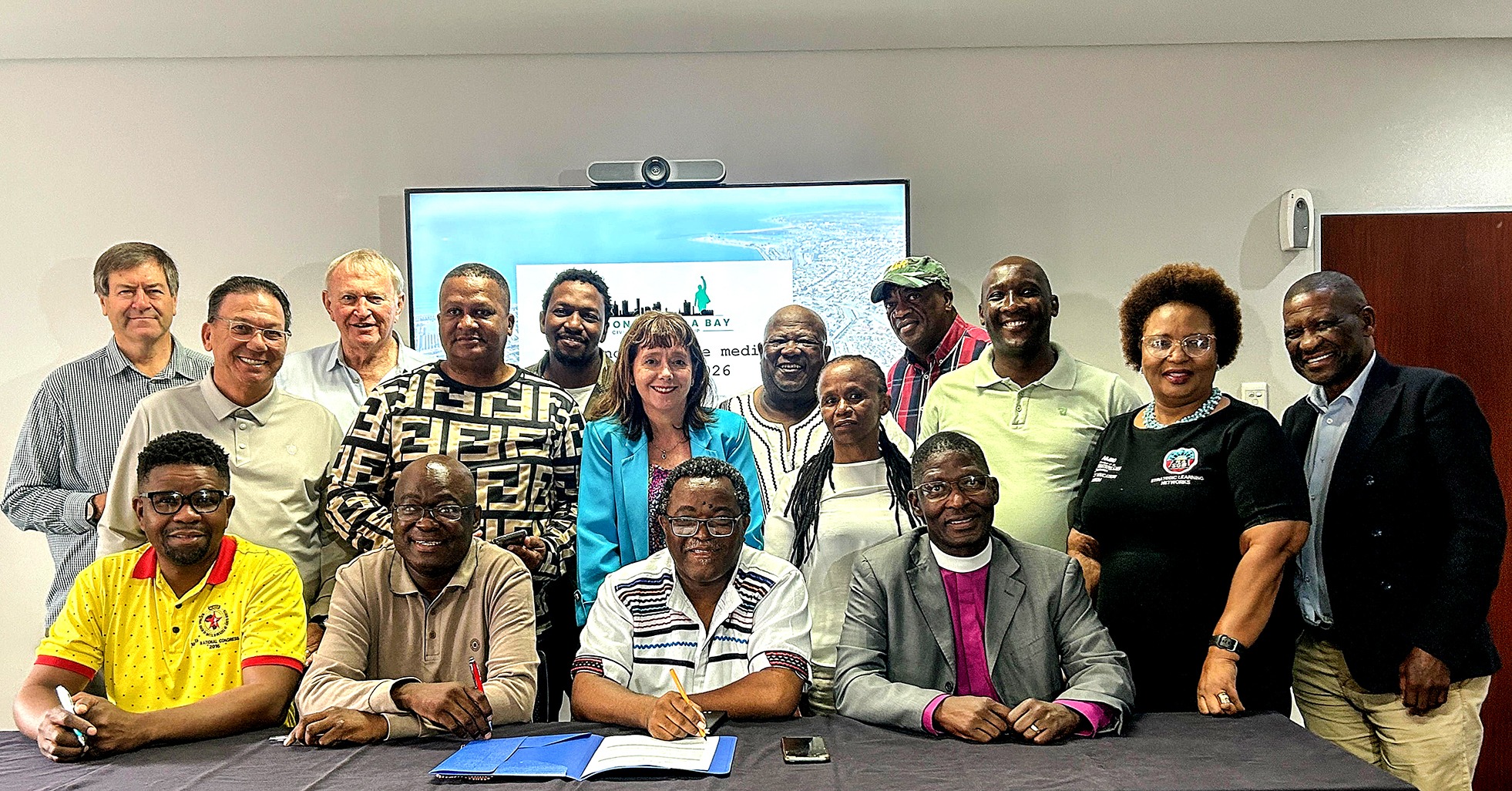
 Members of the Coalition for Civil Society signed a social impact document to recommit themselves to oversight on service delivery and governance issues in Nelson Mandela Bay. (Photo: Supplied / Nelson Mandela Bay Chamber of Commerce)
 The Nelson Mandela Bay municipality has been strongly criticised by members of the Coalition for Civil Society for failing to maintain its electricity infrastructure, following a five-day blackout caused by the collapse of two pylons on the Bethelsdorp-Greenbushes 132kV line.
The power outages that began on 22 January caused widespread water disruptions, and although electricity was restored on Tuesday, many communities remain without water as infrastructure faults continue to be reported daily.
The municipality has largely attributed the collapse of the pylons to vandalism, but Nelson Mandela Bay Business Chamber CEO Denise van Huysteen said the core problem lay in the city’s electricity infrastructure, which had suffered from years of inadequate maintenance.
/file/attachments/2986/Screenshot2025-12-15at145231_514674.png "Nelson Mandela Bay Chamber of Business CEO Denise van Huyssteen has attributed ongoing and widespread power cuts in the city to maintenance failures (Photo: Facebook)")
Van Huyssteen was speaking at a press briefing called by the Coalition for Civil Society, held to sign a social impact document and reaffirm the group’s commitment to collective civic responsibility.
“Many have experienced blackouts with these massive power outages in various areas. We also have ongoing outages across the city, and we’ve been tracking them over the years, and all point to the need for maintenance of electricity, water and sanitation infrastructure. The pylons primarily collapsed because of the lack of maintenance; vandalism is a secondary issue.”
Electricity failures a threat to economic activity
The chamber began tracking electricity outages in 2023. The outages during this period have negatively affected the business sector across the metro’s 11 business clusters.
“While load shedding has materially reduced, the unreliable electricity supply remains a major challenge for small to large businesses, and is evident by the high number of unplanned power outages and power dips which take place,” she said.
Van Huyssteen said that since the chamber began its tracking in 2023, there had been 185 power outages and dips, “with varying levels of disruption periods incurred”.
“The cost has been significant to business and has caused production line stoppages, equipment failure, damaged products, spoilage and scrap. Moreover, this has affected the ability of manufacturers to meet production, sales and export targets, while workers have been subjected to short-time and in some instances, retrenchment.”
Van Huyssteen indicated that the outages had resulted in reputational harm to the metro and its ability to retain and attract investment and employment.
“We believe that this is the most fixable metro in the country, and if a targeted electricity maintenance action plan was implemented, this could very quickly provide more reliable electricity to business and residents.”
However, Van Huyssteen said this was almost impossible when maintenance contract renewals were stalled.
“We need people constantly and physically checking the power lines. It cannot be that the city only reacts when something has gone wrong; we can prevent these outages from taking place.”
Van Huyssteen added, “The vandalism of municipal assets such as substations and pump stations is a major concern to us. When they go down, communities and businesses are left without electricity, water and sanitation services. It’s vital that there’s control over this.”
She said the water management crisis was a combination of factors and not just declining dam levels.
“It’s also the unaccounted water losses and the consumption rate that need to be reduced. Everyone has a role to play here.”
Monitoring service delivery
Coalition of Civil Society chairperson Monga Peter said there were burning issues the municipality needed to resolve – issues the coalition would monitor to measure mayor Babalwa Lobishe’s performance.
/file/attachments/orphans/Monga_297853.jpeg "Chairperson of the Coalition for Civil Society Monga Peter. (Photo: Andisa Bonani)")
Peter said they would present their oversight plans and concerns at Friday’s meeting with Lobishe – something he said Lobishe had committed to during an engagement with Cooperative Governance and Traditional Affairs Minister Velenkosini Hlabisa in December.
“The coalition is bound by the motive to contribute [to] salvaging our city from political and administrative instability that derail service delivery. We wish to present … at the appropriate time a scorecard that lists all issues that these diverse sectors intend to render their oversight responsibility [by] observing the scorecard list,” Peter said.
“We will engage the mayor on the scorecard in the set meeting. In that session, we intend to commit the leadership to a service delivery plan that we will monitor and evaluate as a collective.”
Peter said the coalition had identified that the metro’s problems related to issues concerning:
- The appointment of a competent and skilled city manager who was free of political interference;
- Supply chain management issues;
- Implementation of service delivery contracts;
- The water management crisis;
- Vacancies relating to key technical skills;
- The maintenance of electricity, water and sanitation infrastructure;
- Protection of municipal assets from vandalism; and
- The enforcement of municipal law and order regulations.
Industrialisation for job creation
Representing organised labour, the South African Federation of Trade Unions (Saftu) coordinator in the Bay, Mziyanda Twani, said the metro had undergone an economic decline which had directly influenced job losses.
/file/attachments/orphans/Mziyanda_753541.jpeg "Saftu regional coordinator Mziyanda Twani. (Photo: Andisa Bonani)")
“When this happens, workers … get displaced through retrenchments. When retrenchments happen, the unemployed add to the burden we have in communities and society at large experiences social ills.”
Twani said the reindustrialisation of the city was key to job creation, which would equally address social ills.
“For the past 10 to 15 years, we have experienced plant relocations. This is why we want to … work towards creating jobs to reduce social ills and restore human dignity.” DM