
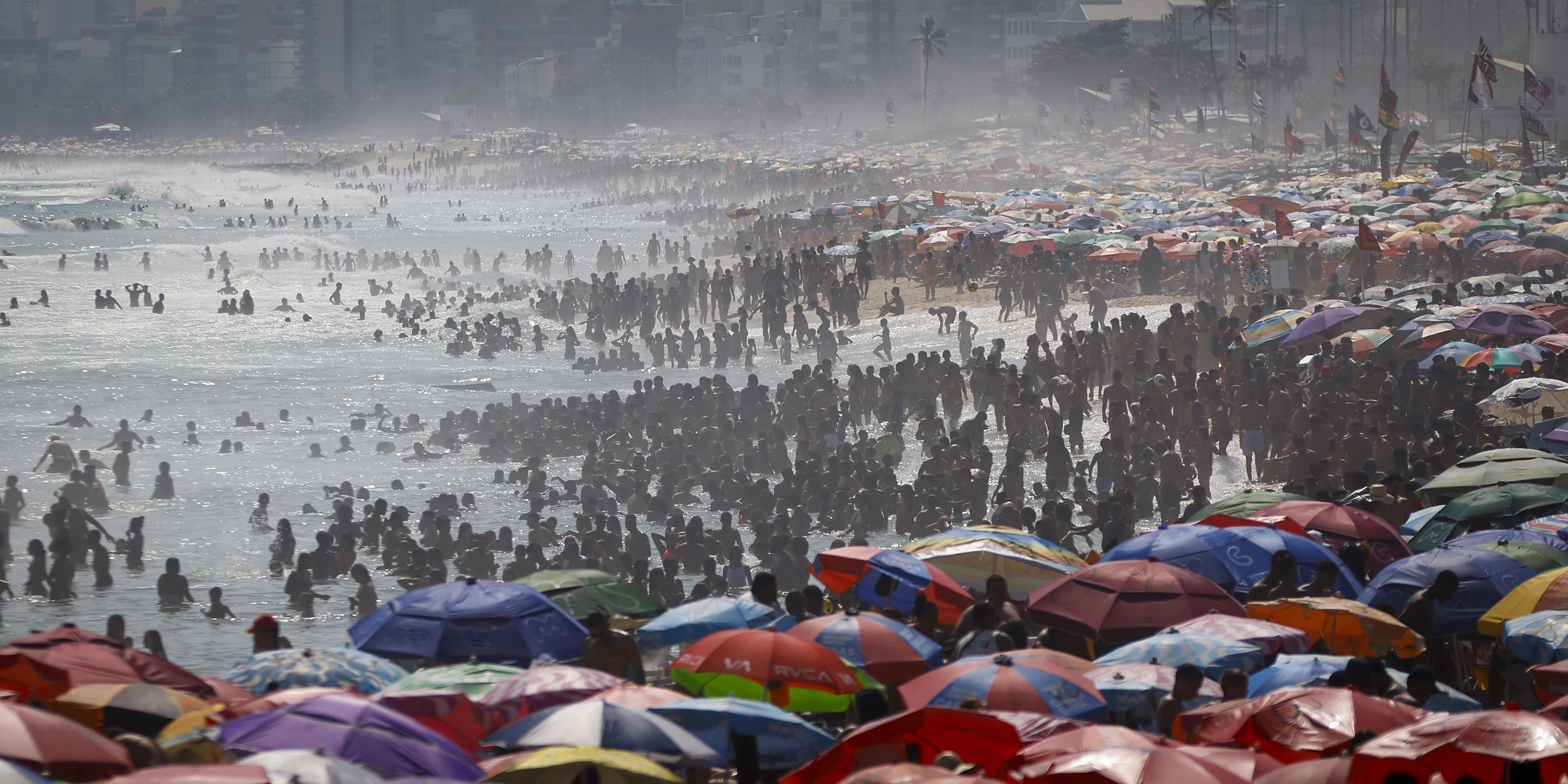
 People enjoy a beach break amid a record-breaking heat wave at Ipanema beach on 15 November 2023 in Rio de Janeiro, Brazil, where the temperature spiked to over 42°C. (Photo: Wagner Meier / Getty Images)
 Climate scientists have long warned that South Africa is particularly vulnerable to climate change, with projections showing the likelihood of longer and more protracted droughts in the west of the country and more intense rainfall events towards the east.
In the past few years, scientific bodies have consistently clocked up the climate records, with the last decade being the hottest in recorded history. It is virtually certain that the world will overshoot the threshold of 1.5°C increase in global temperatures that the Paris climate agreement was intended to limit us to.
In SA, this summer has given us a vivid illustration of the potential havoc to come – with the Western Cape having experienced widespread and intense fires that have seen the provincial government call for a provincial state of disaster to be declared.
Meanwhile, in Limpopo and Mpumalanga an intense flooding event due to a tropical weather system has all but shut down the Kruger National Park, one of SA’s biggest tourism revenue earners.
This is not to forget the ongoing impact of a prolonged drought in parts of the Karoo and the very real threat now hanging over Cape Town and other Western Cape towns of a looming water crisis of Day Zero proportions.
Over and above the loss of lives, the mounting and real economic costs attached to all of this, in the order of billions of rand, is clear – in damaged infrastructure, lost revenue and people’s livelihoods. As a nation vulnerable to climate change, the cost lies in the disruptions to key sectors, among them construction, transport and agriculture, with current infrastructure often proving insufficient to withstand recurring damage.
The insurance industry has yet to catch up, meaning most losses are uninsured and borne directly by households and businesses – and as actuaries come to terms with the likely impacts, insurance will become harder to obtain and more expensive for vulnerable areas and sectors.
And yet, on the international stage, we see a rise in climate denialism and the outright reversal of attempts to put us on the right trajectory. The latest piece of not-unexpected news – that of the US’s unprecedented withdrawal from the United Nations Framework Convention on Climate Change alongside the dismantling of the scientific bodies that cast a light on these issues – does not change the reality of the scientific consensus. However, it does hamper our ability to better estimate and understand impacts, and monitor the changing world.
/file/dailymaverick/wp-content/uploads/2024/12/November-27-2024.jpg "The sun rises over Bondi Beach in Sydney, Australia, during a record heatwave. (Photo: Brook Mitchell / Getty Images)")
If there has ever been a time to focus the mind, it is now. These losses and disruptions are but a small taste of what lies ahead if we do not take control of runaway carbon emissions.
Despite a cooling La Niña current in the Pacific pushing global temperatures just below the 1.5°C warming over pre-industrial levels, the World Meteorological Organization confirmed that the average global temperature for the past three years broached this threshold.
There is no returning to the climates of yesteryear – we can expect chaotic impacts like this January to be the baseline for future climate norms, and it is only likely to worsen. As South Africans, we like to think that we are on the right side of history, and as a country the time is now to step up – not least around the issue of climate change. We have several opportunities in the coming months to do so.
Global negotiations
While multilateral progress towards a solid roadmap to wean the world off fossil fuels suffered a major setback at the recent COP30 negotiations, it actually birthed a “coalition of the willing” that are prepared to make progress and support each other independently of the UN Framework Convention on Climate Change.
An open invitation to join the “Transitioning Away from Fossil Fuels” roadmap was spurned by SA in November. However, Colombia is looking to convene an independent conference on transitioning away from fossil fuels in April, which is an opportunity for SA to get in on the ground floor on a realistic plan for the global transition.
Despite more than 80 countries supporting the roadmap process, SA has yet to commit to engaging, raising the question of how solid our nationally determined commitment to net zero emissions by 2050 really is. It’s not clear yet what will come from Colombia’s April meeting, but as a responsible global citizen committed to a just transition, SA should be there.
Adaptation
Halfway through what has been termed the “critical decade”, South Africa has some solid policies for tackling climate change, but has made little progress on reducing greenhouse gas emissions, and virtually none on preparing the country for the impacts of our shifting climate.
The Climate Change Act of 2024 mandates a national adaptation plan, and further requires that we develop detailed plans for different sectors (cutting across 21 government departments and entities) and all metropolitan and district municipalities. However, this section of the act has not yet commenced, and the mandated three-year timeline to complete adaptation planning opens up a huge implementation lag.
The Intergovernmental Panel on Climate Change has noted on many occasions that the later adaptation action starts, the fewer options are available, and the more damage is locked in for the long term. As the extreme weather events of this summer have demonstrated, we cannot afford such delays, and while it is urgent that the act commences fully, it is also clear that all actors should already be assessing the climate impacts and planning accordingly.
Mitigation
With per-capita emissions well above the global average, and historical emissions exceeding SA’s fair share of 1.5°C, we must also act urgently on mitigation.
The Department of Electricity and Energy is currently putting together an Integrated Energy Plan to map out potential future options, with consultations happening later in the year. Since the energy sector is responsible for almost 80% of national emissions, this is perhaps the most critical component for national development.
/file/dailymaverick/wp-content/uploads/2024/12/11-August-2024-1.jpg "A boy pours water on his head during high heat in Brussels, Belgium, on 11 August 2024 as the country braced for its first summer heatwave. (Photo: EPA-EFE / Frederic Sierakowski)")
Work conducted by the University of Cape Town under WWF’s Illustrative People’s Energy Plan shows that it is feasible to reach net zero CO₂ emissions by mid-century while increasing energy sector employment, improving public transport, electrifying the transport sector and increasing the free basic allocation of electricity to all households. Coupled with an economic model, the study also demonstrates that this approach will still support developmental growth and reduce damage to both people’s health, wellbeing and the environment.
The upcoming government Integrated Energy Plan could be central to the sort of just transition that will realise our national developmental goals – as long as it adequately embraces the reality of climate change and realistically includes the long-term risks of different approaches. It must adequately map out the cost implications, making the case for both investors and the public clear.
Advocacy
The new line-up of members of the Presidential Climate Commission was just announced in December, taking over from the inaugural commission.
As an entity charged with gathering evidence and helping to guide national policy to ensure a climate resilient future, it will no doubt have its work cut out for it in the next few months. The rest of us can best help by raising our voices to ensure that the necessity of addressing climate action is understood in all public forums.
With fire, floods and drought all at our doorstep the chaotic implications of a more dynamic climate future are becoming clear to all, and there has never been a more urgent time for us to push for action. DM
James Reeler is a Senior Climate Specialist with WWF South Africa.