




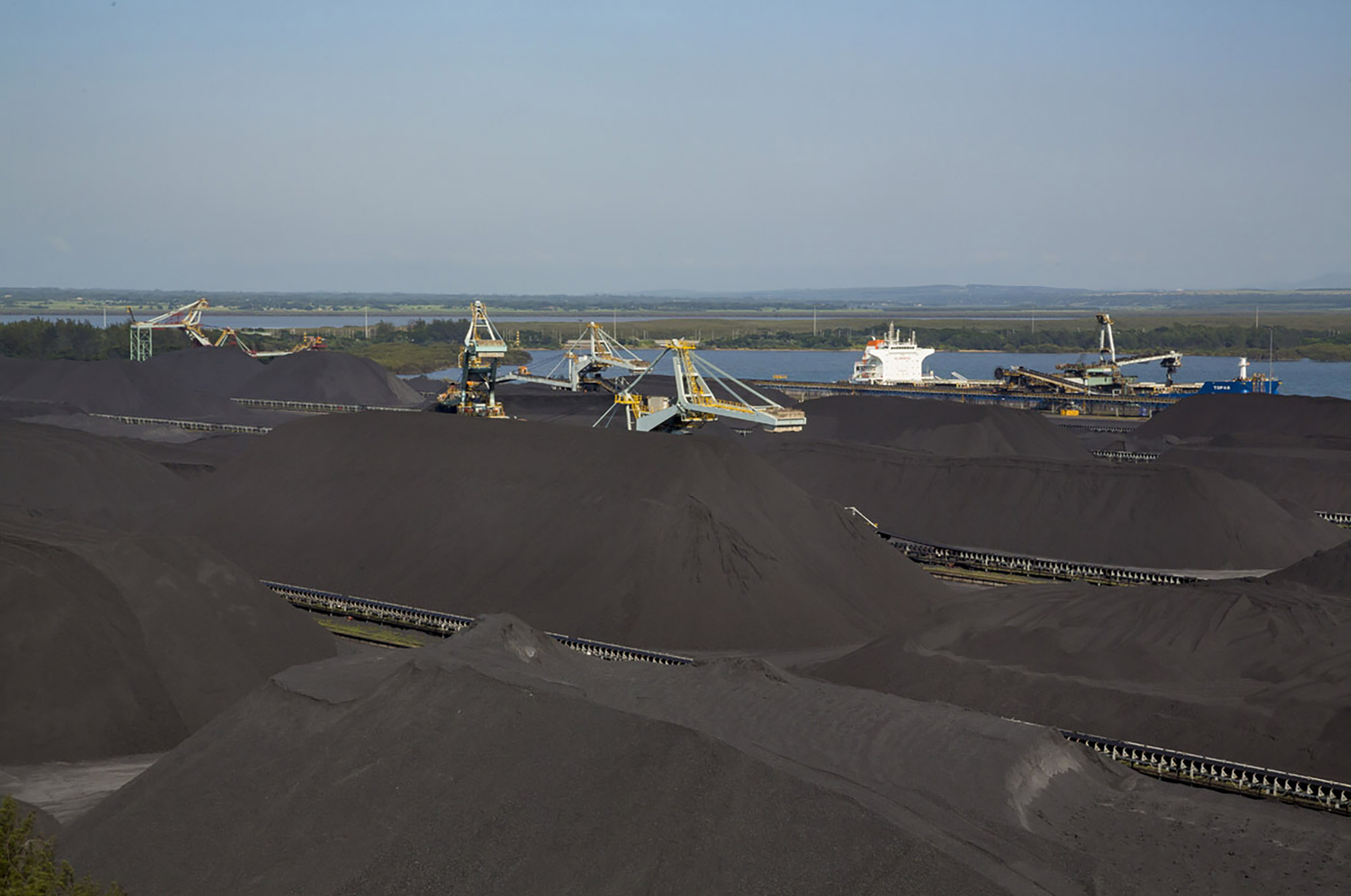
 Coal awaits export from the Richards Bay Coal Terminal. (Photo: RBCT)
 Richards Bay Coal Terminal (RBCT) exported 57.66 million tonnes of coal in 2025, an increase of more than 10% on the previous year – the latest sign that state-run logistics provider Transnet is slowly getting its groove back.
Addressing the media at the terminal on Tuesday, 27 January 2026, the coal terminal’s CEO Alan Waller said that more than 60 million tonnes was “on the cards” for 2026 and that “by the end of this year we should be achieving a consistent 65-million tonne rate”.
/file/attachments/orphans/IMG_2871_699370.jpeg "RBCT CEO Alan Waller delivers the coal terminal company's annual results, 27 January 2026. (Photo: Ed Stoddard)")
That means that the weekly pace would add up to 65 million tonnes, and so far in January the rate has been at 62 million tonnes per year. Last year, Waller had forecast that 55 million tonnes would be reached in 2025, with 60 million tonnes an aspirational goal.
Richards Bay Coal Terminal’s performance is joined at the hip with Transnet’s, and its gradual recovery from the train wreck it had become – one of the most costly examples of state failure to beset SA’s economy – largely explains the coal terminal’s increased exports.
What this means
Any sign of Transnet improvement is good for SA’s slow-growth economy. And while there are legitimate concerns about coal’s role in the scorching of our planet, South Africa as a developing economy needs to grow its export markets where it can. Even if global goal demand was to start falling soon – and hopefully it will for the good of our planet – the terminal’s markets are unlikely to drop off a cliff anytime soon.
Key on this front has been the replacement of problematic Chinese locomotives – or “locos” in industry speak – with far more efficient French 23E models.
There has also been a massive decline in copper cable theft on the coal line – from 180km in 2024 to 59km last year. The 2024 figure is equal to the distance of two Comrades Marathons, while the 2025 number is just more than the Two Oceans Marathon.
“Ground forces are using predictive tools,” Waller said, without going into too much detail because it is a sensitive security issue. But he said the combination of drones, foot and K9 patrols were “deterring and preventing” cable theft on the line.
Richards Bay Coal Terminal is striving to boost its own efficiencies through an automation programme. But Waller said no one would be retrenched as a result – a sensible policy as wage talks loom this year with the Association of Mineworkers and Construction Union.
Almost 80% of the terminal’s exports last year were to Asia, with India taking the tiger’s share. Europe accounted for 7.2% and Africa almost 7%, with Morocco the biggest market for the terminal’s product on the continent.
Underutilised asset
Richards Bay Coal Terminal is an underutilised asset. It is one of the world’s largest coal terminals and has the capacity to handle and ship 91 million tonnes a year.
In 2017, the terminal’s coal export volumes reached a record 76.47 million tonnes before gradually falling to just over 70 million tonnes in 2020. As the wheels came flying off at Transnet, the pace of the terminal’s export decline accelerated, hitting a record low of 47.2 million tonnes in 2023.
That also coincided with a fall in the fortunes of coal as a growing number of banks stopped funding new projects for the fossil fuel because of its links to climate change. With the green energy transition shifting into higher gears, the end of coal seemed nigh – or, at least, that was an emerging consensus.
But forecasts of coal’s demise have proven premature: demand for the commodity climbed for the third year on the trot in 2025, reaching a new all-time high, according to estimates by the International Energy Agency.
Read more: Coal demand hit a record high in 2025, confounding its obituary writers
Banks are no longer treating the commodity like it is toxic.
“We certainly are hugely optimistic. South African coal is still hugely in demand,” Waller said regarding the outlook for coal. “We even see with financial institutions that there is a softening towards us, including among insurers.” DM