




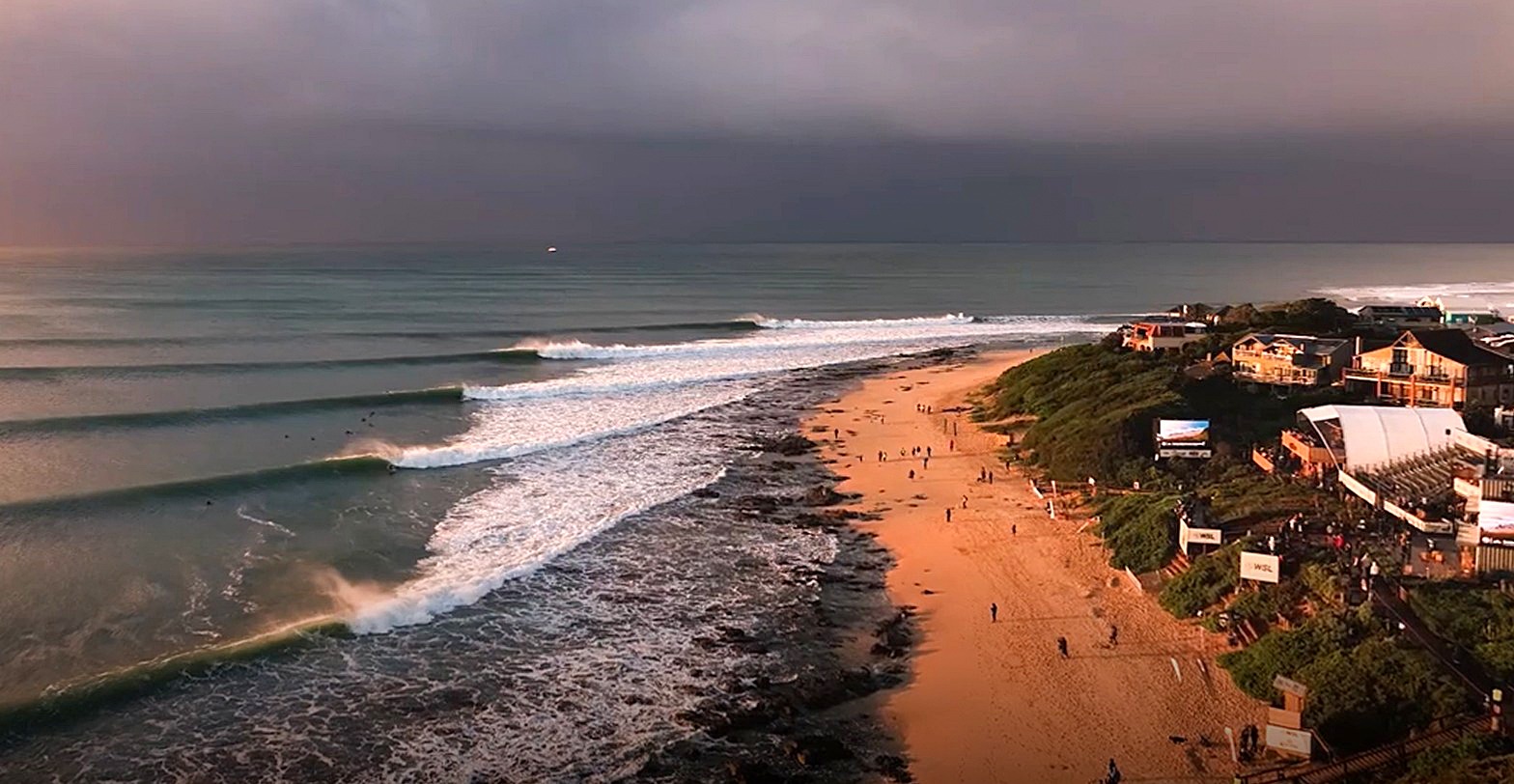
 Supertubes in Jeffreys Bay is renowned as one of the world’s best right-hand point breaks. However, the World Surfing League has cancelled this year’s Corona Cero Open J-Bay at Supertubes because of a lack of financial support. (Photo: World Surf League)
 Surfing in South Africa was dealt a gnarly blow this week when it was announced that the country’s premier surfing event would not be returning to its shores this year.
The World Surf League (WSL) announced on Sunday that the Corona Cero Open J-Bay, at the iconic Supertubes in Jeffreys Bay, had been pulled from its 2026 Championship Tour schedule, citing a lack of financial support as the reason.
While there have been no clear indications about who is to blame for the event wiping out, some fingers have been pointed at SA’s provincial and national government structures for not throwing their weight behind the event.
“The cancellation of the J-Bay Open is not only a disappointment for South Africa, but for Africa as a whole. Jeffreys Bay has always been one of the best stops along the WSL world tour, with the best waves and a very well-organised event year after year,” said Surfing Africa director Johnny Bakker.
/file/attachments/orphans/JBaySurf2_701082.jpg "Jeffreys Bay started as a small surfing village, but its popularity has exploded in recent years, thanks to Supertubes, which many consider to be the best right-hand point break in the world. (Photo: Angela Daniels)")
Surfing in Jeffreys Bay can be traced back to the 1960s when surfers from across the world discovered what is arguably the planet’s best right-hand point break, Supertubes, where consistent, fast, barrelling waves peel to the surfer’s right and break along a rocky point that juts out into the ocean.
The WSL put competitive surfing on the map in 1976 and over the past five decades has curated an annual Championship Tour at the best global surfing destinations, with top-ranked surfers competing for world ranking points.
For many years, Jeffreys Bay, in the Kouga Municipality, has been a staple of the championship calendar.
“It is with regret that we announce the WSL will not host an event in Jeffreys Bay in 2026. The absence of a confirmed funding commitment from the national Department of Sport, Arts and Culture has led to this decision,” said Kouga’s mayor, Hattingh Bornman.
Lack of commitment
He said that despite his municipality’s ongoing support for the event, their annual budget of R2-million was not enough to secure the event, and a lack of commitment from the national Department of Sports, Arts and Culture was the final nail in the coffin.
“Over the last three or four years, there have been many discussions with provincial and national government, and while a lot of verbal commitments were made, these commitments were never put into action.
“Therefore, the WSL has decided to withdraw the South African event.”
/file/attachments/orphans/JBaySurf3_611226.jpg "Thousands of fans flocked to Jeffreys Bay last year to watch the world's best surfers compete, including current top contender, Brazil's Yago Dora. (Photo: J-Bay Surf Fest)")
Bornman said losing the event would have a devastating financial impact on the municipality, which was still negotiating with the WSL to bring the event back to Jeffreys Bay in 2027 if it can secure additional sponsorships and funding.
While the WSL did not point fingers directly at government departments, its statement hinted at the fact that this was not the first year that the event was in jeopardy.
“We have made the difficult decision to pull Jeffreys Bay from the 2026 Championship Tour calendar. We did our very best to make J-Bay work in 2025, but the financial support isn’t there to make it viable this year,” said WSL chief executive Ryan Crosby.
Crosby confirmed Bornman’s assertions that the WSL would continue to engage with local role-players and explore how to bring the event back to “one of the best waves in the world”.
/file/attachments/orphans/JBaySurf4_953018.jpg "The beachfront at Supertubes is always packed when the world’s top surfers compete in the J-Bay Open. (Photo: J-Bay Surf Fest)")
Meanwhile, to maintain the Championship Tour’s 12-event schedule, Jeffreys Bay will be replaced by Raglan on the west coast of New Zealand’s North Island.
“Raglan is a great addition to the tour and has been made possible thanks to valuable support from the New Zealand government,” said Crosby.
Despite the local municipality’s claims, the department said the narrative that minister Gayton McKenzie has withdrawn his support for the event is untrue.
In its statement, the department said that the organisers of the event did not follow the correct channels to secure funding from sports, arts and culture.
“Anyone wishing to apply for funding for such an event must do so in line with the Bidding and Hosting of International Sport and Recreation Events Regulations.
“In terms of these Regulations, event organisers are required to submit formal applications to the Department whenever they bring international competitors to South Africa for a sporting event. The minister considers such applications and may approve or decline them.”
It further stated that requests for funding must first go before Cabinet for consideration. But since no applications were brought in terms of the WSL event, no decision could be made.
“All public comments that are seeking to place at the feet of the minister for the inability to secure a WSL event in 2026 are misguided, a form of deflection and unjustified scapegoating.”
Significant setback
The chairperson of the Kouga Business Forum, Lieb Swiegers, said the withdrawal of the WSL was very disappointing and a significant setback for Kouga and Jeffreys Bay.
“This community has long relied on the event as a vital economic and marketing boost during the traditionally slower winter season.
“The WSL event has historically provided a substantial injection into the local economy, sustaining businesses across hospitality, retail, tourism and services during a period when activity is otherwise subdued.”
Beyond the short-term economic boost, Swiegers said the J-Bay Open was an invaluable international marketing platform that promoted Jeffreys Bay and its surroundings as a global tourist destination.
“The global exposure generated by the event has consistently elevated Jeffreys Bay’s profile as a premier surf destination, attracting both tourists and investors from around the world.”
He said any hopes of bringing the event back to South Africa would require serious national intervention and substantial subsidies, while the Kouga business community, together with event organisers, would do everything in their power to make Jeffreys Bay an attractive and viable option.
/file/attachments/orphans/JBaySurf5_331221.jpeg "The biggest concern is the loss of revenue for local businesses and the tourism industry after the cancellation of the J-Bay Open. (Photo: Angela Daniels)<br>")
“The WSL event is not only a sporting highlight but a cornerstone of the town’s economic resilience and international reputation. Its reinstatement is essential for the prosperity of local businesses and the continued growth of Jeffreys Bay as a global surf capital,” said Swiegers.
In 2024, Jeffreys Bay also missed out on the Championship Tour, but the WSL hosted an alternative event, the J-Bay Classic, at Supertubes.
The speciality event was not part of the world ranking events, but still drew surfers from across the globe to compete in alternative surfing formats, including high-performance boards and mixed teams.
Swiegers said while this event did not draw the same crowds as the J-Bay Open, it was still backed by the WSL and benefited from its marketing.
Impact on business
Andrew Carter, owner of the Beach House J-Bay, a guesthouse overlooking Supertubes, said the WSL announcement was still very fresh, and they had yet to crunch the numbers on what the impact would be on their business.
However, he was optimistic that another event would take the place of the J-Bay Open.
“There will undoubtedly be an impact. I usually block out that whole period as the WSL normally reserves my whole property well in advance.
“But even if the J-Bay open falls away, I’m pretty sure something else will take its place. No event will match it, but I don’t foresee the guesthouse standing completely empty.”
Carter said that due to his location, he would probably still have plenty of bookings, but businesses further away from the beach would be hard hit.
Daniel Esterhuizen, who owns several Airbnbs in Jeffreys Bay, said he usually gets bookings from as early as February for the surfing event.
“I have property close to the beach and higher up into town, and the beachfront ones are always booked out well in advance. But I honestly don’t know what’s going to happen this year.
“I think some people might still come to experience the other things Jeffreys Bay has to offer. I mean, we are on the Garden Route and just down the road from Addo Elephant National Park. I’m holding thumbs that the town still fills up,” said Esterhuizen.
Bakker said that besides the economic downturn, the J-Bay Open was crucial for surfing development not only in South Africa, but as the only WSL event on the African continent.
“With surfing becoming an Olympic sport, we have seen it develop immensely over the entire continent in recent years. An event like the Youth Summer Olympics, taking place in Qatar this year, is also another great platform for our athletes to showcase their talents.
“But we need to expose our athletes and our venues through events like the J-Bay Open to help them springboard to that next level.” DM