



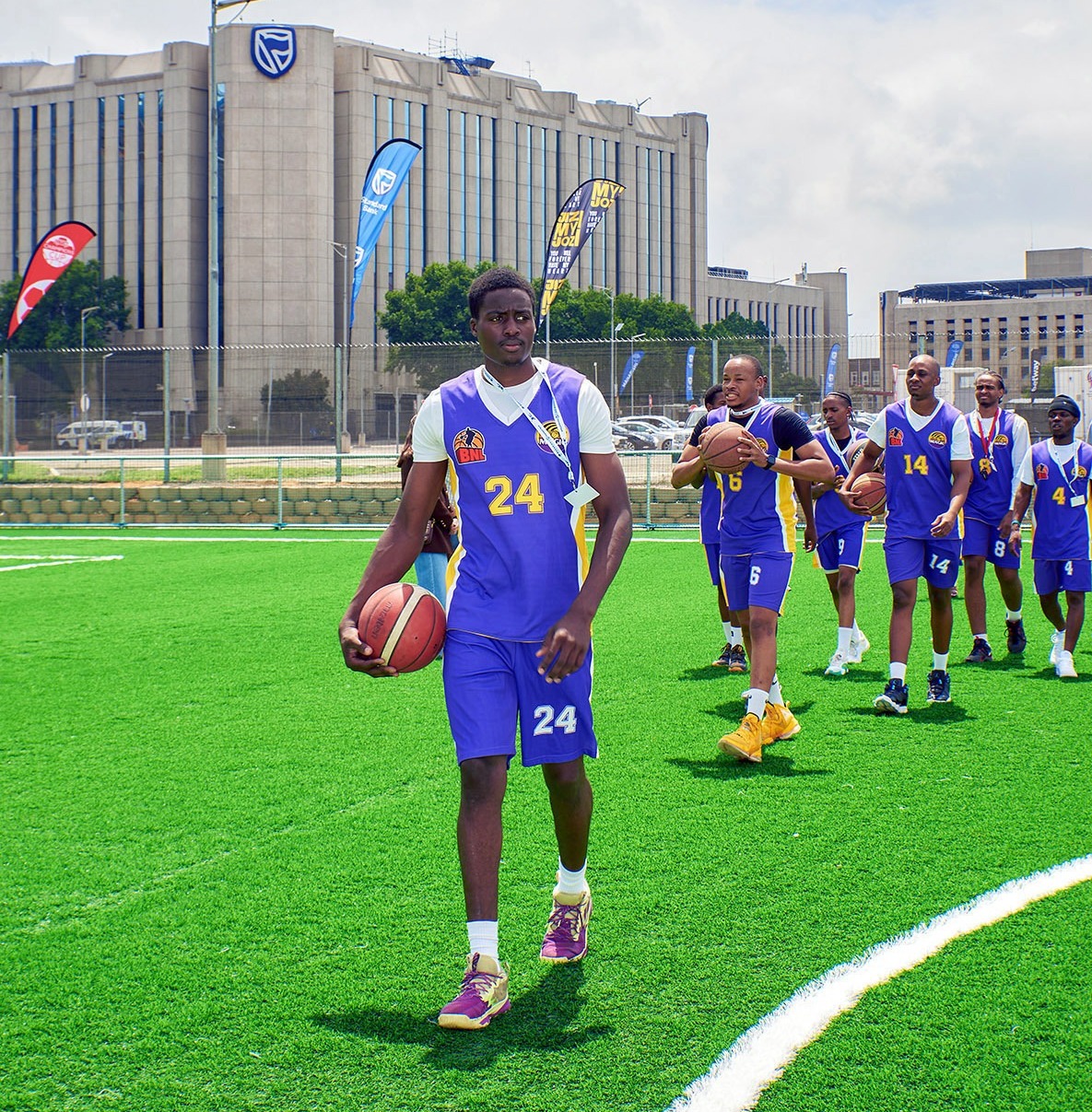
 Field of Dreams will bring new opportunities for the students of Maharishi Invincibility institute based in Joburg’s inner city. The project as funded by Standard Bank in collaboration with other sponsors. (Photo: Supplied / Standard Bank)
Sometime after New Year’s Eve, a video of Hillbrow raced across social media: the streets are empty, screams ricochet through the night, fireworks land like missiles. For many people watching that frantic montage hardened into the whole truth – confirming a familiar idea of the city as a chaotic, dangerous and ungovernable place.
A few days later, in the icy waters of the Saunders Rock tidal pool in Cape Town, where chitchat with strangers acts as a life preserver while you try to distract yourself from the sharp needles of cold pricking your legs, someone asked me what I do. I replied that I publish a guide to Joburg. He had seen the video. He laughed and said next I should definitely share a map with my audience of how to get to Cape Town.
Thousands of people saw and will continue to see that clip, but only a few blocks away from Hillbrow, something much quieter – and far more explosive – is taking root.
The changes in the city over the past two years do not announce themselves loudly. They arrive as a series of moments that, to the untrained eye, can seem random – a building repurposed here, a campus expanding there, a field of grass appearing where there was once an empty parking lot. They are part of a repatterning of the city: a growing web of quietly reshaping the future of Joburg as “education town”.
Walk the precinct around 44 Main Street, formerly the headquarters of Anglo-American and now the HQ of Jozi My Jozi, who are leading many partnership initiatives, and the first sensation is one of joyful disorientation. The paving’s pristine. Unexpectedly lush and carefully tended gardens soften the edges of buildings. Water moves through the fountain with its famous Impala Stampede sculpture by Herman Wald.
/file/attachments/orphans/HermanWaldsImpalaStampede-phBridgetHilton-Barber_594727.jpg "The Impalas still Stampede: the iconic sculpture moved downtown to 44 Main, now an arts and education hub for the inner city. (Photo: Bridget Hilton-Barber)")
Within close walking distance of what most would regard as an unlikely pocket of the city, the Field of Dreams was launched at the end of November – a sporting precinct built for students of the Maharishi Invincibility Institute. Grass, courts, lines painted on the ground – space to run, to play, and to breathe.
/file/attachments/orphans/1Highlights_SB-Field_108_830190.jpg "Field of Dreams will bring new opportunities for the students of Maharishi Invincibility Institute based in Joburg’s inner city. The project was funded by Standard Bank in collaboration with other sponsors. (Photo: Supplied / Standard Bank)")
The field is only one strand in a much larger vision.
Joburg was never designed as a residential city. Its highways and ring roads were engineered to funnel labour in, labour out. And yet, the future being imagined here depends on people learning, staying and living in the city. Education is the anchor.
The Maharishi Invincibility Institute has become a cornerstone of this idea, offering degrees and programmes in disciplines such as cybersecurity, finance, analytics and consulting-oriented thinking – skills that translate directly into employment.
It is a pay-it-forward model, funded in a way that removes many of the barriers that keep young South Africans from a tertiary education. It is also an education model built on outcomes, not abstraction. Crucially, the institute recognises that students arriving from deeply impoverished communities often carry trauma that must be addressed alongside academic learning.
The institute’s newly founded Security Academy extends the thinking outwards, with students contributing directly to safety in the surrounding precinct. On any day, you’ll see a phalanx of uniformed students performing drills in the 44 Main piazza. Education here isn’t sealed inside lecture halls; it radiates into the city.
There have been a number of moments over the past few months that are quietly adding to the momentum – including the gifting of 45 Main to the Maharishi Institute to expand their educational reach, and the announcement that the John Kani Performing Arts Academy moved into 44 Main. This is a space to watch.
In a country where young people aged 15-34 are said to make up approximately 33.1% of South Africa’s population (roughly 21 million people), finding ways to engage with and create a positive impact for this segment can create an outsized boost of economic productivity – and bring about real change.
No other South African city is doing things quite like this, and it’s the inner city that is leading this charge, creating an extraordinary vote of confidence in education as an urban strategy.
Back to The Field of Dreams, which emerged from a single, piercing observation.
Ali Bacher, an inspirational cricketing figure both for his sporting prowess and leadership skills, had offered to give motivational talks to students after being inspired by the work of Maharishi founder Taddy Blecher.
/file/attachments/orphans/AliBacher-FieldofDreams_813667.jpg "From left: Operations manager at the Maharishi Invincibility Institute Motsei Masilo, former national cricket captain and altruist Dr Ali Bacher and group real estate executive head at Standard Bank Nkosinathi Manzana.")
After one of these, sometime in late 2022, a fourth-year BCom student came over to talk to him and said: “Mr Bacher, you are part of sport. But here we are in an 11-storey building and there isn’t even a blade of grass where we can kick a soccer ball.”
That sentence landed with a man whose life has been shaped by sport and by the belief that opportunity must be built, not hoped for.
“I went home and thought about it,” Bacher said.
A man of action, the thinking phase moved quickly into the doing phase. Who knows what it took to get there, but on the last day of November, the 83-year-old sporting legend cut the ribbon with partner Standard Bank for a sports precinct in the city where students can play soccer, basketball and netball within walking distance of their educational campus. In a city where access to green space is deeply unequal, that gesture is revolutionary.
What binds these projects together is not perfection, but momentum. As Robbie Brozin, co-founder of Nando’s and of Jozi My Jozi, often quips, we are “building the plane while flying it”. This is not a master-planned city dropped from above. It is a living system, shaped through partnerships, trust and a willingness to experiment.
Movements like Jozi My Jozi provide connective tissue, bringing together people with big ideas and even bigger hearts – people who understand that cities change when citizens show up.
I sometimes find it frustrating that these stories are not told loudly enough. But perhaps that is the point. This work is not designed for spectacle. It is designed for durability.
Many people will never visit Johannesburg’s inner city. For them, the viral clips will continue to stand in for reality. But if you choose to look again – if you walk this precinct, feel the paving underfoot, hear the water, see students moving between buildings, glimpse a soccer game in progress – another city comes into focus.
If that’s too much to contemplate, just look down when you are next on the M1 freeway passing the Standard Bank Buildings along Simmonds Street. Somewhere deep inside the same Johannesburg that trends for all the wrong reasons, a Field of Dreams exists.
Here are three things on my radar this week:
- Visit A42.art in Parktown North, a space for listening, repair and radical imagination set up by A42, a pan-African not-for-profit transforming sites into regenerative destinations that reimagine what a museum can be.
- Joburg’s restaurant scene is on the move. Read the latest update.
- Have lunch or breakfast at Sadie’s Bistro on Main Street in Marshalltown because Julian Ribeiro and his team make damn good food. Open only on weekdays. DM
Laurice Taitz-Buntman is an avowed urbanist and the founder of Johannesburg In Your Pocket, a city guide and media platform dedicated to reframing Johannesburg through storytelling, travel, and urban experience.