




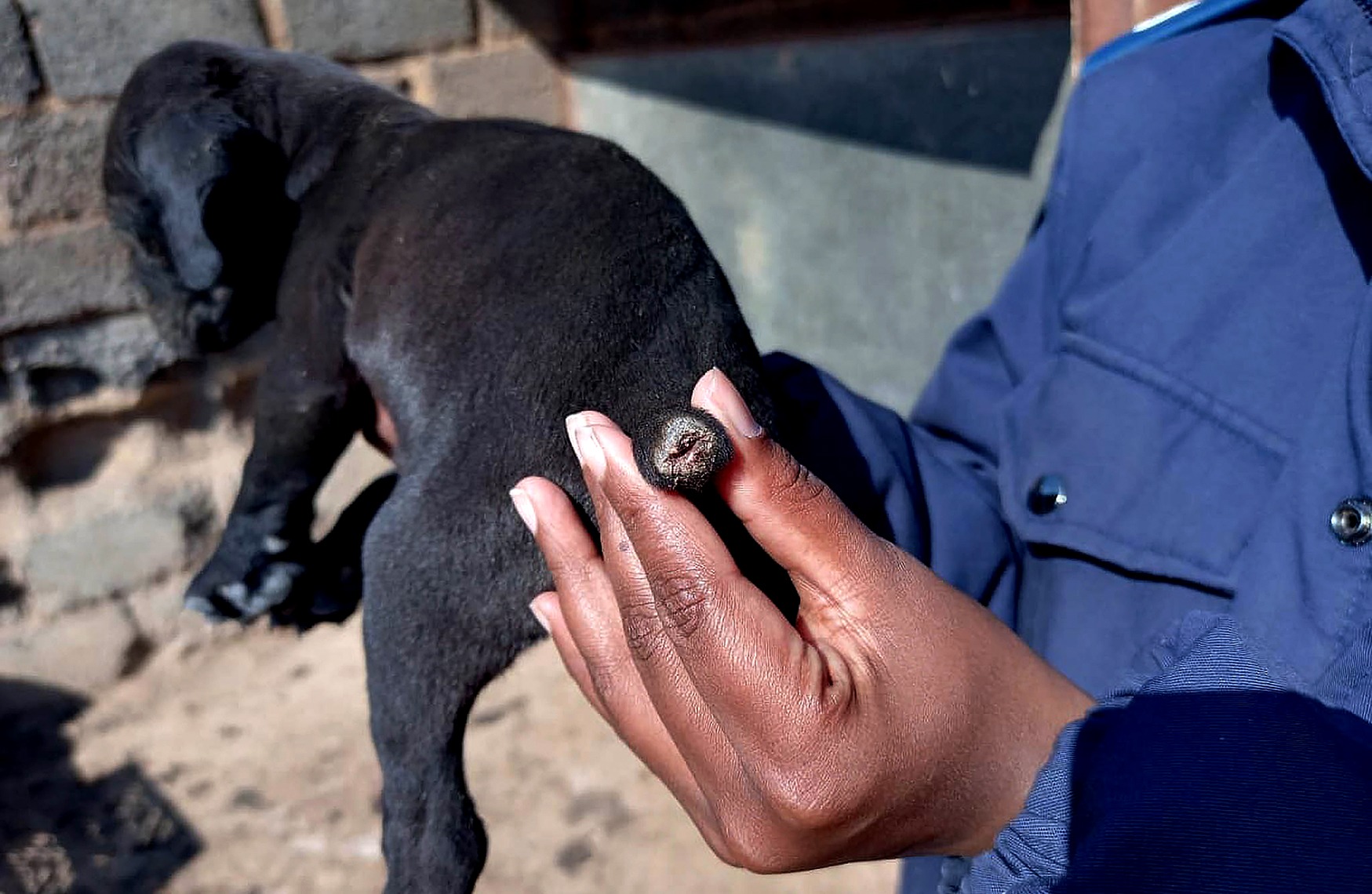
 Tail docking is extremely painful. (Photo: NSPCA)
 /file/dailymaverick/wp-content/uploads/2025/10/label-analysis-2.jpg)
Tail docking a dog is maiming, extremely painful and deprives a dog of a vital communication system. For these reasons, it’s banned in South Africa.
But it persists: hunting dogs, spaniels, Jack Russells, Rottweilers and boerboels without tails are a common sight — many of them young dogs, clearly born after the practice was outlawed under the Animals Protection Act.
After pursuing a case for nearly two years, in December the National Council of SPCAs (NSPCA) secured a conviction against a breeder, Carlene Coetzee, after inspectors found seven puppies hidden under a wheelbarrow in her garage. All had maimed tails. She was sentenced to a fine of R20,000 or 10 months’ imprisonment.
The case has drawn attention not because tail docking is new, but because it’s so familiar — and so quietly routine —that it has often slipped beneath scrutiny.
/file/attachments/orphans/TaildockingNSPCA-3_777119.jpg "Despite being illegal, tail docking in South Africa persists. (Photo: NSPCA)
<br>
<br>")
What docking involves
Tail docking is the partial amputation of a dog’s tail. It is usually performed when puppies are between two and five days old. At that age, the tail already contains bone, muscle, tendons, blood vessels and nerves. The nervous system is active and pain perception is present.
The procedure itself varies. Some breeders use surgical scissors or a scalpel to cut through skin, muscle and bone. Others use tight rubber bands placed at the base of the tail, restricting blood flow until the tissue dies and eventually detaches. In many non-therapeutic dockings, anaesthesia is not used.
Immediately after docking, puppies often show signs of acute distress: howling, agitation, rapid breathing and changes in feeding behaviour. Longer-term effects can include inflammation, infection, abnormal nerve regrowth (neuromas), altered sensitivity at the amputation site and complications affecting bowel or urinary function, depending on how much of the tail was removed.
/file/attachments/orphans/TaildockingNSPCA-2_759981.jpg "After docking, puppies often show signs of acute distress, which include howling and rapid breathing. Longer-term effects can include inflammation and infection. (Photo: NSPCA)")
Tails are also functional. They contribute to balance during movement and play a central role in communication. Dogs signal intention, uncertainty, excitement, submission, fear and playfulness largely through tail position and movement. Removing the tail alters how dogs communicate with each other and with humans, often leading to misinterpretation of social cues.
These anatomical and neurological facts are well established. What has shifted over time is how necessary — or unnecessary — the procedure is considered.
How the practice began
Tail docking predates modern dog breeding. In parts of Europe, it was historically associated with working dogs — particularly hunting and herding breeds. One rationale was injury prevention: the idea that shortening the tail reduced the chance of damage in dense undergrowth or confined spaces.
Other explanations were less practical. In some periods, docked tails were linked to tax categories, and licensing was cheaper or absent for working dogs than for companion animals. In others, docking was thought to prevent disease, improve speed, or even increase aggression — claims that have since been discarded.
As dog breeding was formalised in the nineteenth and early twentieth centuries, docking migrated from specific working contexts into breed definition. Kennel clubs codified appearance, and the docked tail became part of the visual shorthand of certain breeds.
Over time, the practice became routine, applied to entire litters regardless of whether dogs would ever work in the field. Docking shifted from a conditional, task-based intervention to a standardised aesthetic one.
What evidence shows
As veterinary research advanced, the original injury-prevention arguments began to weaken. Large-scale studies of working dogs show that tail injuries do occur, but at relatively low rates. Preventing a small number of potential injuries by amputating the tails of all puppies in a breed has increasingly been seen as disproportionate.
Crucially, most tail injuries that do occur are treatable. By contrast, docking is irreversible. It removes a healthy body part in anticipation of a possible future problem that may never arise.
This evidence has driven legislative change in many countries.
Across Europe, Australia and parts of South America, non-therapeutic tail docking has been restricted or banned. The legal reasoning is technical rather than emotive: removing a healthy body part requires justification, and cosmetic preference does not meet that standard.
The South African position
South Africa’s approach follows the same logic. Under the Animals Protection Act 71 of 1962, tail docking constitutes maiming unless it’s performed for legitimate veterinary or therapeutic reasons that improve the welfare of the individual animal. Routine docking for appearance or breed convention is illegal.
The law doesn’t prevent veterinary intervention when an animal is injured or ill. It does prevent routine alteration carried out in advance, based on tradition or preference rather than medical need.
Despite this, enforcement has historically been uneven, and docking has continued quietly in some breeding circles — often normalised by familiarity.
The case
That quiet persistence is what makes the recent conviction significant. In December, after nearly two years of investigation, the NSPCA secured a conviction against boerboel breeder Carlene Coetzee for illegally docking puppies’ tails.
Inspectors found seven boerboel puppies concealed under a wheelbarrow in a garage, all with docked tails. The breeder had previously been warned after admitting to docking puppies’ tails with rubber bands at a dog show. The court imposed a R20,000 fine or a 10-month prison sentence, with part suspended on condition of non-reoffending.
The NSPCA described the outcome as an important precedent, particularly in the context of an increase in maiming cases nationally. What the judgment affirmed was straightforward: docking performed for cosmetic reasons falls within the legal definition of unlawful maiming.
/file/attachments/orphans/TaildockingNSPCA-4_777235.jpg "Docking is often normalised by familiarity. (Photo: NSPCA)")
A visible shift
The case highlights a growing mismatch between inherited breed standards and contemporary law. Many breed descriptions still assume docked tails, even in countries where docking has been illegal for years. But experience elsewhere shows that this gap closes over time.
In jurisdictions with long-standing bans, undocked dogs are now shown, judged and bred as normal. Breed appearance adjusts. What once looked unfamiliar becomes unremarkable. The visual identity of the dog evolves intact.
South Africa appears to be moving through that same adjustment phase. The science is settled. The law is clear. What remains is the gradual recalibration of practice, expectation and habit.
The conviction does not introduce new principles. It applies existing ones with clarity. Healthy tails were removed. The reason was cosmetic. The law does not allow this.
What makes the moment notable is that it brings an everyday, often unnoticed practice back into focus. Tail docking has not vanished because it’s controversial; it has lingered because it became ordinary. The case interrupts that ordinariness.
And in doing so, it suggests that practices grounded in habit rather than necessity do change — not through spectacle, but through steady alignment between anatomy, evidence and law.