
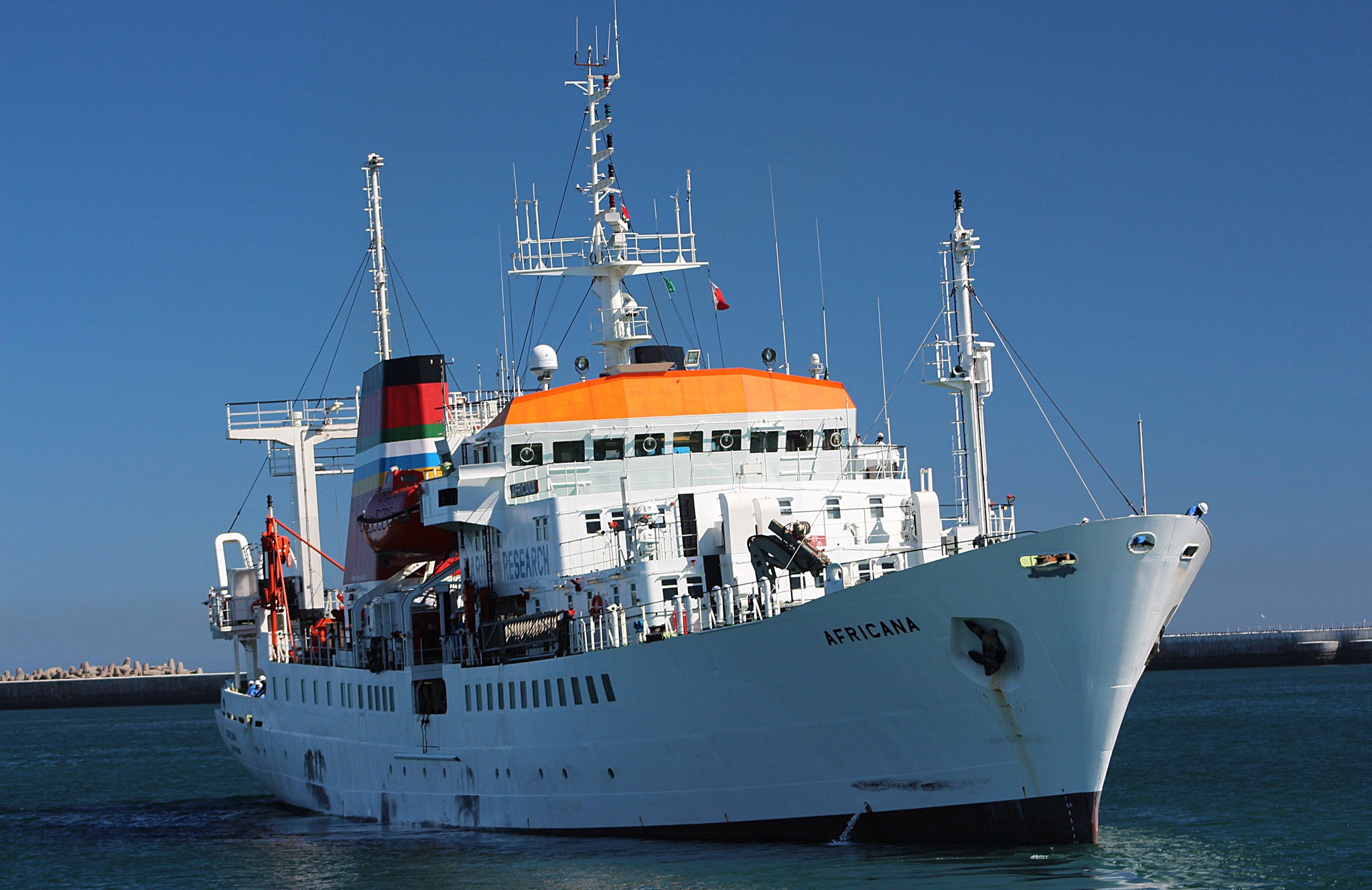
 The ageing research vessel, Africana. (Photo: DFFE)
 /file/attachments/2985/TroubledWaters_405609.jpg)
For most South Africans, fishing policy feels distant: something that happens offshore, managed by people we never meet, argued about in courtrooms and harbours far from daily life.
But the health of South Africa’s fisheries is a strategic national asset underpinning food security, coastal livelihoods and an entire web of industries – from processors and exporters, to dock workers and scientists.
In this series, fishers across the industry have spoken candidly about what they see as failures in the system: shrinking quotas, missed surveys, weak enforcement and a growing sense that the burden of conservation is being carried by communities rather than the state.
In response, senior officials within the Department of Forestry, Fisheries and the Environment opened their doors, offering a rare, detailed look at how the system actually functions – and how it continues to operate under sustained institutional and resource pressure.
What emerges is not a story of denial or defensiveness, but of a department trying to hold together a complex, high-stakes system with finite capacity and resources, escalating compliance risks and increasing stakeholder expectations.
A system under pressure
Cheslyn Liebenberg, chief director for monitoring, control and surveillance, is blunt about the reality facing enforcement. “We’ve lost around 100 fisheries control officers over the years,” he says. “At one stage we had close to 250. Now we’re operating with roughly 150 to police the same coastline and the same exclusive economic zone.”
That loss matters because South Africa’s coastline stretches more than 3,000km and enforcement now contends not only with increasing dependency and poor compliance by resource users, but with international organised criminal networks involved in abalone and lobster poaching as well as local gangs linked to drug trafficking and the firearms trade.
For years, fisheries inspectors were unarmed. Patrol vessels were frequently out of service due to maintenance backlogs. Night work was limited by civil service rules.
“The poachers innovate faster than we can,” says Liebenberg. “For example, they’re able to procure surveillance equipment and technology bought off the shelf, like drones. We have to go through rigorous procurement procedures, deal with budget constraints and training of drone pilots. But, even though we don’t have drones, we are supported by other law enforcement partners during joint operations.”
Despite this, he points to a system that is far from blind. Vessel monitoring systems and satellite-based AIS (automatic identification system) tracking allow officials to see both local and foreign vessels moving through South African waters in near real time. Foreign fleets entering that exclusive economic zone are flagged, tracked and – where necessary – engaged through flag-state and compliance mechanisms.
“People say we don’t know what’s happening in our waters,” he says. “But we do. The problem isn’t awareness – it’s response capability and sustained presence.”
Enforcement today is less about dramatic chases and more about coordination: joint operations with SANParks, CapeNature, the SAPS and the navy; targeted inspections at landing sites and compliance audits that have recently led to the cancellation of hundreds of noncompliant abalone exemptions.
The science squeeze
If enforcement is stretched thin, science has been squeezed as hard.
Dr Kim Prochazka, chief director for Fisheries Research and Development, estimates that her branch has lost 40% to 50% of its scientific capacity over the past two decades.
/file/attachments/orphans/DFFE-1_538201.jpg "Doing science off the Africana, a government research vessel. (Photo: Department of Forestry, Fisheries and the Environment)")
Marine scientists have not been replaced. Specialist posts have disappeared during repeated departmental restructurings. Yet the expectations placed on fisheries science – precision, transparency, international credibility – have only increased.
Nowhere is this more visible than in the controversy surrounding research surveys.
South Africa relies heavily on a single, aged government research vessel, the Africana, to conduct critical abundance surveys, particularly for small pelagic fish such as sardine and anchovy. When maintenance funding arrives late – or not at all – surveys slip. When surveys slip, scientists are legally required to apply a precautionary approach when setting catch limits.
/file/attachments/orphans/Fisheries-45_836655.jpg "The fisheries satellite tracking system watching fishing boats in real time. (Source: Don Pinnock / Google Insight)")
“The perception is that we just slash quotas when surveys are missed,” Prochazka explains. “But the truth is that surveys are one input among several. We still use catch data from the fishery itself. We still rely on long-term trends built over decades. Our job is to protect fish stocks.”
Still, she acknowledges the cost of uncertainty. Small pelagic fish are naturally volatile, responding rapidly to environmental change. Without up-to-date survey data, risk increases – not only to fish stocks, but to food webs and the stability of the industry itself.
/file/attachments/orphans/DFFE-3_757651.jpg "The ageing research vessel, Africana. (Photo: Department of Forestry, Fisheries and the Environment)")
The irony, she notes, is that though Fisheries receive enough funds to keep the Africana in port, they often don’t have the budget to sail it. Attempts to charter industry vessels as back-ups have repeatedly failed due to procurement rules and lack of compliant bids. “We don’t expect vessels for free,” she says. “We expect to pay. But the system doesn’t make this easy.”
Quotas and the burden of fairness
At the centre of most disputes lies the question of quotas: who gets access, for how long and under what conditions.
That terrain falls under Saasa Pheeha, chief director for marine resource management. His job, he says, is to balance conservation science with socioeconomic reality – livelihoods, jobs, food security and transformation – all within a finite resource.
“Fishing is not just biology,” Pheeha explains. “It’s politics, economics, history and justice layered on top of each other.”
/file/attachments/orphans/Fisheries-1_660914.jpg "Tuna sold off a bakkie in Cape Town. (Photo: Don Pinnock)")
Rights are issued for a period not exceeding 15 years, as allowed under the Marine Living Resources Act. The duration of a right depends on the stock status. Stable fisheries like the hake sector can sustain longer allocations; rebuilding or depleted stocks cannot.
While fishers argue that shorter rights discourage investment, Pheeha notes that longer guarantees on fragile resources risk entrenching overexploitation and limiting adaptive management.
Paper quota holders – rights holders who use their allocations as income, with no serious intention to invest, share the risks or fully participate in the sector – have become a lightning rod for anger within the industry. Pheeha insists this problem is being actively addressed.
Past and recent allocation rounds, he says, included risk assessments to exclude such applicants. These have already led to the exclusion of applicants and revocation of rights.
/file/attachments/orphans/Fisheries-3_936129.jpg "An early Fisheries research vessel. (Photo: Department of Forestry, Fisheries and the Environment)")
“We’re tightening the system,” he says. “And we’re also working with the Competition Commission to prevent excessive consolidation of fishing rights. This is to avoid larger companies buying up all the small fishing companies.”
Litigation, he concedes, is unavoidable. Fisheries rights are valuable, contested and legally reviewable. Appeals and court challenges slow the system and drain resources, but they are also a consequence of constitutional protections and high demand for access.
Small fishers, big consequences
Nowhere are the pressures more acute than among small, medium and micro-enterprises commercial fishers – the so-called missing middle. Their operations are too large to meet criteria for small-scale cooperatives but too small to compete with industrial operators. Many struggle with short seasons, small and fragmented allocations and rising fuel and operational costs.
Officials acknowledge the problem. Allocation models, he says, increasingly try to cushion smaller operators during cuts, shifting reductions towards larger quota holders. But when stocks recover, increases often flow back to the big outfits – reigniting resentment.
“This is the hardest part of the job,” Pheeha admits. “Every decision helps someone and hurts someone else.”
For all the conflict, there are successes that rarely make headlines.
Hake stocks have recovered to sustainable levels under long-term management plans and carry international certification, as does the pole-and-line albacore tuna fishery, confirming their status as sustainable and well managed. South Coast rock lobster has rebounded after painful cuts.
South Africa’s fisheries science and management continue to receive high marks from international review panels and regional fisheries management organisations, despite operating with fewer people and less money than comparable countries.
Globally, Prochazka notes, fisheries management is improving – slowly, unevenly, but measurably. “We’re hard on ourselves,” she says. “But when you compare us internationally, we’re not failing. We’re holding the line.”
The real risk
The greatest danger, officials agree, is not disagreement or criticism – it is erosion through neglect. Deferred maintenance, unfilled posts, outdated data systems, slow procurement and insufficient funds hollow out capacity until crises become inevitable.
Fishing may happen offshore, but its consequences land squarely onshore: in jobs lost, food prices, and communities destabilised.
The people inside the system know this. They’re not blind to its flaws. What they ask – implicitly – is whether politicians and the country in general recognise what is at stake before resilience gives way to collapse. DM
Setting up the series: Untangling SA’s fishing industry
Mark Wiley: South Africa’s vanishing fish
Tim Reddell: Steering Viking Fishing through SA’s troubled waters
Deon van Zyl: ‘We’re crippled by government inefficiency’
Doug Butterworth: Seafood’s balancing act and the science of sustainable catch limits
Colin Attwood: Counting the uncountable and the science of tracking fish
Kobus Poggenpoel: ‘These traditions will die with my generation’
Travis Daniels: at one with the sea
Aunty Val: being a woman trek netter on the Cape coast