




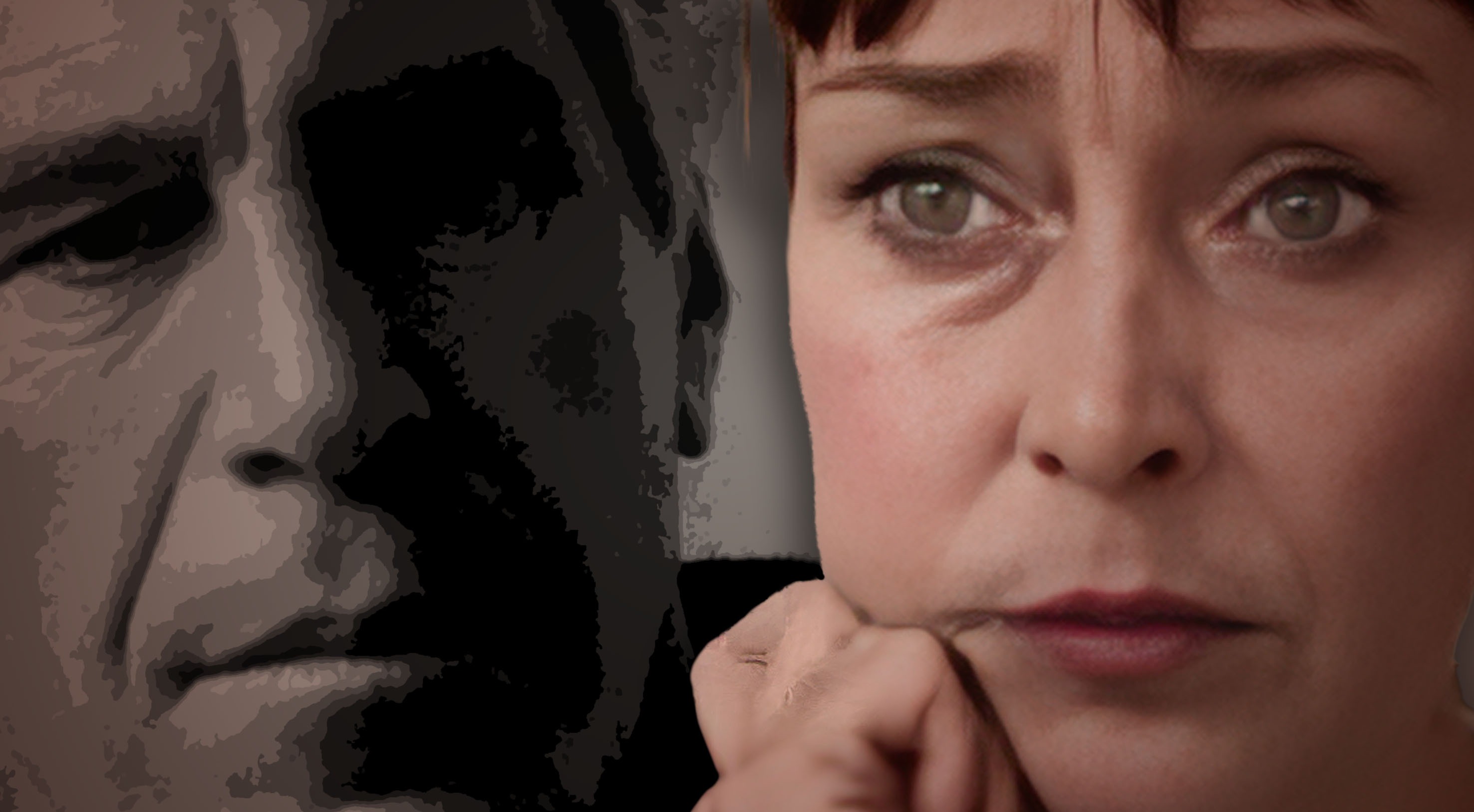
 Illustrative image: Jeffrey Epstein. (Original photo: Rick Friedman / Getty Images) | Juliette Bryant. (Photo: Supplied)
 Traumatic memory is a tricky beast. It doesn’t unfold neatly in a clean sequence. It lives in the nervous system, triggered by a sound, a smell, a word, a fragment. Short. Sharp. Staccato.
Juliette Bryant’s most visceral memory begins with one instant that cannot be undone. The private plane door closed – and Jeffrey Epstein began his sexual assault.
“I suddenly realised, oh my God, I’ve been lied to. These people are going to try to kill me. I’ll never see my family again. I had to do whatever they wanted.”
Her body draws inward, a hand covering her face. “I had no money. No passport. I was completely alone. It felt like the death of the real me.”
The horror was not only in the violation, but in the environment that enabled it – where isolation and Epstein’s power were absolute. Isolation plus danger delivers one primal instruction: survive at any cost.
“And the girls on the plane – the ones who staged the modelling casting in Cape Town – they just laughed,” she says.
Bryant is one of the only known South African survivors groomed by Epstein. Her two-year ordeal, intermittently from 2002 to 2004, still haunts her.
She sits at the intersection of Epstein’s global crimes, US institutional failures and an unfinished accountability process abroad.
Read more: Neverending nightmare — abuse survivors shackled to a life ‘stuck in survival mode’
The bait
It began on 26 September 2002. Bryant, then 20, was at a popular Cape Town nightspot when she was approached by a glamorous young woman. Would she like to meet “the owner of Victoria’s Secret”? The global lingerie empire. The supermodel launchpad.
Bryant was a psychology student and an aspiring model: ambitious, beautiful, financially strained, emotionally vulnerable. She was Epstein’s type.
She was taken to Beluga, another trendy Cape Town eatery, where she was introduced to former US president Bill Clinton, in town on an African tour focused on HIV/Aids and development. His entourage included actors Kevin Spacey and Chris Tucker – and a silver-haired man she didn’t recognise.
/file/attachments/2987/0412642710_771575.jpg "Former US president Bill Clinton speaks at Constitution Hall in Washington, DC on 21 November 2024. (Photo: EPA / Will Oliver)")
“I’d never met a celebrity, let alone a president,” Bryant says. “It was overwhelming.”
Her first impression of the silver-haired man was unremarkable.
“I didn’t really notice him. He just seemed like a middleman. He looked shorter than me and wore sneakers. But he was charismatic and seemed genuinely interested in me.”
That man was Jeffrey Epstein.
He presented himself as a modelling scout for his friend Les Wexner, the billionaire founder of L Brands, the parent company of Victoria’s Secret. Epstein’s leverage over Wexner and other wealthy men is widely recognised as enabling his wealth, network and elite access.
The woman who had introduced Bryant later called to say that Epstein wanted to inspect her portfolio the next day at the Cape Grace Hotel.
The following morning she was swept into the spectacle of Clinton’s blue-light convoy, accompanying him to the University of the Western Cape, where he delivered a speech on his “African Dream”.
Bryant has not accused Clinton or the actors in any wrongdoing.
Clinton flew on Epstein’s plane several times in the early 2000s after leaving office. He has expressed regret about the relationship and said he knew nothing about Epstein’s criminal activity.
Reuters also reported that Clinton and his wife, Hillary, have offered to cooperate with the House Oversight Committee into the Epstein Files, but have refused to appear in person before the panel, saying its investigation is a partisan exercise aimed at protecting President Donald Trump, who was friends with Epstein during the 1990s and early 2000s. Trump says he broke off ties before Epstein pleaded guilty to prostitution charges.
Read more: House panel advances contempt measures against Clintons in Epstein probe
Bryant presented her portfolio in the suite at the Cape Grace Hotel to a “recruitment team” claiming to represent Karin Models. They praised her almond-shaped eyes, her lithe frame. Epstein was especially complimentary.
/file/attachments/2987/04GX-706_page1_-_Zorro_Ranch_NM_-_Aerial_view_of_a_large_mansion_in_the_middle_of_the_desert_336071.jpg "Zorro Ranch in, Santa Fe, New Mexico. (Photo: Wikimedia Commons)")
Two weeks later, with a visa arranged and a ticket paid for by Epstein’s staff, she flew to New York – her first overseas trip – to launch her international career.
By then Epstein had already ingratiated himself with Bryant’s mother, Virginia, reassuring her in a 30-minute phone call that her daughter’s education and welfare would be taken care of.
After an overnight flight to New York, Bryant was told to pack a small bag for the Caribbean. “I thought I’d been booked for my first shoot. A car drove me straight onto the runway at Teterboro Airport without going through customs.”
Flight logs show Epstein’s jets used Teterboro hundreds of times. Bryant later discovered her name had been omitted from the manifest. “If I had disappeared,” she says, “no one would have known what happened to me.”
Only when the plane door closed did she learn the truth. The three “recruiters” from Karin Models were not scouts at all. In several interviews and in a civil suit against Epstein’s estate, Bryant has identified two of these women as his co-conspirators: Sarah Kellen and Lesley Groff. Both Kellen and Groff were named as unindicted co-conspirators in Epstein’s 2007-08 Florida plea deal.
Neither has faced prosecution, but survivors have named them in civil lawsuits.
Epstein’s ties to Karin Models were also linked to French model scout Jean-Luc Brunel. Arrested in 2020 on charges of rape, sexual assault and trafficking young girls to Epstein, Brunel was found dead in his prison cell in 2022. Like Epstein, his death robbed survivors of the chance to understand the full machinery behind the abuse.
“Things happened that scared me so deeply I can’t even talk about them,” Bryant says. “Epstein was demonic. He fed off the terror.”
/file/attachments/2987/04Bryantwas20yearsoldwhenshewasfirsttraffickedbyEpsteintohisCaribbeanisland_500792.jpg)
The con
Epstein – the Brooklyn-born college dropout who became a maths teacher and then a financier – had perfected a calculus of control, manipulation and abuse. It weaponised geography and engineered dependency, always under the shadow of disappearance.
“He told me he was a CIA agent,” Bryant recalls, “that my family was on a list and that he could set me up to be arrested or eliminated. I believed him. I had no choice. No one dared disobey him.”
As court records confirm, Epstein flew Bryant to New York, to his Little Saint James island and to his Palm Beach, Paris and New Mexico properties. She recalls seeing dozens of foreign young women and girls at various locations, many unable to speak English and kept isolated from one another.
Watch: Epstein survivor reveals shocking details about human trafficking experience
Bryant believes Epstein was not the ultimate architect of the abuse. He was a frontman, shielded and directed by more powerful individuals and organisations.
“He played the role,” she says. “But the machinery behind him was enormous and sinister.”
She believes it is still operational.
/file/attachments/2987/04GettyImages-1154618548_305458.jpg "Jeffrey Epstein’s sex offender mugshot taken in Florida on 25 July 2013 after he was charged with procuring a minor for prostitution. (Photo: Florida Department of Law Enforcement via Getty Images)")
The poisoned chalice
The self-styled master of the universe was also a master fabulist, presenting himself as a philanthropist and scientific visionary. He even employed a publicist, Christina Galbraith, who posed as a “science writer”.
Her bylines in outlets like Forbes, HuffPost and National Review praised Epstein as a businessman with a passion for science, omitting his 2008 conviction as a sex offender. After a 2019 New York Times investigation, the publishers removed the articles.
Even after his claims to scientific expertise were debunked, and after his 2008 “sweetheart deal” conviction, Epstein remained a force in the world of science. He sponsored conferences, funded university programmes and kept close company with an elite coterie of Nobel laureates, scientists, philanthropists, philosophers and technologists. They were drawn to him like sunbirds to nectar, sipping from a poisoned chalice as he fed, feted and financed them.
He donated millions to Harvard’s Program for Evolutionary Dynamics and about $850,000 to the Massachusetts Institute of Technology.
He also inserted himself into Silicon Valley’s “broligarchy” – tech titans, venture capitalists and transhumanists. He embedded himself as the conduit between capital and innovation in an ever-expanding sphere of power, even as the shadow of his crimes loomed publicly over him.
Epstein’s obsession with controversial research would become pivotal to Bryant’s experience at the secluded Zorro Ranch in the foothills north of Santa Fe, New Mexico. There, amid surveillance, secrecy and fear, Bryant believes that Epstein’s methods shifted.
She was no longer merely feeding his sexual rapacity. She was an instrument for something even darker.
At Zorro Ranch, Bryant believes Epstein was harvesting her eggs for experiments in human cloning. She has fragmented memories: a pelvic examination. Waking in a laboratory. Figures in hazmat suits. A woman in medical clothing. No continuity. No context. Only sensation.
These recollections can be dismissed as trauma-born delusions. Epstein was a teetotaller, but he may have drugged her.
New Mexico legislators have proposed a truth-finding commission to investigate Zorro Ranch.
/file/attachments/2987/04AphotographtakeninsideEpsteinsislandhome_451747.jpg)
Media reports also lend eerie resonance to Bryant’s fragmented memories. In 2019, The New York Times reported Epstein’s obsession with transhumanism – the belief that technology can transcend biological limits.
From genetic engineering to artificial intelligence and the quest for immortality, the roots of transhumanism reach back to eugenics with its ambition to “perfect” humanity, and to Nietzsche’s vision of the Übermensch – a superior, self-determining human. Epstein’s obsession with transhumanism and cryonics mirrored these impulses.
The Guardian and Vanity Fair reported that he wanted to impregnate as many as 20 women at Zorro Ranch with his sperm. He also reportedly requested that his head and penis be preserved after death – a grotesque reflection of his obsession with control, sexualised power and legacy.
Hierarchy and The Handmaid’s Tale
Epstein’s network mirrors the perverse hierarchy of Margaret Atwood’s novel The Handmaid’s Tale. At the bottom were underage girls from vulnerable backgrounds – disposable, used, discarded. Above them were the “Handmaids”: fertile females groomed, controlled and prized for reproduction. Around them orbited the enforcers and facilitators – women who normalised, enabled and managed the abuse.
Bryant insists that, unlike many survivors, she was never trafficked to other men. Epstein kept her to himself. But she says he took her to visit the late Bill Richardson, then governor of New Mexico, whose campaign Epstein helped finance.
/file/attachments/2987/04AphotographofBryantshotonepsteinsisland_793585.jpg "A photograph of Bryant, shot on Epstein’s island. (Photo: Supplied)")
Secrecy, lawsuits and betrayal
Bryant kept her ordeal secret for 15 years, coming forward only in 2019 after Epstein’s arrest. After his death in custody, she joined dozens of survivors in civil claims against his estate as part of the Epstein Victims’ Compensation Program.
The programme ended up paying out roughly $121-million to about 150 eligible claimants, including Bryant, out of more than 200 claims submitted. She says she was awarded substantial compensation from the programme, and more as part of a 2023 class action against JPMorgan Chase for turning a blind eye to Epstein’s trafficking.
The individual amounts were never publicly disclosed by the programme. She insists it was never about the money. She had hoped the 2025 Epstein Transparency Act would reveal the full truth. Instead, the drip-feed of less than 1% of the files has been retraumatising.
“No one can deny there is a cover-up,” she says. “Yet perhaps if I knew everything, I would be dead, like the others.”
What lies beneath
Survivors have died under circumstances that deepen the sense of threat. Virginia Giuffre (41), Epstein’s most prominent victim and crusader for justice, died by suicide in April 2025. Carolyn Andriano (36), a key witness in the 2022 trial and conviction of Epstein accomplice Ghislaine Maxwell, died in 2023 of an apparent accidental overdose. Leigh Skye Patrick (29), who had been trafficked since the age of 14, died in 2017 under similar circumstances.
Epstein is dead. But his accomplices live on. His money still moves. His secrets remain sealed. And in that hermetic world, Juliette Bryant is not a footnote to his story, but a living consequence.
Traumatic memory is a tricky beast. And it is now shouting: enough. DM
This story first appeared in our weekly DM168 newspaper, available countrywide for R35.
/file/attachments/orphans/DM-23012026001CPTJHB_284128.jpg)