




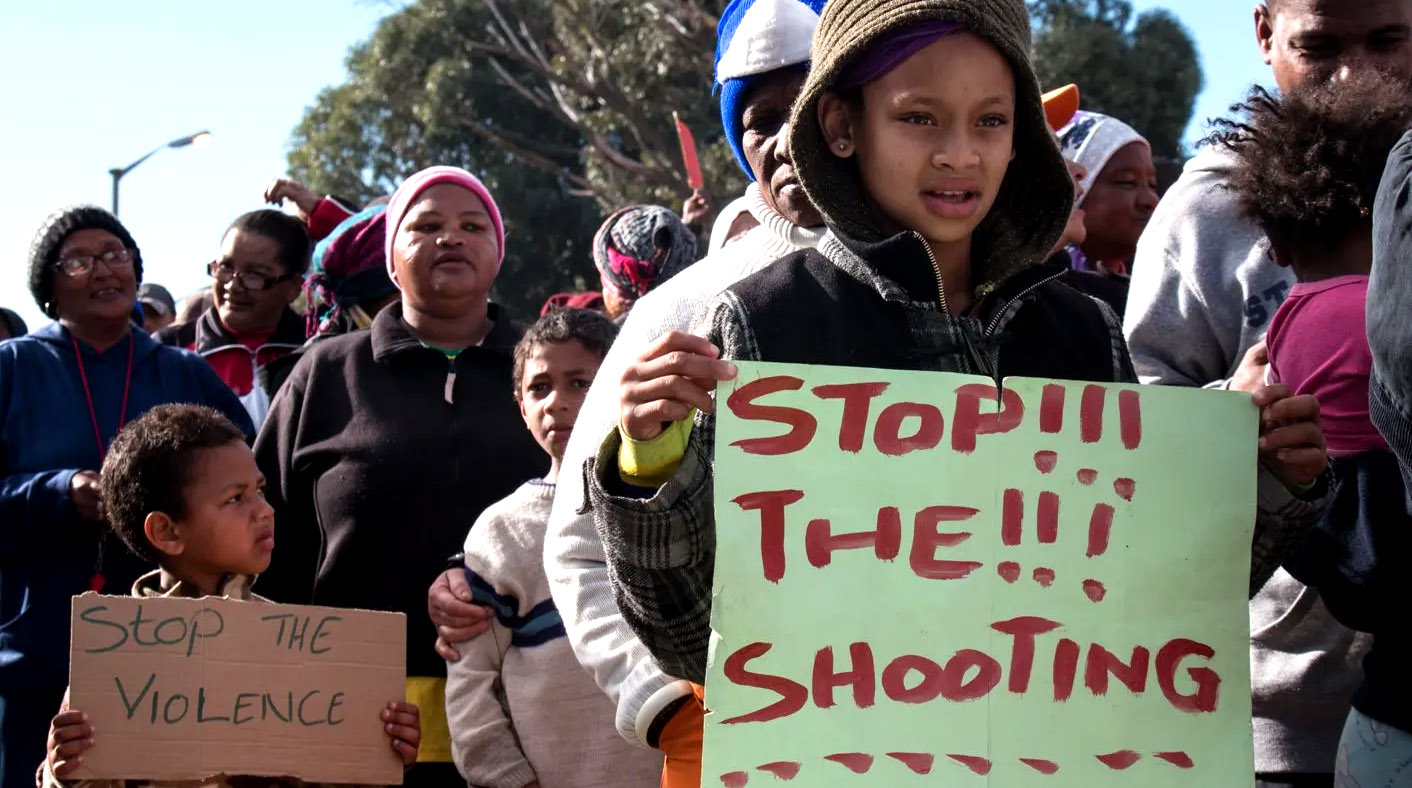
 Children participated in “Take Back The Streets” march in Manenberg, Cape Town. (Shaun Swingler)
 /file/dailymaverick/wp-content/uploads/2025/10/label-Op-Ed.jpg)
The new year brings the illusion of clean slates. Yet, 2026 arrives with a distinct heaviness: a reckoning with how fragile law, justice and political order have become, at home and abroad.
South Africa enters the new year still absorbing the revelations of the Madlanga Commission and the uncomfortable clarity it provided about criminal networks, policing failures and the erosion of public trust. And while our own institutions grapple with questions of accountability, the world has been jolted by the US’ military intervention in Venezuela and the capture of President Nicolás Maduro, under the guise of the War on Drugs.
/file/attachments/2984/NA-crime-2_380518_e20e823063d69a43754ed9eb0436eb56.jpg "Police in Nelson Mandela Bay are fighting an uphill battle against drugs and violent crimes in the city's gang-ridden northern areas. A major concern is the number of youths, between the ages of 14 and 35, involved in criminal activity and gangs. Violent crimes and drugs are among the highest recorded crimes in the area. (Photo: Deon Ferreira)")
We are justifiably shocked and scandalised and the public conversation has landed on a familiar and deeply misleading place: “drugs” are the problem, and harsher criminal justice responses are posed as the solution. Provocatively, we are asked to reconsider this popular, simplistic narrative: cartels are not infiltrating the state because drugs exist, they are infiltrating the state because prohibition creates a lucrative, unregulated economy, which criminal networks exploit.
South Africa is home to an estimated half a million people who use illicit drugs (such as methamphetamine and heroin), the majority of whom use occasionally, in a non-problematic pattern and in ways that pose little to no threat to the public. Yet our law continues to treat them as criminals, corralling people who use drugs and low-level drug sellers into the same punitive framework designed for large-scale traffickers and cartel operatives. This is a profound misallocation of state power: we chase people who use drugs away from the support they might need, we jail the poor, we ignore the underlying conditions creating problematic drug use, and we leave the cartels intact.
The result?
A policing environment perfectly engineered for corruption and mismanagement and abuse of power.
Prohibition doesn’t weaken cartels, it strengthens them
The Madlanga Commission’s hearings have exposed what research has shown repeatedly, that criminalisation of drug use creates enormous illicit markets, and illicit markets in turn create incentives for corruption. When a product is illegal but widely used, its regulation shifts from the state to whoever is willing to use violence and bribery to control the trade.
/file/dailymaverick/wp-content/uploads/2022/02/Caryn-Brazilian-SA-narcotics-trade3.jpg "Cocaine hidden in packs of sugar and destined for Durban was discovered at Brazil's Port of Santos at the end of December 2021. Photos: Brazil Federal Police")
The South African Police Service is not uniquely flawed – it is in many ways structurally overwhelmed. Its members are given an impossible mandate, which is to eliminate drugs from society while the law itself ensures that drugs remain profitable, unregulated and hidden. This is the same pattern seen globally, from Mexico and Brazil to the Philippines. Prohibition does not dismantle criminal organisations, it feeds them. The costs are borne not by policymakers or police, but by marginalised communities, especially young, Black, poor and working class, caught between violent illicit markets and punitive legal systems.
Meanwhile the real casualties mount.
The South African government’s current, largely punitive, approach has not reduced drug use. It has not made communities safer and it has not slowed drug trafficking. It has had the opposite effect by deepening inequalities and violent narratives such as the “War on Drugs”.
It may feel counterintuitive to consider using less criminal law against individual users, not more, to deal with drug problems in South Africa. But, consider the evidence: countries that have adopted non-custodial sanctions for minor, nonviolent drug-related crimes (use and possession for personal use) – Portugal most famously – have seen reductions in overdose deaths, HIV and hepatitis transmissions, in the number of people entering the criminal justice system and a refocus of law enforcement on organised crime.
In other words, in Portugal they stopped confusing drug use with drug trafficking (selling of drugs) and they stopped hoping that policing alone can undo decades of inequality, trauma and social exclusion.
Unfortunately, South Africa, trapped in an outdated criminal model, continues to conflate buying and selling of drugs, with tragic consequences.
This moment demands courage, not nostalgia
/file/attachments/orphans/13622975_929436.jpg "Captured Venezuelan President Nicolas Maduro and his wife, Cilia Flores, arrive at the Wall Street Heliport during their transport to the federal courthouse for their arraignment in New York, New York, USA, 05 January 2026. (Photo: EPA/Stringer)")
As the “War on Drugs” narrative driven by the US’ illegal invasion of Venezuela deepens, we must confront how the faultlines of vulnerability and marginalisation run through illness, violence and criminalisation. We have been here before. In the 1990s and 2000s, criminalisation, stigma and Aids denialism cost thousands of lives. It was only when we abandoned moral panic and embraced a rights-based, evidence-driven HIV response that progress became possible.
Drug policy is at the same crossroads now – the next frontier?
The upcoming National Drug Master Plan 2025-2030 and ongoing statutory reviews give South Africa a rare chance to pivot from punishment to evidence-based prevention, treatment, harm reduction and support. We can move from policing to public health and safety. Our approach could move from persecuting people who use drugs to dismantling real criminal power and using our precious police resources more prudently and effectively.
Decriminalising personal possession of drugs will not end drug use. But it has the potential to help end the criminalisation of poverty, free up our courts and alleviate our overcrowded prisons. It also has the potential to redirect resources towards prevention, treatment and harm reduction and, importantly, it has the potential to starve criminal networks of the low-level arrests they rely on to distract the public from high-level corruption. DM
Charity Monareng is executive director at Students for Sensible Drug Policy International (SSDP International).