



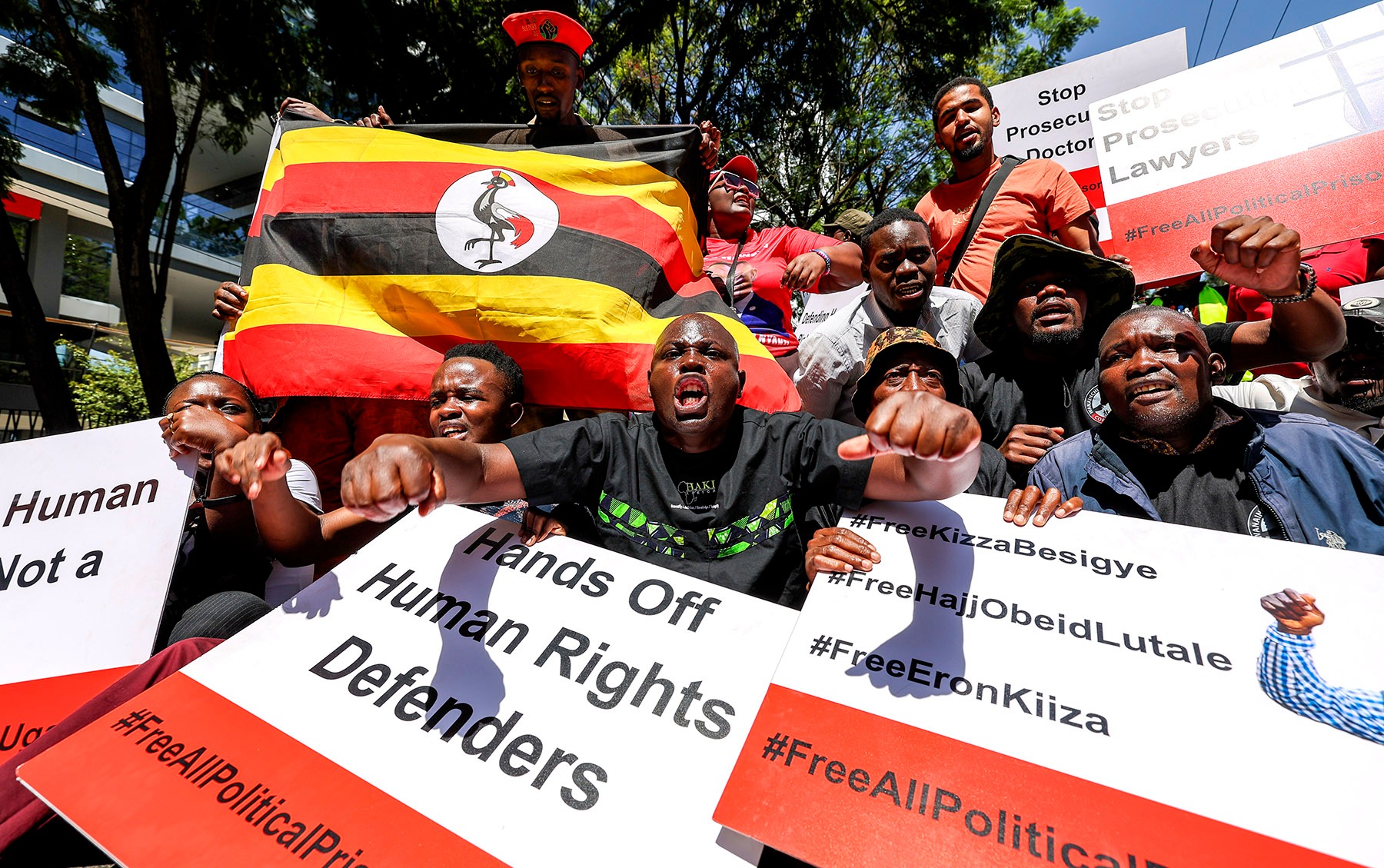
 Kenyan demonstrators hold placards and shout slogans as human rights groups demonstrate for the release of all political prisoners, including the detained Ugandan opposition leader Kizza Besigye, outside the Uganda High Commission in Nairobi, Kenya, on 24 February 2025. Besigye, a four-time presidential candidate and former military officer in the Uganda People's Defence Force, is on trial on charges of statement of offence and unlawful possession of firearms after being kidnapped in Nairobi and taken to Uganda last year. (Photo: Daniel Irungu / EPA)
 Urgent calls have been issued for the immediate release of the imprisoned Ugandan opposition leader, Kizza Besigye, who is “seriously ill” and requires immediate medical intervention.
Besigye – formerly the chief political challenger to President Yoweri Museveni – has been in jail since November 2024 on what he and many others insist are trumped-up, political charges.
His wife, Winnie Byanyima, executive director of UNAids, warned on Thursday, 22 January, that “Dr Besigye is seriously ill and has been denied timely and adequate medical care. Last night [21 January], after a sharp deterioration in his condition, he was rushed to the clinic of his personal doctor, where he was treated, and then returned to prison late at night.”
/file/attachments/orphans/126633391_970716.jpg "UNAids executive director, Winnie Byanyima, is the wife of Ugandan opposition leader Kizza Besigye. (Photo: Isaac Kasamani/ EPA )")
Besigye’s deteriorating health is in a sense a symbol of the condition of Uganda’s political opposition, which was hammered – by fair means or foul – in the 15 January presidential elections.
Museveni wins by landslide
Bobi Wine was the main challenger to the 81-year old Museveni this time, but the incumbent president won by a landslide, with 71.65% of the vote according to the electoral commission, securing a seventh term in office.
Wine (43) was awarded just 24.72% of the presidential vote.
/file/attachments/orphans/13645150_230474.jpg "Ugandan opposition leader Robert Kyagulanyi, popularly known as Bobi Wine. (Photo: Daniel Irungu / EPA)")
It was Museveni’s largest electoral victory since he took power via a military coup in 1986 and subsequently entrenched his power in regular elections after democracy was introduced in 1996.
Wine dismissed the results of the 15 January election, saying they were manipulated by repression of his and his party’s political campaign and vote-rigging, which took place under the cover of an internet shutdown.
Most observers agree these elections were not free and fair, but some analysts, including Africa Confidential, have also assessed that the fragmentation of the opposition helped Museveni and his National Resistance Movement secure an even bigger victory than usual.
/file/attachments/orphans/AFP_20260115_92UL8CV_v1_HighRes_UgandaVote_557542.jpg "Uganda President Yoweri Museveni, leader of the National Resistance Movement, waves at supporters after casting his ballot in Rwakitura on 15 January. He was returned to a power by a landslide, in an election that many observers have said was neither free nor fair. (Photo: AFP)")
African Union finds fault
Even the African Union, not known for criticising fellow African leaders, found considerable fault with the election. The AU official observer mission, led by former Nigerian president Goodluck Jonathan, expressed concern in a preliminary report at the weekend about “reports of harassment, intimidation and arrest of opposition leaders, candidates, supporters’ media and civic society actors, as well as the suspension of Non-Governmental Organisations (NGOs) and the internet shut down”.
It also reported that opposition supporters and civil-society activists had been arrested and abducted during the campaign.
/file/attachments/orphans/12639733_556774.jpg "Ugandan opposition figure Kizza Besigye stands in the dock at the General Court Martial in Kampala, Uganda, on 20 November 2024. (Photo: Isaac Kasamani / EPA)")
That “instilled fear and eroded public trust in the electoral process”, Jonathan said, telling reporters that the internet shutdown had “disrupted effective observation” of the vote and “increased suspicion”, but that the overall conduct of the polls on election day was “peaceful”.
Wine fled into hiding soon after voting ended on Thursday, 15 January, issuing a video report in which he said police and soldiers had broken into his house to arrest him, but he had managed to escape.
“Those so-called results they are declaring are fake, and they don’t in way reflect what happened in the polling stations,” he said. This week Wine posted an update on X, saying: “I am not free. My home is still under siege, and the criminal regime is trying to hunt me down. And yet, three out of my four Deputy Presidents are also in detention!”
Wine said his National Unity Platform’s deputy presidents for the Northern Region, Lina Zedriga Waru, and Western Region, Jolly Jacklyn Tukamushaba, had been abducted and were still missing while his deputy president for the Central Region, Muwanga Kivumbi, had been arrested.
/file/attachments/orphans/12648766_517864.jpg "Activists and members of the People's Front for Freedom display banners showing opposition figure, Kizza Besigye, as they march towards the Kenyan embassy in Kampala, Uganda, on 25 November 2024. (Photo: Isaac Kasamani / EPA)")
“As the persecution intensifies, may be remain rooted in hope and faith, that our struggle – the Ugandan struggle – will end in victory,” said Wine, who always wears a helmet and a bullet-proof vest in public, after his entourage was previously fired on by security forces during campaigning.
Wine also posted that it was “very sad to hear that Dr Kizza Besigye’s health has continued to deteriorate while in detention, having been denied access to proper medical care. We stand fully in solidarity with him and pray for his recovery. Museveni and his criminal regime must never get away with all the suffering they have caused to our nation.”
Besigye ‘extremely weak’
Byanyima said on Thursday that the prison authorities had not informed her of her husband’s worsening condition. “I learnt of it through other means and rushed to the clinic myself during the night. When I saw him, Dr Besigye was extremely weak, shaking, running a high temperature and suffering from severe abdominal pain.”
Byanyima’s remarks were reported by the Platform of African Democrats, which noted that Besigye, who had been in the custody of the Ugandan security forces since November 2024 “to face trumped-up charges before a military tribunal, […] should immediately be released from this unjust custody and be allowed to receive medical treatment as his condition requires immediate intervention.”
Byanyima said her husband was guarded by six prison officers and a plainclothes military intelligence officer. After treatment he was “bundled into a prison pickup truck, squashed between two warders”.
“Winnie is concerned that he is being held by the military and that his medical care is being restricted,” the Platform for African Democrats said, demanding that Besigye “be granted immediate high-level medical care and an end to the farcical trial by military tribunal which, like the recently rigged general election, is an assault on democracy”.
/file/attachments/2987/13647927_979892.jpg "Presidential election posters line a street at sunset on election day in Kampala, Uganda, on 15 January 2026. (Photo: Daniel Irungu / EPA)")
Byanyima told the BBC that the prison authorities were misleading the public by saying Besigye had been taken to hospital for a routine checkup; on Tuesday, they had gone to court to say he could not appear in court because of his medical condition.
She said when she saw him he was very weak and could barely stand up. “And the symptoms he has had for five days were not going away, and the first results showed the infection had been increasing in the last two days.
“I’m very worried about his situation. He’s in a cell that’s very hot; hardly any light comes in. He’s on a bed infested with bed bugs.”
She said the prison authorities had wanted to treat him in their hospital, which he had refused, insisting on receiving proper care from his own doctor. The prison hospital was “a notorious hospital where people died even from preventable diseases” and lacked proper equipment, she said. Eventually after long negotiations, the prison authorities had allowed him to visit his own doctor at a private clinic.
The doctor reported him to be severely dehydrated and running a temperature and suffering stomach pain. He immediately put him on antibiotic treatment.
Besigye, himself a doctor who was once Museveni’s physician, was then returned to prison. DM