




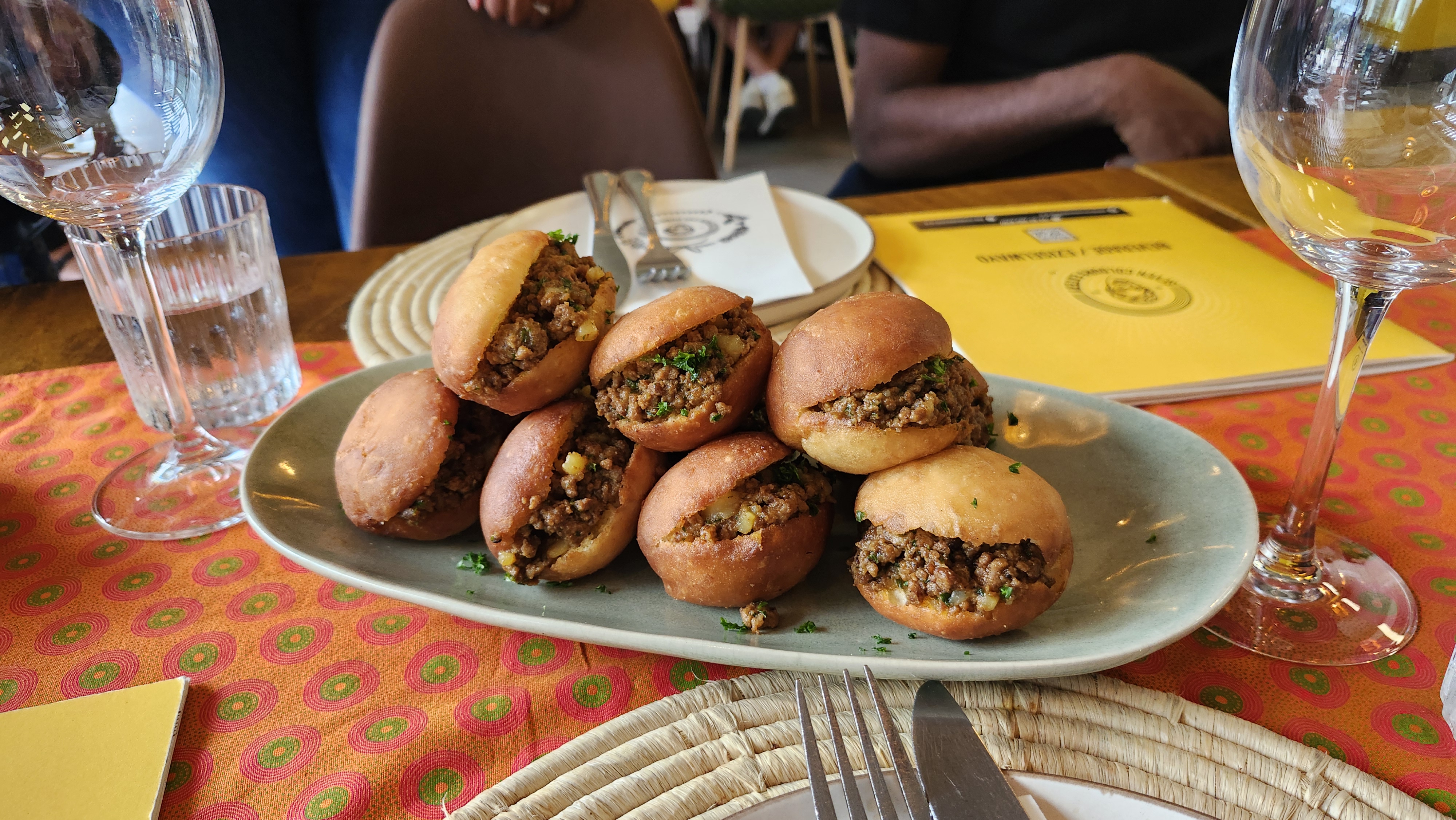
 Beef magwinya with herb seasoning served at the Seven Colours Eatery at the V&A Waterfront in Cape Town. (Photo: Naomi Campbell)
 Playful colours on a plate welcome curious palates at the Seven Colours Eatery in the heart of Battery Park at the V&A Waterfront in Cape Town. The restaurant hosts a vibrant array of traditional South African dishes for locals and tourists to experience a taste of cultural cuisine.
“Seven colours” is a nickname or reference to meals cooked for friends or family on Sundays or for special events, a custom in South African households.
Prepared and served for those gathering around the dinner table, it is a true representation of the “Rainbow Nation” with a range of red beetroot, yellow rice, multicoloured vegetables and even brown rice as the starch.
Various meat dishes including mince are also placed on the single plate, creating a special dining experience that celebrates curiosity and culture.
The Founders Without Borders cohort, which included founder Laurenne Mvete and students Walter Heiser, Tahirah Abdul-Qadir and Olivia Simons, along with TGIFood editor Tony Jackman and myself, travelled to Cape Town after visiting the Peninsula School Feeding Association in Philippi. We went not just for lunch, but to sample South Africa’s rich flavours and culture.
While the morning was dedicated to learning about meals that matter, lunch was for tasting and exploring a new cuisine for Heiser, Abdul-Qadir and Simons, who were visiting Cape Town for the first time.
Mvete, on the other hand, is not only a second-time traveller to Cape Town like myself, but she dined at the Seven Colours Eatery when she first visited the city.
I had the opportunity to try several traditional South African dishes and street food during the summer, from chakalaka and pap to bunny chow.
/file/attachments/2987/OutsideoftheSevenColoursEaterylocatedattheVAWaterfrontinCapeTownPhotoNaomiCampbell_436051.jpg "The Seven Colours Eatery at the V&A Waterfront in Cape Town. (Photo: Naomi Campbell)")
Regardless of our different culinary journeys and previous exposure to South African cuisine, the six of us sat at the centre table in the restaurant “tucked away” in the Canal District.
Neatly arranged on the table were white plates, utensils, cups and menus on an orange table runner. Woven baskets on the wall pay homage to African decor.
It was Tuesday and the options of the day included two staple dishes to choose from – ujeqe, which is steamed bun, and turmeric rice (fluffy basmati rice with a turmeric fragrance). The protein options included uMleqwa, also known as hardbody chicken cooked in a traditional Xhosa style which can take up to three hours, and isityu senkomo, a beef potjie which is a fall-off-the-bone beef stew, slowly cooked in a cast-iron pot.
All meals came with sides – medium-spiced bean chakalaka, crunchy coleslaw, savoury spinach using Swiss chard with whole-grain mustard, onions and peppers, and traditional pickled beetroot with a sweet and tangy kick.
/file/attachments/2987/chefsevencolours_713488.jpeg "Chef Nolu Dube-Cele explains the menu at her restaurant in the Waterfront’s Canal District. (Photo: Tony Jackman)")
As a foodie and an American food reporter taken graciously under Tony’s wing, it isn’t the fine dining experiences that make covering food compelling, it is the story behind the meal.
For our table, we received not only a set menu with dishes like magwinya, vetkoek and coleslaw, we were greeted by the culinary visionary behind the plates to learn more about the restaurant before the meals were placed before us.
The concept of food “overflowing from the same plate” is the essence of chef Nolu Dube-Cele’s restaurant. Where flavour and colour intersect, diners have the opportunity to try “a true taste of Mzansi magic that’ll transport you straight to those family gatherings we all treasure”.
Born in the Eastern Cape in a village called Tsengiwe, Dube-Cele, also known as Chef Nolu, wants diners to experience the comforting meals she enjoyed as a child.
“It is about celebrating Nolukhanyo. I am Xhosa, I grew up in the Eastern Cape, I’ve travelled, I love food. I love drinks and of course I love my country,” she said.
She studied hospitality management at the Cape Peninsula University of Technology in Cape Town and gained international cooking experience in the UK and the US. Upon her return, Chef Nolu brought her expertise to luxury boutique hotels.
Seven Colours curates a blend of soul food, community and home for tourists and locals to enjoy.
“Take off your jacket and relax because you are at home. If I had a bigger house, it (Seven Colours Eatery) would be at home,” she says jokingly.
Positioned at the V&A Waterfront, the restaurant is not only making a name for itself in a global market, but creating opportunities for local success and collaboration among South African businesses.
“I decided in my restaurant I will celebrate brands that represent this country and that tell of my story as a South African” said Chef Nolu.
Black- and female-owned wine brands are displayed and offered on the menu, such as HER Wines led by South African women including team leader Praisy Dlamini, and Tolokazi, created by Apiwe Nxusani-Mawele, the first Black-owned female brewer, who uses a blend of sorghum and rooibos in her products.
/file/attachments/2987/image00002_573040.jpeg "Chef Nolu introduces beverage brands she supports. (Photo: Tony Jackman)")
Chef Nolu founded the Seven Colours Eatery in 2016, originally as a home-based catering service that gained traction in markets and even private events across Cape Town. Six years later, the restaurant opened to the public and has become a feast for foodies and a favourite among locals.
At the Cape Town Street Food Festival, Chef Nolu won “Best Smelling Dish” for her tshisanyama sosaties, smoked and spicy grilled chicken and beef mix. Her restaurant also won the award for Best in Gastronomy Tourism for Cultural Dining.
Before Chef Nolu concluded her heritage story through a culinary lens, she emphasised not only the purpose of the seven colours plate, but the diversity of the meal that even accommodates different dietary restrictions, from pescatarians to plant-based options such as pap and indigenous grains like amazimba (sorghum).
“It is called the seven colours plate. They cook it mostly on a Sunday in our community where they choose a staple dish like rice and then there is a meat dish which is like a grilled chicken, could be like a stew, could be a braai, and then it gets to vegetables and salads, all in one plate,” she said.
/file/attachments/2987/HardbodychickenuMleqwastewservedatSevenColoursEateryattheVAWaterfrontinCapeTownPhotoNaomiCampbell_713080.jpg "Hardbody chicken (uMleqwa) served at the Seven Colours Eatery. (Photo: Naomi Campbell)")
After being filled with inspiration, it was time for tasting. The first dish to arrive was an array of magwinya, a range of mincemeat, beef and chakalaka. The golden brown fat cakes were fried to perfection and stuffed with a plant-based protein filling.
Mvete shared her thoughts on the beef magwinya.
“It really brought me back to my African roots. In a sense it tastes like beignet or maybe other African countries call it puff puff, but it’s like a beignet with ground beef and meat inside, which is so good,” she said, a reminder of how similar the diaspora truly is.
Simons tried magwinya for the first time and immediately thought of an American fast food go-to – a burger:
“This is the first time that I ever tried it and the way I described it, it is kind of like a thicker doughnut dough. If we are going to compare it to American food it’s like eating a burger, but there is ground meat inside and it is really flavourful and delicious.”
/file/attachments/2987/CreamybakedmacaroniandcheesewithherbflakesservedattheSevenColoursEateryattheVAWaterfrontinCapeTownPhotoNaomiCampbell_118688.jpg "Another kind of mac and cheese, made with samp and beans. (Photo: Naomi Campbell)")
Next came the anticipated seven colours course samples – baked and creamy macaroni cheese with sprinkled herbs, umngqusho (samp and beans) made with maize and sugary beans that was an all-you-can-eat comfort treat, a chilled coleslaw served with more green herbs and sliced radish, chakalaka, a table favourite with its tomato base, carrots, onions, peppers and beans, an iron-rich beetroot salad that had both a vinegar and sweet undertone, beef stew slow-cooked with potatoes, baby marrow, tomatoes and carrots mixed in gravy, hardbody (chicken) topped with green herbs, and braai-style skewers with grilled beef cubes seasoned with onions and peppers.
With the variety before us, each of us dished our own plates and passed around the protein, starch and salads, sampling the seven colours cuisine to our own liking, just how Chef Nolu intended.
/file/attachments/2987/SevenColoursEaterysidedishesincludingbeetrootsaladchakalakaandbeansandbeefstewPhotoNaomiCampbell_437216.jpg "Seven Colours Eatery side-dishes include beetroot salad, chakalaka and beans and beef stew. (Photo: Naomi Campbell)")
“When they (locals) think seven colours, they think rice, but I decided my seven colours place will be multicultural. We do it family style, that’s how we do the plate. You get to serve each other, you get to share the food and as the food is coming out we will tell you what the dishes are,” said Chef Nolu.
The dessert concludes the Seven Colours Eatery experience and diners can select from the malva pudding, melktert and even Peppermint Crisp tart.
Our table received a creamy custard-like pudding with cinnamon sprinkled on top, with a sliced strawberry on the rim of the cup.
As we finalised the bill and waited for our Uber to arrive, six different cultures at the table continued to converse and enjoyed the last bits of our sweet treat to hold us until dinner.
“I always say you can forget all of the meals of the dishes and all of the stories, but never forget about that Seven colours concept of unity in our diversity,” said Chef Nolu. DM