



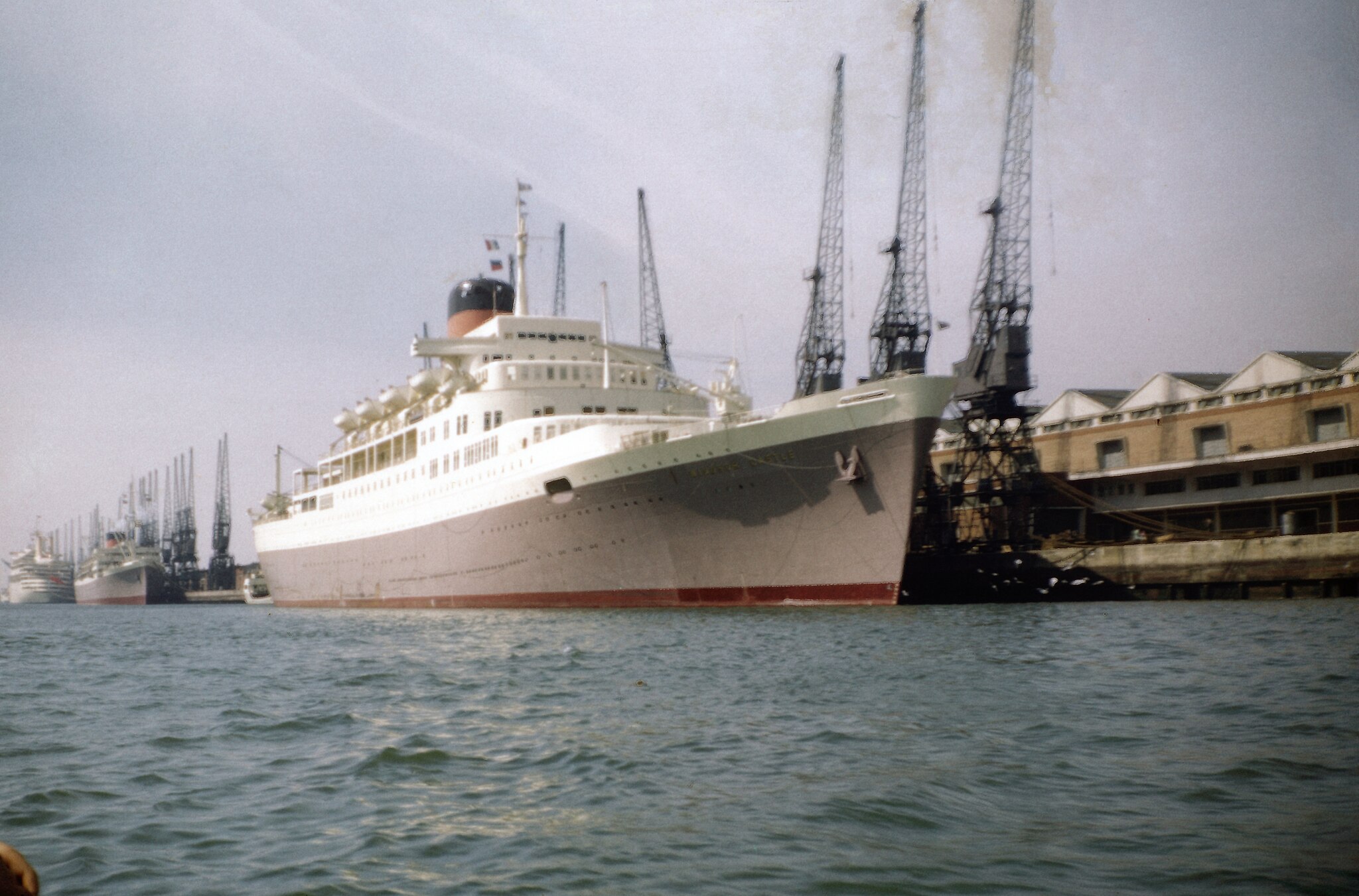
 Windsor Castle at berth in Cape Town docks, 1970s. (Photo: foundin_a_attic on Wikimedia Commons)
 Sitting on the dock of Table Bay in 1970, the lost boy tried to imagine his future. It was hard to see anything through the mist of fear and helplessness. The lyrics and Otis Redding’s caress of a voice would filter through his mind while he strolled on the dockside, brine in his nostrils and his inner world flooded with insecurities and questions.
I always identified with Redding’s song, Sitting on the Dock of the Bay, which has proven timeless. I knew it even then, as a 15-year-old bunking school interminably. Sitting in the café at A berth with Windsor Castle at moor, sipping a Coke bought with my school pocket money, the crew in their white uniforms chattering at the other tables. The school I didn’t go to much.
The boy was always a thinker, an observer, even then. And he’d think…
Looks like nothing’s gonna change, everything still remains the same…
Even if he would argue now that “still” is superfluous there.
The kid eventually went back to school and, in time, defeated his demons. He went on to a long career in newspapers from the Cape Times and Cape Argus to, now, Daily Maverick. Along the way he wrote some plays and books. And now he’s arrived back in the Mother City for the fourth time since his family first arrived there in July 1969. It’s become home again.
And I’m in town. We park in that tucked-away spot in Gardens where those in the know park their cars free all day, and walk down Government Avenue to work; back again at the end of the day. I’m not alone: at my side is our own Naomi Campbell, back in Cape Town briefly from Jersey City on a founders’ tour with other students and to write a story or three for TGIFood. That’s a bonus.
I tell her I want to show her where we used to work, walk, shop; what this building is and that one. This was here, that was there, there used to be, once there was… look, that’s the National Gallery, National Museum, National Library. That’s Rhodes, some love him and others hate him.
See there, that’s where Tutu hung out… there’s Parliament, that’s the cathedral; look, there’s the spot where my dad took the photo of me and my older brother and sister, I’m two, Phillip’s six and about to die. I’m holding a little brown bag of peanuts to feed the squirrels. Look, there’s a squirrel now…
/file/dailymaverick/wp-content/uploads/2025/11/trio-jackman.jpg "Phillip, Tony and Pat Jackman in the Company’s Garden, January 1958. Phillip was to die in a bicycle accident two months later. (Photo: Cyril Jackman)")
But all of that lies ahead. We turn up the drive of the Mount Nelson Hotel and stroll inside. Past the hushed-tones reception where the staff are better dressed than some of the guests. (Pointing:) I lurked here in May 1980, assigned to try to spot John Lennon and get an interview. I didn’t get it, never found him, and before the year was out he’d be shot dead on a Manhattan sidewalk. I’d find the spot in 2013, and weep at the memorial to the slain Beatle in the park opposite the Dakota building.
I aim for the space in the Nellie that once was a lounge, then became the Cape Colony restaurant when a British artist was flown out to paint a colonial-era trompe l’oeil of the Constantiaberg on a large expanse of wall. Tell Naomi how we had lunch at that table with the artist, and Nick Seewer (the GM of the day), and Graham Viney, who had just renovated the Nellie’s sumptuous rooms and public spaces. Now it’s just had another renovation, three decades later. Still as grand and lovely as ever.
I tell her the space became the Planet restaurant and is now Amura, and it looks beautiful, if unrecognisable from its former guises. I’ll sneak in for dinner some time, I tell her.
She’d asked me earlier, before we opened the door to Amura: are you sure we can go in here? I thought about this — and realised that I feel a sort of ownership of the Nellie, in the way that some places in one’s own city are a part of us; cornerstones of our loves. “I give us permission,” I said, and we sashayed in.
/file/attachments/2987/nellie_418970.jpg "Naomi's pictures of the Nellie including Amura restaurant, centre. (Photos: Naomi Campbell)")
That was the Helmsley Hotel (I point to the pink Nellie suites); I tell her there was a Thai restaurant called Sukhothai on the Hof Street corner in the Nineties at the start of the Asian restaurant explosion in the city. The precursor of the K-food phenomenon now spreading its tentacles throughout the planet in the wake of K-pop. And that there was a Korean restaurant in Three Anchor Bay once, with round tables that had a Lazy Susan in the middle containing a little braai. You cooked your own dinner.
Back on Orange Street, I walk us into the grounds of the Labia. Isn’t it wonderful the way the courtyard has been greened up and prettified. It’s a joy to be in. In the foyer, I see the gorgeous art deco details with the fresh eyes of a young American.
The corner of Rheede Street was home for years to the Buccaneer steakhouse, once an award-winner; now it’s been Nonna Lina restaurant for a generation and I wonder: does anyone remember? Nearby is the site of the second iteration of Sukhothai after it moved from Orange Street, which became premises to a handful of short-lived eateries before Societi occupied it for a decade or more.
/file/dailymaverick/wp-content/uploads/2022/08/HEADER-ED_335679.jpeg "The Labia Theatre, Gardens, Cape Town. (Image: Gallo Images / ER Lombard)")
Walking up Rheede Street, the space where Chef Pon once had his Sawadee Thai, is now part of the Kloof Street Hotel. Pon had been brought out from Thailand by restaurateur Larry Chung. After Sukhothai closed he and Chung had opened Chef Pon’s Asian Kitchen near Breda Street, and later Pon had gone his own way. Though he and his family ultimately returned to Thailand, his name lingers elsewhere in Cape Town’s eating life. Does anybody know where Larry is?
Chef Pon introduced me to salt and pepper squid. Salt and pepper anything really. Prawns, calamari. Even lamb gets that simple treatment sometimes in my kitchen. It gets seasoned, but nothing more, and the essential flavours you are eating are allowed to shine.
After a meeting at Daily Maverick’s Kloof Street offices, we walk down Kloof and into Queen Victoria, past the corner premises where the Kaapse Tafel restaurant flew the flag for authentic Cape cuisine for seemingly a lifetime.
Even a google search with its name and street address comes up with nought. It seems the algorithms are not finding the places that once were but are now gone. The way to address this is by people who own the old menus and photographs of buildings or premises putting them online with appropriate information. If that’s you, please get to it. If you know sources of the old Cape restaurants please let me know.
We enter the Company’s Garden in the forecourt of the South African Museum and Planetarium, and stroll through the Rose Garden (which seems less of itself) towards the Gardens tea room, which is exactly as it was but now called the Company’s Garden Restaurant. They could at least fix the slate paving outside. It appears untouched other than by boots in decades.
/file/attachments/2987/toasted_398061.jpg "Our toasted sandwiches at the Gardens tea room. (Photo: Naomi Campbell)")
We sit down for toasted sandwiches, coffee and water, which Naomi pays for. I scan the menu and the prices are eye-widening. Aimed at tourists, no doubt. Fair enough, in a sense, but if you’re charging those prices you need to fix the joint up a bit. (Many dishes are priced well over R200, R400-odd for seafood pasta.) I’m embarrassed that she’s picked up the bill but she seems unfazed by the prices. I guess that’s the cynical calculation of those who set their restaurant prices for the tourist market.
We stroll out of the Company’s Garden through the Arch that celebrates our beloved Archbishop Tutu, always the greatest of all Capetonians for me, and I point to the small parking lot in the grounds of St George’s Cathedral where we parked the ageing yellow Toyota Corolla with its rust spots before going to work at Newspaper House for the day. Sometimes, the Arch would be nearby and throw us a smiling wave. It felt like the city itself was smiling at us. I’d stand with my back to the car hoping he wouldn’t see the rust spots.
I show her the entrance to The Crypt, a licensed jazz club in the confines of a city cathedral where you can get drunk on music and liquor with the approval of the church elders.
Turning into St George’s Mall, I explain that it’s a pedestrian mall, unlike a shopping mall, and I notice that Doppio Zero has gone on its corner just before Newspaper House, in the premises where Clive Keegan once lurked in the former Fairbairn House before he went into local politics and became city mayor. I worked with his wife, later mayoress, Marilyn Keegan, and we were invited in their early tenure to a mayoral dinner where Clive gave one of his characteristically rich speeches.
/file/attachments/2987/calamari-603119_12801_687236.jpg "(Generic fried calamari image by Pixel1 from Pixabay)")
Clive loved to hang out with us journos at the Café Royal in Church Street and everybody loved it when he spewed forth his lush prose with a raised chin and perfectly enunciated tones. There was no one in town quite like Clive Keegan. We’d eat a plate of fried calamari rings and chips for less than R1, downed with a bottle of vin de plonk for even less. Then, one night, the place burnt down and an era was gone.
In the next street, Burg, were the previous premises of The Cape Times where I’d begun my career in September 1976 as George Young’s cabin boy, as colleagues liked to call me. Shipping Editor George had taken me on precisely because I used to hang out in the harbour as a kid, playing truant in the docks, and that’s how the stupid, lost boy got into newspapers.
And the boy is here now, almost 50 years later, with his American friend in tow. And there’s Newspaper House, I tell her, where we worked for decades, and this was Marks Coffee House, and that cool Asian spot, Haiku, was the Talk of the Town, which became our new press club haunt after the fire. And Bukhara next door, part of the same business and its predecessor, and I wonder if Sabi Sabharwal is still lurking around here.
And I’m wondering who remembers Talk of the Town, and Nino’s, the Italian place that was in the same spot before it, where the eccentric Nino bottled garlic oil so pungent it could kill a vampire at 10 paces. Nino taught me how to make aglio e olio e peperoncino using that very oil.
/file/attachments/2987/newshouse_509859.jpg "Newspaper House in St George’s Mall. A portal to memories. The old Cape Times premises were a block away in Burg Street. (Photo: Naomi Campbell)")
And the ghost of colleagues past, everywhere. Roger Williams, the Cape Times Chief Reporter who named the Golden Acre when it was an empty plot. Anne Taylor, who I met on my first day at The Cape Times all those Septembers ago and who introduced me to the woman who would be my wife and who is still our friend, today. Tony Heard walking out of the Burg Street premises, taken away by police after publishing his own interview with Oliver Tambo. Marianne Thamm behind a protest poster nearby.
Here’s Molly Green, who was a colleague and friend for life until she left us in the early 2000s, suddenly, and Ronnie Morris, the Foodie’s Wife’s comrade-in-arms when they were both union organisers. Di Cassere herself, staunch in her bold work on behalf of us all as Vice-President of the national journalists’ union. And Maureen (Mo) Pithey, friend and brilliant tongue-in-cheek columnist. Steve (the Honourable Lord) Wrottesley, oddball crime reporter and good sport.
And my mind sees Yazeed Fakier, one of my dearest friends (happily, we’re planning to get together soon). I picture Yaz and I at my mom’s flat in Three Anchor Bay one day in the late 70s when I said, hey, let’s go see a movie in town, and he blanched and looked at me, and I looked at him and the penny dropped. One of us was white, one brown, and we could not see a movie together. Petty apartheid only disappeared much later. So we played Living on the Faultline instead. He still says today that I introduced him to the Doobie Brothers.
And here’s mutual colleague Fiona Chisholm, who we learnt has died only this week, a veteran arts editor after having been a popular daily columnist. I remember the day Arts Editor Brian Barrow walked over to where I was subbing alongside Molly and Margie Jacobson and said to Molly, would you like to review movies? And the moment Tony Heard approached Fiona and asked her to be arts editor. And the long careers that followed.
And George Young, of course, who picked me up at the start of one working day at Three Anchor Bay in his little green Ford Escort and pointed to two tankers and a tug near Robben Island.
“See those? They’ve come adrift. They’ll be on the rocks before noon.”
They were Antipolis and Romelia. Their rusted remains still hug the rocky seabed along the Twelve Apostles, as forgotten as a thousand restaurants, hundreds of colleagues, and generations of readers and diners past.
And now, here we are. Cape Town again. DM