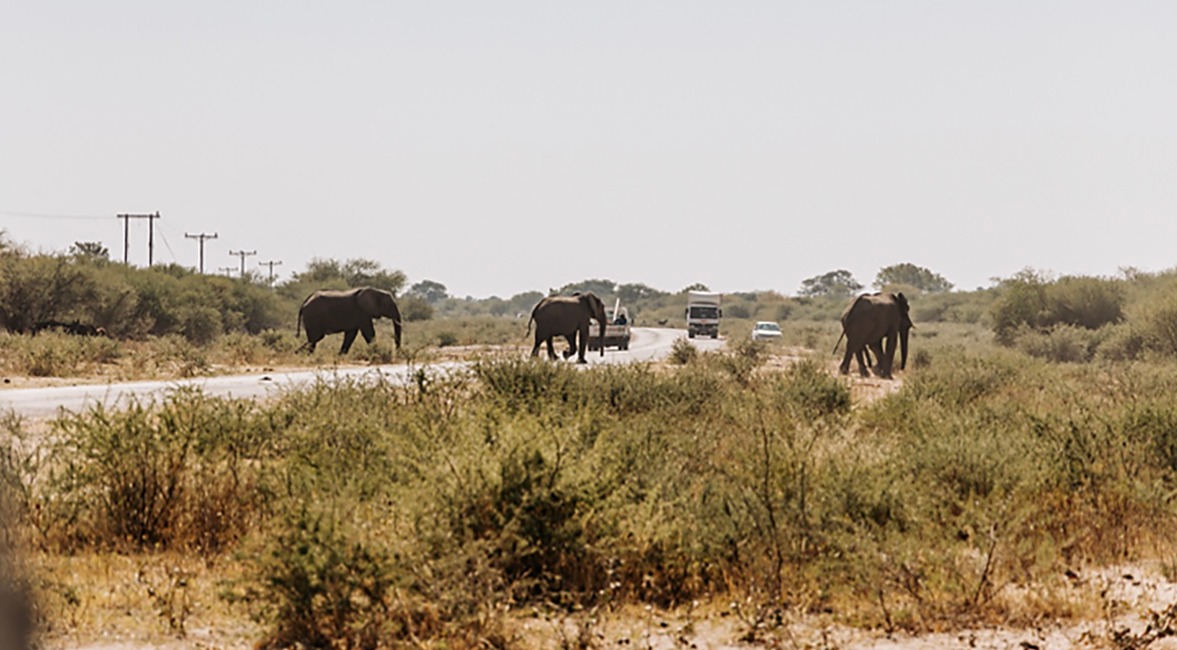
 Elephants cross the road outside of Gumare, west of the Okavango Delta. These elephants had broken a water pipe, that had resulted in a standing dam, and were crossing the main road to get water. (Photo: The Origins Foundation)
 In the past several weeks, there have been many discussions around elephants in Botswana.
The first discussion point was the Elephant Without Borders (EWB) report by Scott Schlossberg and Mike Chase, in which a new population modelling exercise was undertaken that considered new elements of density dependence and external variables of drought and poaching to provide a new suggested quota limit for the hunting of elephants.
That report was followed by several articles by Dr Adam Cruise and Don Pinnock in Daily Maverick that suggest current hunting quotas in Botswana will “turn a conservation success story into a global controversy” and higher hunting quotas are “bad news for the future of Botswana’s elephant population”.
When one examines the report on the surface, everything makes sense. The numbers make sense. The ideas make sense, hunting at current levels, plus poaching of big bulls and drought, will reduce the numbers of big elephants in the future.
I think if you asked the general hunting fraternity: should we be limiting the take of older, big bulls in the population? You’d be surprised when most would agree with that notion. However, that answer would be quickly followed by an additional belief that elephants in Botswana should have their value increased – that would show the belief in the conservation success story, benefit the Botswana government, and most importantly, funnel more funds back to the communities interacting with elephants daily.
Seeing the bigger picture
The current Botswana elephant issue fits the idiom that you can’t see the forest through the trees. The forest in this analogy is the Botswana elephant population.
At 140,000, it’s the largest elephant population in the world. Additionally, there has been no scientific report, nor scientist, nor operator who believes Botswana has too few elephants; in fact, the opposite is true. Most would agree that there are probably too many elephants for the habitat currently available, given the growing human population in Botswana.
One only needs to look at the bombed-out landscape of Chobe to understand that there may be an elephant density problem.
With the largest elephant population in the world comes significant consequences for humans, communities, and increased human-elephant conflict. Increased human-elephant conflict has not been linked to hunting (as suggested by a recently dismissed court filing), but rather a factor of an increasing human and elephant population existing in the overlapping landscapes.
Given the human component of this issue, the driver of any action as it relates to elephants must come from the communities, and their voice must come first. So what is actually happening on the ground with regard to elephants in Botswana?
What does the data say?
In this world, words matter, and it’s important to ensure that when you’re articulating a point that everybody understands the difference between different terms. For example, the term “quota”.
Quota does not mean how many animals were killed. Quota is an allocation by a government for a specific species. More often than not, quotas are not filled by the offtake. Offtake is the actual animals taken from the quota.
For example, only 55% of the California black bears quota was filled in 2025, 27% success on Namibian leopards from 2016-2018 (with a high of 61%), Tanzania lions 40-75% 2024, depending on region, and so on. This same relationship holds true for elephants in Botswana as well.
The EWB report’s major conclusion is that there is a need for a reduction in hunting quota from 0.3% of the population (430) to 0.2% (280) of the population. This will ensure the sustainability of elephant bulls in the population, given the external variables of drought and poaching. This recommendation assumes 100% of the quota is fulfilled every year.
If the EWB concludes that a 0.2% quota would be sustainable, what is the current actual offtake of elephants on an annual basis? Since 2021, the current offtake percentage averages at 0.15%, well below the suggested sustainable quota by the EWB. The suggested conclusion of the EWB report is already happening and has been since 2021.
/file/attachments/orphans/Op-ed-Kroger-Botswana-elephants2_780664.jpg "Table from Schlossberg and Chase, EWB report showing quota vs take vs elephant populations in Botswana.")
Some will say, “but an increasing quota will result in increasing offtake”. The quota, since the hunting moratorium was lifted in 2021, has increased by 42% over the 1996-2013 hunting era. However, the offtake has decreased from an average of 0.16% between 1996-2013 to 0.15%, that is, higher quota, less offtake.
These statistics beg a very simplistic question: Do we actually have a dilemma based on matching the conclusions of the EWB report to the actual offtake data?
/file/attachments/orphans/Op-ed-Kroger-Botswana-elephants3_896485.jpg "Elephants on the Mababe depression in NG41. (Photo: The Origins Foundation)")
Do we have a dilemma? The answer is, no
Schlossberg and Chase state in their report, “As shown above, hunting quotas of 0.1-0.2% produce relatively large trophy sizes indefinitely in model populations, so long as drought and poaching are not too frequent.”
Regardless of modelling estimates and outcomes, the actual data, as outlined earlier, speaks volumes in that hunting is currently hitting the suggested targets of the EWB report. The data of offtake is currently between 0.1 and 0.2%, which suggests, based on the EWB’s conclusions, that at current levels there is no issue with elephant hunting in Botswana.
However, with an elephant population of around 140,000, the discussion shouldn’t be about the sustainability of large trophy elephants, but rather about the value of elephants writ large.
Value is what drives community tolerance of interactions with elephants.
How can we bring greater value? There is an opportunity in Botswana in this current elephant debate to morph elephant protocols, which would allow a class of elephant to be taken, that, based on the data, would not be of the old trophy class elephant bull in the population. Two factors go into this suggestion: 1) data, and 2) data.
Becoming better
If you examine the data of the proportion of quota being used before the ban and after the ban, some things are clear: the percentage take of the quota is decreasing – it has dropped 15% even though the elephant population on the landscape has purportedly increased by 10%, which could suggest that it’s harder to find those trophy-class bulls.
What’s unclear is, why? Is it due to hunting? Is it due to poaching pressure? Is it simply due to density-dependent factors like increased elephant-induced mortality (bulls killing other bulls in competition for resources)? Nobody can answer that. But why not use this data point as a tool to value these trophy bulls more?
Quota allocation could be manipulated so that there is only one trophy bull per assigned block, but demand a significant government fee on that bull (for example, a $75,000 trophy fee).
The other elephants on quota could be hunted under strict age-based protocols as expertly defined in the APNR of Kruger National Park, which evaluates an elephant in the 30-year class that will never get to a trophy-class category. Identify these elephants, place a smaller fee on these elephants, and increase the quota of this class.
This system could provide more value to all age classes of elephants, and will have several positive wins, including:
- Help maintain the sustainability of the elephant population;
- Increase the value of elephants for communities;
- Increase value for operators, outfitters;
- Create more revenue for the government; and
- Fit perfectly with the sustainability model of elephants suggested by the EWB.
Current elephant hunting in Botswana is not in crisis, is not a global controversy and is not bad news for its conservation; those are attention-grabbing headlines. The data from the field objectively denies this.
However, there is an opportunity right now, with all this discussion on the table, to improve the value of elephants so that there is a win-win for everyone involved. DM
Dr Robert (Robbie) Kröger is a restoration ecologist originally from South Africa, but now is based in the United States. His work through the nonprofit he started, The Origins Foundation, aims to showcase the true consequence, benefit, and impact of the sustainable use of wildlife globally.
/file/attachments/2986/2026-01-12_15-12-58_121311.png)