




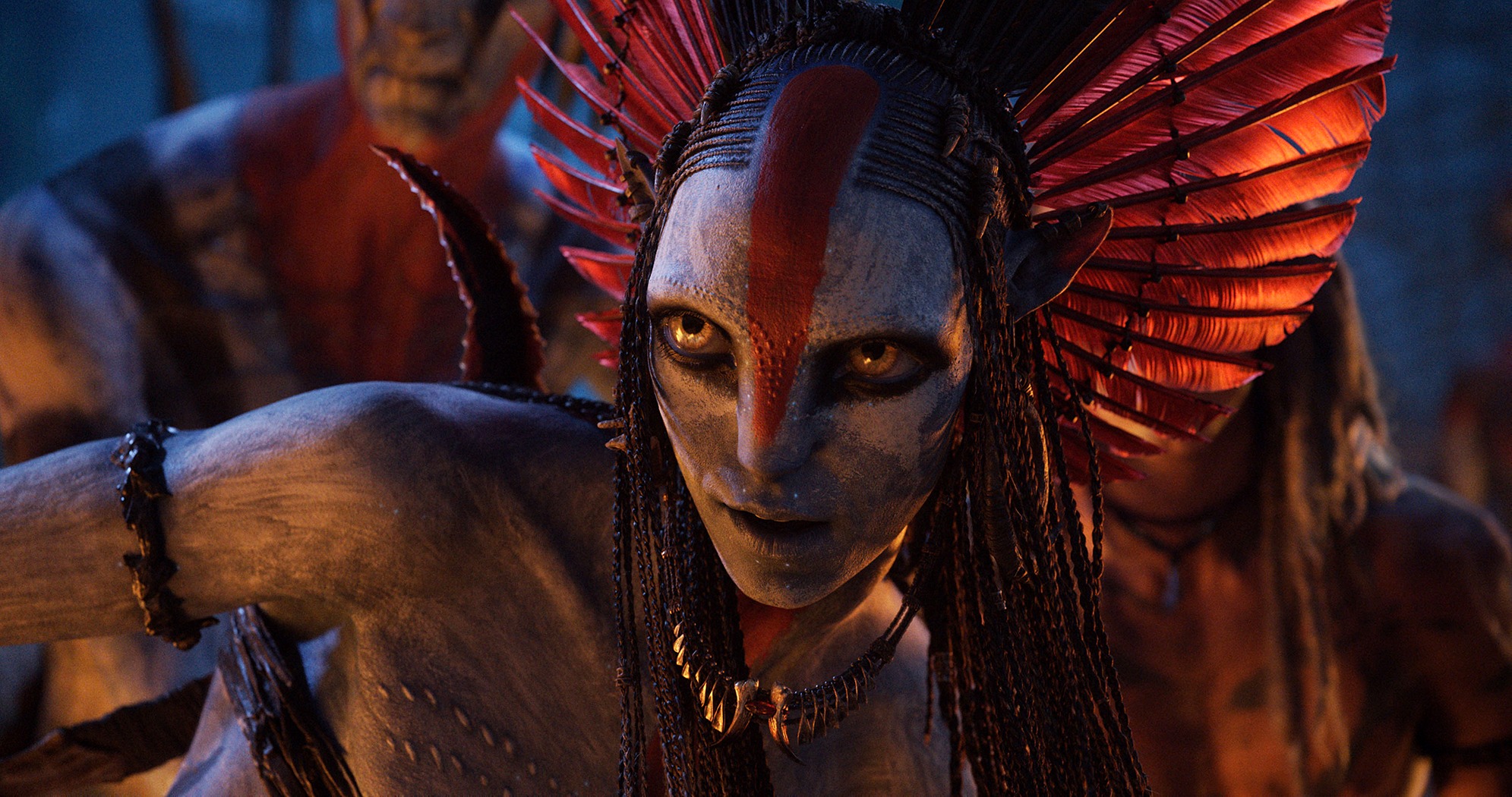
 Varang (Oona Chaplin) in Avatar: Fire and Ash. (Photo: 20th Century Studios)
 With Avatar: Fire and Ash still topping the box office, it seems likely that director James Cameron will have the commercial capital to take us back to the planet of Pandora at least one more time after this. And this writer could not be happier.
Although this blockbuster franchise’s latest bout of sci-fi cultural appropriation wasn't mind blowing, I find myself wanting more. Rather, my desire for more Avatar stems from the fact that this three-hour-plus behemoth ends on one of the clunkiest lines of dialogue in the entire series, and the 71-year-old Cameron is too important to cinema history for this to be the final discordant note on a story that has taken up so much of his life.
Despite living with aspects of this world in his head for four decades, Cameron’s Avatar films have always been a collection of tropes and archetypes. In the 2022’s Way of Water, the film was able to distract and dazzle with unprecedented visual effects (courtesy of 13 years’ worth of bleeding-edge filmmaking development by Cameron since the first Avatar in 2009). It also introduced us to an entirely new ecology of Pandora’s flora and fauna courtesy of the “Water People” clan, pushing the creative world-building envelope further. With Fire and Ash, there’s no such evolution.
The visual quality continues to tower above its peers as watching this in IMAX 3D with a high frame rate is a seriously jaw-dropping experience (high frame rate is a very contentious technology, but in the ultra-colourful sci-fi fantasy world of Avatar, it works).
However, the lack of screenwriting progress is egregious when you realise that Cameron and co-writers Rick Jaffa and Amanda Silver haven’t just pulled from established motifs yet again, they have also copied their own homework this time. It’s not so much an original screenplay as it is sections of Way of Water’s Wikipedia page printed out and held together with tape, with new scribbled notes slotted in between them.
The Sully family, led by ex-human-marine-turned-alien-Na’vi-warrior Jake Sully (Sam Worthington) and his wife Neytiri (Zoe Saldaña), are still on shaky ground with the aquatic Metkayina clan that is hiding them from the human-run Resources Development Administration (RDA).
Hard-nosed reborn RDA military man Colonel Miles Quaritch (Stephen Lang) is still trying to hunt down the Sullys, while very reluctantly trying to bond with his estranged human son Spider (Jack Champion). Jake and Neytiri’s adoptive daughter Kiri (Sigourney Weaver) is still trying to unravel the mysteries of her birth and powers, while their son Lo’Ak (Britain Dalton) is still getting into trouble as he tries to find his place in life.
These and several other plot points are basically repeats of what came before, with just a few added wrinkles. The death of the eldest Sully sibling in the previous film has left Neytiri in rageful mourning, unfairly directing her anger at Spider as the only human target. Meanwhile, despite Neytiri obviously not wanting him around, Spider is desperate to fit in with the Na’vi.
When the family decide to take him back to live with their human scientist compatriots, they run into trouble courtesy of a raid by the hyper-aggressive Mangkwan clan, the “Ash People”, led by the fiery Varang (Oona Chaplin). This brutal attack results in a surprising development for Spider which in turn makes him incredibly valuable to the RDA, sparking a whole new series of clashes.
/file/attachments/orphans/NeytiriZoeSaldaaandJakeSullySamWorthingtonin20thCenturyStudiosAvatarFireandAsh_20thCenturyStudios_325520.jpg "Neytiri (Zoe Saldaña) and Jake Sully (Sam Worthington) in Avatar: Fire and Ash. (Photo: 20th Century Studios)")
/file/attachments/orphans/Ascenefrom20thCenturyStudiosAvatarFireandAsh_20thCenturyStudios_160901.jpg "A scene from Avatar: Fire and Ash. (Photo: 20th Century Studios)")
Seeing as they get mentioned right there in the title, if you expect the introduction of the Ash clan to be a big game changer here, you will be disappointed. Much like how the Water People were just Polynesian stand-ins, so too the Ash People are just Cameron’s way of transplanting the real-world Baining fire dancers of Papua New Guinea into a sci-fi setting. But outside of a smattering of scenes showing the Mangkwan living in the ashy slopes of a volcano, their culture is barely explored.
To be fair, Chaplin’s Varang, finely walking the line between sultry and psychotic, still makes for a magnetic villain despite this lack of development. With her violent rejection of the goddess Eywa due to past trauma, she’s almost a dark mirror image of the pious Neytiri, who Saldaña once again brings to life powerfully.
The two of them are definitely the thespian standouts here (the rest of the cast are actually all really solid, with one exception), and exploring their link further would have been an interesting angle if Cameron hadn’t just turned Varang and the rest of the Mangkwan people into Quaritch’s hired thugs.
Screen time that should have gone to them is instead often devoted to Spider who gets elevated into almost lead status here. Just a pity that Champion is not quite up to the task. The level of acting maturity the young actor possesses was fine when he was just a second-string character in the previous film. Here he’s simply in over his head. What doesn’t help is that Spider gets the bulk of the film’s hokey dialogue (including an entire bit about how much he needs to pee right as the film gets to one of its most dramatic moments).
/file/attachments/orphans/JakeSullySamWorthingtonin20thCenturyStudiosAvatarFireandAsh_20thCenturyStudios_113624.jpg "Jake Sully (Sam Worthington) Avatar: Fire and Ash. (Photo: 20th Century Studios)")
It’s not all Spider all the time though, as several other important narrative threads also get tackled. It feels that with Cameron’s initial uncertainty about the franchise’s future, he shoehorned in as many of these plot lines as possible, resulting in that bladder-destroying 197-minute runtime. But credit where its due, because Fire and Ash is never boring.
There is a noticeable familiarity in action beats due to no new variety in terms of setting or creatures on Pandora, but Cameron always keeps things moving and interesting. He’s just innately too good at making crowd-pleasing blockbusters to fully drop the ball here. Nothing quite reaches the bad-ass peak of a rampaging Neytiri from Way of Water, but it’s still very entertaining. And as mentioned before, it always looks phenomenal.
That combo of eye-popping visuals and fun action will more often than not be plenty for general audiences to call Avatar: Fire and Ash a good time. Had more effort been spent on developing the Ash People into the game-changing antagonists Cameron hinted at in the past – not to mention another much-needed pass on the dialogue – this could have been a great time. DM
Avatar: Fire and Ash is playing in cinemas. This review was first published on Pfangirl.