
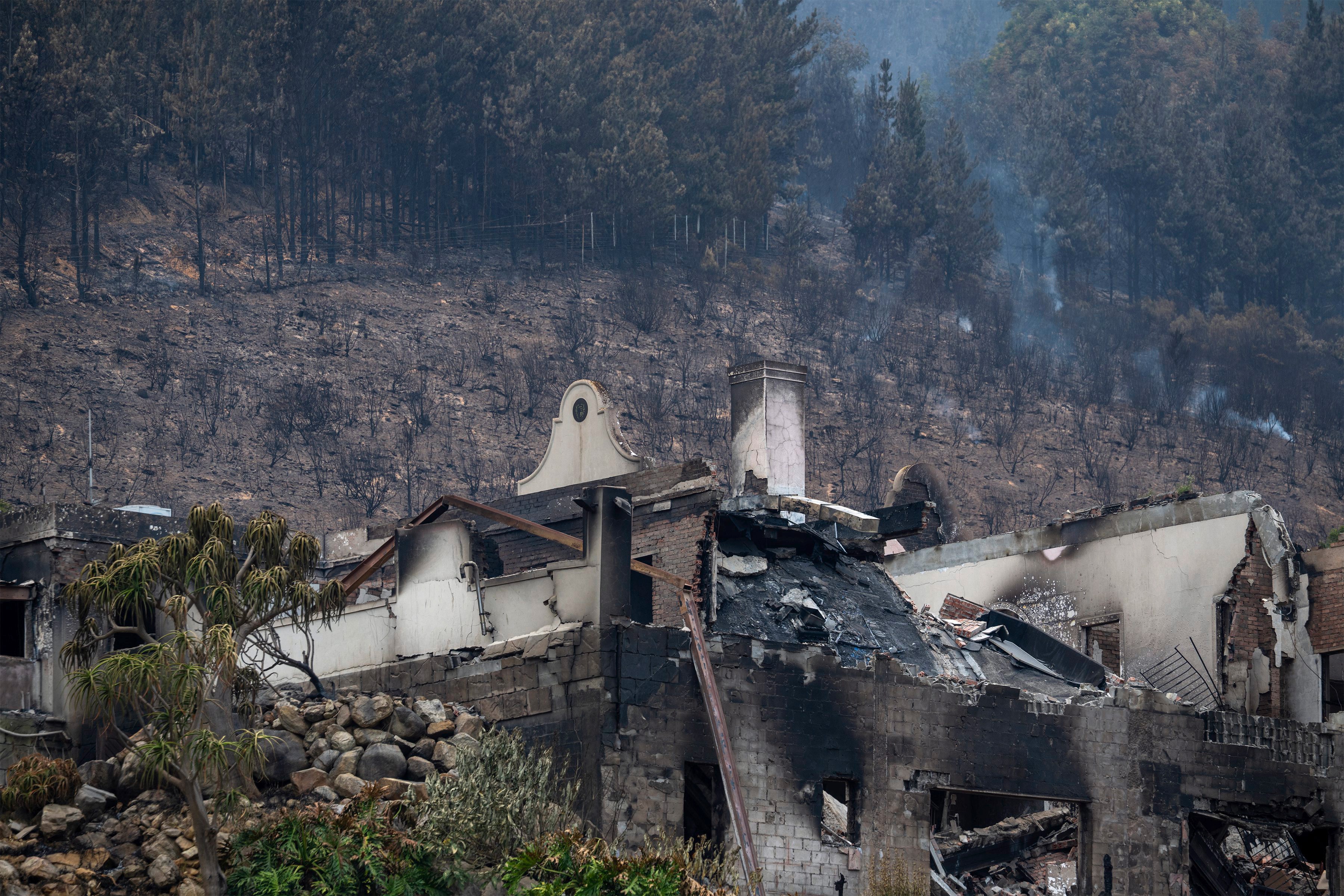
 The Chamonix wine farm mansion in Franschhoek was severely damaged by fire on 12 January 2026. (Photo: Gallo Images / Die Burger / Jaco Marais)
 The Western Cape has approached the national government for a disaster declaration due to water shortages and ongoing fires. This doesn’t mean the continued shortages and fires are over – the weather service has warned of another winter season of below-average rainfall.
On Thursday, 22 January, Western Cape Premier Alan Winde announced he had sent two letters to Minister of Cooperative Governance and Traditional Affairs Velenkosini Hlabisa. Winde applied for two separate state of disaster declarations over water shortages and fires in the province.
As Winde spoke, firefighting operations continued in the mountains above Franschhoek.
According to the Cape Winelands District Municipality, multiple flare-ups occurred on Wednesday afternoon, which caused several fire lines to spread rapidly up mountain slopes.
No structures were damaged and no injuries were reported. The Franschhoek Pass was opened, confirmed the municipality.
Thursday’s briefing at the Provincial Disaster Management Centre came after a provincial cabinet meeting on Wednesday, which agreed to write to Hlabisa to apply for the declaration.
Winde told journalists: “We’ve had a few years of wet seasons. The wet seasons create massive growth and fire load, and now with the dryness in the system, that’s why we have these fires, but that’s also why some of our towns are under serious pressure from a water usage point of view.”
The disaster declaration request was made by Local Government MEC Anton Bredell, who told Daily Maverick last week that the province had already blown its budget for aerial firefighting support.
Read more: ‘It’s going to be difficult’ — Anton Bredell on Western Cape water stress and wildfires
The disaster declaration would allow the provincial government to unlock and access emergency funding.
/file/attachments/orphans/Mark_Taylor_AkkerkloofDam_DSC_3988_008_990376.jpg "Knysna's Akkerkloof Dam. (Photo: Mark Taylor)")
At this stage, there is no specific budget. The costs would be put towards the first hour of helicopter hires when it came to the fire-related disaster declaration. When it came to water, this disaster declaration would help municipalities such as Knysna, which has been battling a severe water shortage.
The Department of Water and Sanitation said on 19 January that there would be an emergency relief allocation of R20-million “from reprioritised water services infrastructure grants to Knysna Municipality, together with the provision of technical capacity, aimed at developing groundwater resources to alleviate the current strain placed on available surface water resources in the Knysna Water Supply System”.
When it came to fires, any disaster allocations would go towards the hiring of helicopters, as these assets were crucial within the first hours of a fire.
“We have already in the province exhausted R19-million just from the 1st of December till the 11th of January,” said Winde.
The initial budget? R16-million.
“Right now in the Franschhoek region, the local municipality as well as the district, all of their resources are going in there,” said Winde.
/file/attachments/orphans/Sune-disastermanagement_841590.jpg "From left, head of the Department of Local Government Graham Paulse, Premier Alan Winde, Local Government MEC Anton Bredell and Chief Director of the Western Cape Disaster Management and Fire/Rescue Services Colin Deiner conduct a media briefing on Thursday, 22 January, where they announced that the province would ask for a disaster classification for water shortages and ongoing fires. (Photo: Suné Payne, Daily Maverick)")
Water issues
In April 2025, Bredell warned of less-than-average rainfall predicted for the winter, which could affect water storage levels.
By December, Swellendam had less than 40 days of water left.
The Garden Route municipality of Knysna has less than 14 days of water left, due to years of mismanagement and lack of infrastructure.
According to presentations provided by the province, Knysna, Kannaland and Beaufort West are high-risk municipalities when it comes to water security.
Medium-risk water security municipalities are George, Bitou, Langeberg (Robertson and Bonnievale), Swellendam, Prince Albert, Matzikama and Cederberg.
In all these municipalities, vandalism and ageing infrastructure are a risk.
/file/attachments/orphans/sune-WesternCapedisastermanagementJPG_537624.jpg "Data displayed in the Western Cape Provincial Disaster Management Centre on Thursday, 22 January. (Photo: Suné Payne, Daily Maverick)")
Fires
On the devastating fires, Winde said: “Our first job is to make sure that we save lives That’s our first prerequisite or requirement and I mean, we’ve had a couple of firefighters hospitalised [for] smoke inhalation, we’ve had a lady who’s had to go, to a hospital to deal with some burns, but, luckily so far we’ve managed to make sure that no lives are lost.”
Western Cape Disaster Management and Fire/Rescue Services Chief Director Colin Diener said that since November 2025, 100,000ha had been burnt and 45 structures destroyed.
The busiest season historically, in 2015, saw more than 133,000ha burnt, said Diener.
He said the province had an earlier start to the wildfire season. Normally, fire season begins in early November and runs through April, but by late October, there were already reports of fires.
The Western Cape underwent an earlier start to its wildfire season in 2025. In November (the week of 10-17 November 2025), there were 632 vegetation fires. South African National Parks responded to 26 fires in the metro.
Winter 2026 predictions
Lebogang Makgati from the South African Weather Service told the briefing: “Into the next month, as indicated, we’re still seeing that … below-normal rainfall conditions continue to persist, and please note that the below-normal rainfall does not mean there won’t be any rain. We will experience some rain. There will still be isolated incidents of extreme rainfall events. However, on average, those conditions will remain below-normal rainfall, which of course poses a risk.” DM