



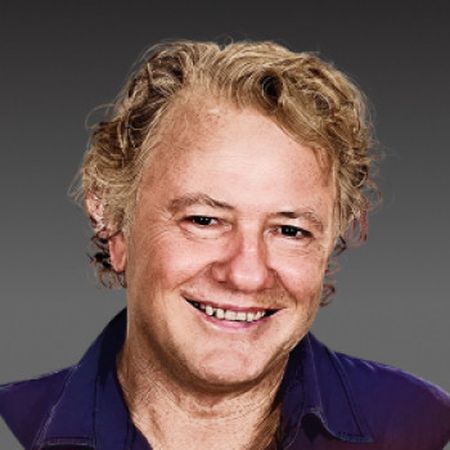
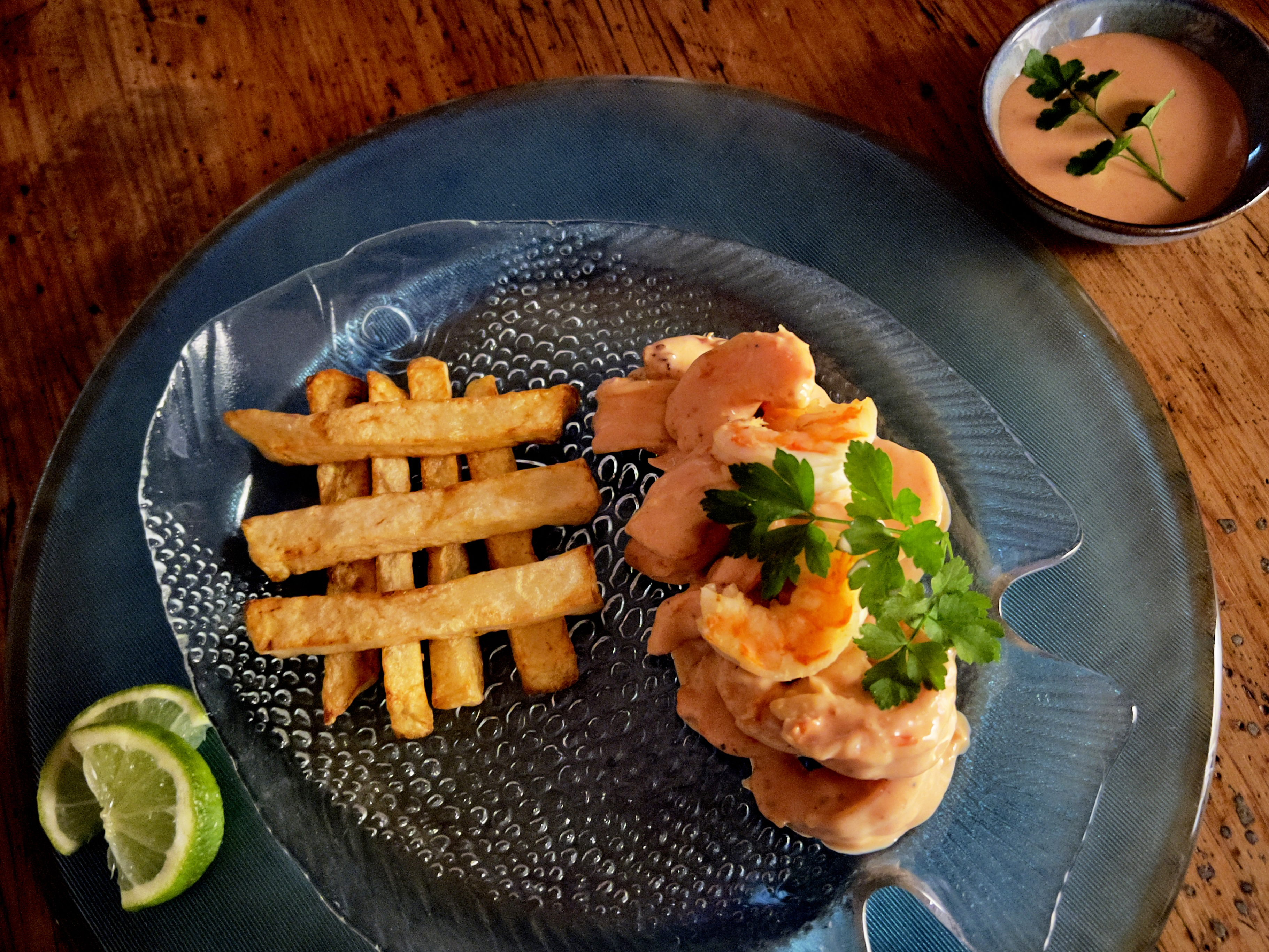
 Tony Jackman’s prawns in Marie Rose sauce, served with potato chips. (Photo: Tony Jackman)
 There’s a depth, a mysterious flavour somewhere between tang and the bitter end of umami, that a great Marie Rose sauce attains when made with brandy. Without it – i.e. when made with ketchup, mayo and only lemon – it will be nice. It will be okay. But it will lack something.
A dash of Worcestershire sauce will go part of the way to solving that; it has its own mysterious flavour that is famously hard to identify, it just is: it’s Worcestershire sauce, one of the world’s magic ingredients that we just accept needs to be in the cupboard at any time of your life. It will be useful again and again.
A Marie Rose sauce is similar, sort of, to a number of other sauces such as America’s “cocktail sauce”, and also their famous Thousand Island dressing. A cocktail sauce in the USA, also known as seafood sauce, is made chiefly of ketchup and horseradish, while a Thousand Island dressing, as explained by Wikipedia, is “based on mayonnaise that can include olive oil, lemon juice, orange juice, paprika, Worcestershire sauce, mustard, vinegar, cream, chilli sauce, tomato purée, and ketchup or Tabasco sauce”. They make no mention of the kitchen sink, but with all that in there you could throw a couple of them in and I doubt anyone would notice.
Ireland has a version of Marie Rose sauce that sticks, plainly, to tomato sauce and mayonnaise, though sometimes Irish brandy (there’s Irish brandy?) is added, whoopee.
Another American variation is what they call a “fry sauce”, made of mayonnaise and ketchup and served with, yes, “fries”, or potato chips to us. In Argentina and Uruguay, meanwhile, “salsa golf”, invented in the 1920s at a golf course by a physician who was bored with the plain mayo with his chips, is made mainly of ketchup and mayo with additions including vinegar, mustard and lemon. No mention of brandy, so it’s not going to be as good.
But they’re all based on one simple truth: tomato sauce and mayo, when mixed, offer a great accompaniment to something fried. It makes sense, therefore, to fry up some prawns, let them cool, and then mix them with any of those sauces.
British food writing veteran Fanny Cradock is often credited with having invented the sauce we know as Marie Rose in the early 1960s, though Wikipedia admits this is disputed. (Consider that Argentinian alternative from the 1920s, for one. And Constance Spry published a recipe for “tomato ice”, a mixture of mayo and tomato pulp as a cocktail base, in 1956.)
As for how it came to be called Marie Rose, Wikipedia explains (sort of): “The connection with the name Marie Rose is also not clear. Cradock is sometimes credited with the name, or there is an association with the British warship the Mary Rose. However, the Mary Rose Trust itself has debunked this, saying, ‘As we still have a number of divers on our team who were around during this period, we can ask them. Not one of them has any recollection of this happening... since the Mary Rose was in the news a lot during this period, it becomes clear that some people did the sums and came up with a nice story to justify the result.’”
But what’s in a name anyway. It’s in the flavour that it matters. This is how I make it. With brandy.
Prawns in Marie Rose sauce
(Makes 4 servings or 8 as a starter)
1 cup mayonnaise
⅓ cup tomato sauce
3 Tbsp brandy
A dash of Worcestershire sauce
Juice ½ a lime
Salt
Black pepper
Plus:
800g blanched prawns
3 Tbsp butter
Method
The product called “blanched prawns” is bought frozen and should be free of “veins”, that silly euphemism for prawn poo. Just defrost them thoroughly and then dry them using a clean tea towel and leave them to air dry for an hour.
Fry the prawns quickly in butter for a minute on each side, then leave to cool to room temperature.
Mix the sauce ingredients together, stirring in the brandy last. Then season with salt and black pepper to taste. That’s it. Drench the prawns in it and you’re away. DM
This piece was first published in July 2022 as a Throwback Thursday article.
Follow Tony Jackman on Instagram @tony_jackman_cooks.