




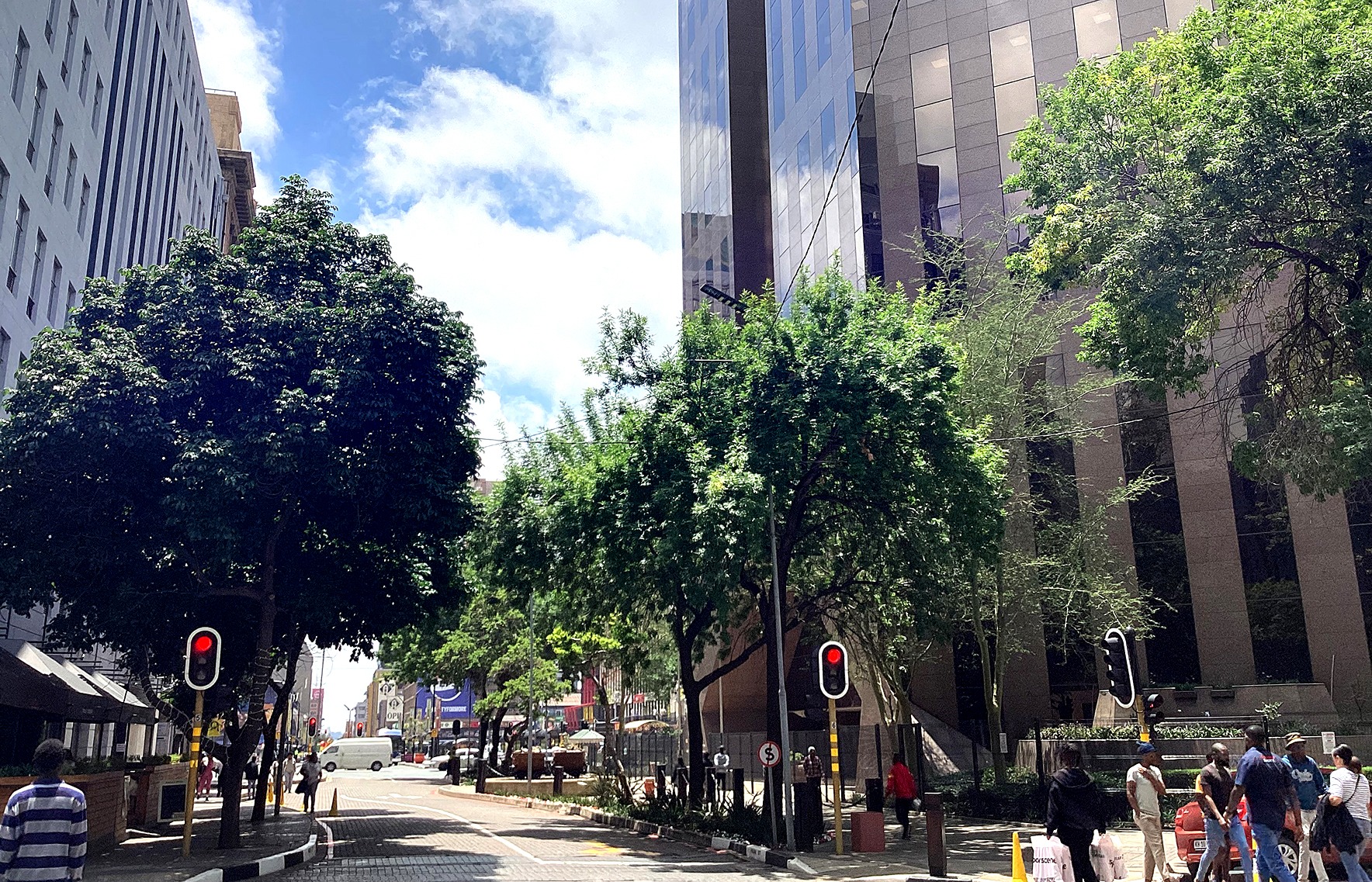
 Blue skies, big buildings and broader boulevards encourage walking in Johannesburg. (Photo: Shahdia Johnson)
 My favourite Johannesburg city reporting story (and I do quite a few) starts outside the Rand Club with David van Niekerk, the CEO of Johannesburg Inner City Partnership.
Months before, we met to talk about his plans for making Joburg a “walkable city”, and I thought: “Well, nice idea, but I mean really!” In my job as a city reporter, you always meet urbanists brimming with ideas that often don’t chime with real life.
Van Niekerk comes out of the club where the partnership – Johannesburg Inner City Partnership (JICP) – is based. We start walking and Van Niekerk points upward to show the solar lighting – a first step in making a city safe and walkable.
Across the inner city, for more than 12 blocks these lights are up, tapping the daylight sun to light up the city from dusk to dawn. It’s the outcome of an interlocking partnership of organisations, including the inner-city partnership and Jozi my Jozi, the citizen-run, business-funded project to regenerate Johannesburg. The lights are fitted with anti-tampering mechanisms linked to the network of CCTV cameras in the city.
/file/attachments/orphans/5-SustainableTech-SolarLightsConnectivity_795293.jpeg "Cities need lighting to be safe, especially at night, and the city is being lit by solar lighting. (Photo: Shahdia Johnson)")
/file/attachments/orphans/5-SustainableTech-SolarLightsConnectivity_104001.jpeg "With so much sun, solar-powered lighting is the way to go. (Photo: Shahdia Johnson)")
“You want vibrance. You want people walking around, going to the shops, going to school. A 24/7 city needs lights and spaces to linger,” says Van Niekerk.
We’re on Main Street and it looks amazing – the boulevards have been broadened and the pavements are in good nick. Cafés are open so you can linger on the street, and the pavements are broad enough to walk safely.
In time, you want to either fully or largely pedestrianise a city to make it properly walkable. (This is different because across the rest of the city exposed manholes are lethal, and pavements are either cracked and broken, or so overgrown with weeds that they are impassable.)
‘Street furniture’
There is “street furniture” – lingo for built-in blocks to sit or places to linger for people on the streets, and hawker stands for an essential informal sector. In the next three to four months there will be “pocket plazas”, says Van Niekerk – spots where food can be grown or where there is public art and places to buy food.
I’ve seen it in Hong Kong and Beijing recently, and they are also common in Istanbul, New York and Indian cities.
Then on to Gandhi Square, a transport terminus that is exactly what a big city public transport hub should be. It’s clean, bustling with commuters, and safe. Imagine if all our taxi ranks could look like this.
Businesses and the City work together to keep the square that way. The Mahatma would be smiling, I think.
/file/attachments/orphans/4-CleanStreetsEmployment-Crewworking_881728.jpeg "Workers employed on the Expanded Public Works Programme keep the city’s streets clean. (Photo: Shahdia Johnson)")
/file/attachments/orphans/1-UrbanIdentity-IconicLandmark_985215.jpeg "Gandhi Square is everything a bit city transport terminus should be. (Photo: Shahdia Johnson)")
From there, we dog-leg up through a few city blocks, heading to the old Ernest Oppenheimer Park – everywhere, public works employees are keeping the streets clean on regular rotation. The workers are funded by the Expanded Public Works Programme and employed by Dalu Cele’s Clean City SA. (If you haven’t met Cele, we’ll profile him soon as a force of nature. He believes Joburg can be cleaner, and shows how to do it every day.)
The streets are spotless and show what can be done. The inner city is often characterised by steaming piles of rubbish that make it pong. The reasons are manifold: Pikitup (the cleaning agency) is disaster prone and poorly run. There aren’t sufficient bins for the number of people who live in the buildings, and as Anna Cox reported here, there are 118 hijacked or occupied buildings, run by slumlords or criminal syndicates and home to Johannesburg’s most vulnerable people.
The impossible made possible
But on this walkability demonstration route, you see the impossible made possible. When the City works with partnerships like the JICP by granting permission and waiving bureaucracy you see development. There are other examples across Joburg.
What they reveal is that the future is in partnerships of the City administration and civil society (like Cele’s Clean City work) working with business (the JICP is funded by businesses) led by visionary built environment specialists (like Van Niekerk), with which the City is blessed, within its administration and without.
/file/attachments/orphans/6-SafePublicSpaceEgoliSquashYouthEmpowerment_793494.jpeg "Young people benefit from sports programmes at inner-city parks. (Photo: Shahdia Johnson)")
/file/attachments/orphans/8-HeritageProtection-SecurityHeritage1_100169.jpeg "A walkable city must be safe. Guardians employed by the Johannesburg Inner City Partnership. (Photo: Shahdia Johnson)")
The park is marvellous: people play basketball and chess while others play racquetball on a custom pitch. Barbers, hawkers and street restaurants have been moved from inside the park to its perimeter, and trade is bustling. That the park is so full is probably an outcome of high youth unemployment, but also of how many young people live in the inner city and how important it is to provide spaces for sport and recreation. Schools regularly use the park now.
Revamping parks and bringing in urban civil society organisations to run them shows that parks are not preordained to be nyaope dens or recycling sorting depots (the fate of many City parks). This one gets locked at night and opened by day, and is kept safe by security staff also employed by the JICP.
Van Niekerk and his teams have mapped how people walk in the city: most come from Hillbrow, Berea or on taxis into the city and then go to work at the banks or courts, or go to the SA Social Security Agency or other government buildings.
Ideally you want a 15-to-20-minute city – the time it takes to walk to where you need to be, and that’s the plan. Now, the demonstration hub means you can walk from Gandhi Square to the magistrate’s court – from Main Street to Marshalltown. The network is being expanded all the time to give life to the vision of a walkable inner city.
“We’re trying to convince people to extend the boundaries a little, so that in the end everything is connected,” says Van Niekerk as our walk ends and the work starts up again. DM