
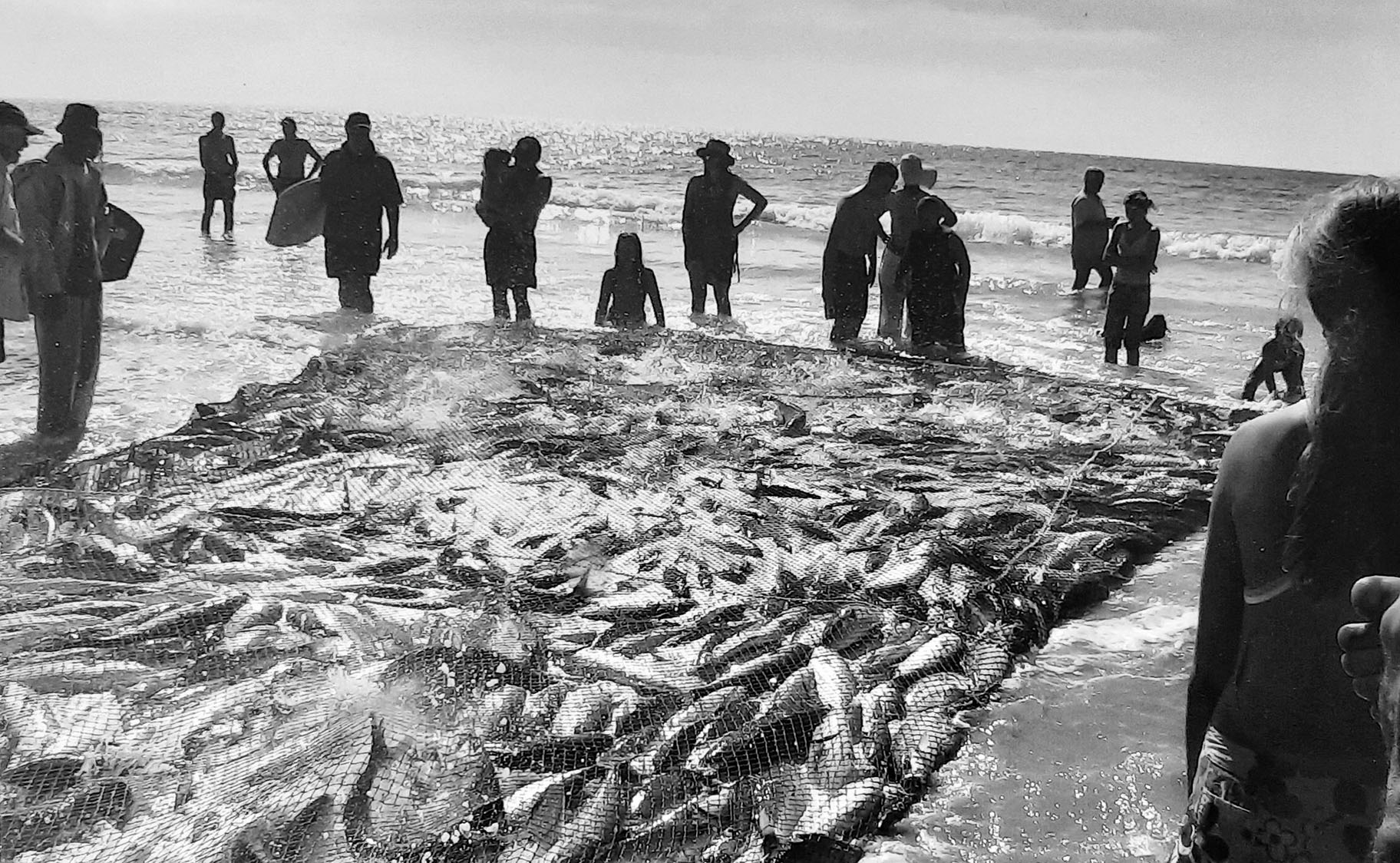
 Trek netting when things were good. (Photo: Mark Wiley)
 /file/attachments/2985/TroubledWaters_405609.jpg)
On the False Bay coast of Cape Town, trek netting is one of the oldest fishing methods. It’s been passed down through generations of families. Among the men who dominate this world, one woman has made her mark: Val Arendse, known to everyone as “Aunty Val”.
Val didn’t grow up as a fisher. She came from the clothing industry, where she worked for many years in management. But when her husband “Chris Vis” inherited his father’s fishing permit, Val stepped in to help. What began as support turned into a vocation. For 26 years, she has been one of the very few woman trek netters in Cape waters.
I sat down with Aunty Val to talk about the mechanics and dangers of trek netting, her instincts for when and where to fish, the challenge of being a woman in a man’s world and the long battles over permits and inspectors.
***
What is trek netting?
Trek netting is when you anchor the net on the shore with a rope and then the crew takes a rowboat out. They row in a circle with the net and bring it back to shore, pulling both ends together. That way, the net closes like a purse.
At the bottom of the net you also tie a rope. Once they go out to the distance they need, they row back and pull it in. Inside, if you’re lucky, are tonnes of cob, yellowtail or harder (mullet). But it’s never guaranteed. Other times you come out with kelp, or red bait, or just rubbish.
It must be dangerous taking a rowing boat into the surf
Dangerous? Oh, my word, yes. You sit in that little rowboat, staring at the waves. If you mistime it, that wave will take you back to shore like a rag doll. Or worse – it will flip you. If a wave comes and you press your oar down at the wrong moment, the wave will throw you into the ocean. You’re under the water with fishers, gear, and sometimes even fish thrashing around. You fight to come up for air and the next wave crashes down. It’s chaos, absolute chaos. That’s why the crew have their own language. They’ll shout commands so one lifts the oar, another brings down and you go through together.
/file/attachments/2985/TreknetterValArendseDonPinnock_144250_a60b36aa0699a9f2223444c166c810af.jpg "Trek netter Val Arendse, know locally as ‘Aunty Val’. (Photo: Don Pinnock)")
How do you know when there are fish in the water?
Ah, that’s the gift. You don’t always see them. Sometimes the water is too thick or murky. Sometimes it looks perfect, but you bring up nothing but seaweed.
For me, it’s a smell, a feeling. I can look at the colour of the water, the way the swell moves and I just know. I tell the men: “This is the piece of water. If you don’t cast here, I’m going home.”
They don’t always believe me. But many times, when they finally listen, they haul in a net full of fish. I might not get the recognition from the men, but Chris (her husband) – he appreciates it. He says he doesn’t like to go out without me on the beach.
What is it like being a woman in a man’s world?
I came out of a family of seven sisters and three brothers. I was the second-youngest girl, and they always said I was the fighter. I lost my mother at eight, and my father told me: “There’s no ‘almost right’ or ‘almost wrong’. It’s right or wrong. End of story.”
So for me, stepping into fishing was not difficult. I came from a corporate world where I managed men, and now I was managing fishing. Yes, it’s male dominated. But I built a name. Everybody knows me as Aunty Val. The crews respect me. They’re scared of me in a way – not scared of me, but scared of doing wrong around me.
/file/attachments/2985/Treknettingpexelsfreetouse_102288_989a9580c7c441a8343adeaa8a33576f.jpg "Trek netters drawing in a net. (Image: pexels)")
Tell me about your work before fishing
I worked in clothing. I was a manager running forecasting, raw materials, the cutting room, the machining, dispatch – everything. The company was called It’s a Pleasure, after two smaller companies amalgamated. I was very young when I started managing – about 30.
It was a good life and I might still be there if the company hadn’t gone down. But when it closed, I joined Chris fully in fishing.
Have you been on the boats yourself?
Yes, on the handline boats. I could catch fish but I couldn’t remove the hooks. Those boats had an oil smell from the motors that made me very sick, so I didn’t go back. Now I’m on the rowboats. I started 28 years ago, even before I left corporate, just to feel what fishing was like. Eventually I became fully active in the industry.
How has trek netting changed over the years?
Chris’ father used to say: “You won’t know if there are fish unless you cast your net.” I believe that too. The fishing itself hasn’t changed so much, though there are less fish – it’s the fishermen and the industry.
Before, you just went to sea. Now there are inspectors, permits and rules. Fishing inspectors used to just observe. There was one who even helped us in the water. But the last three or four years, things have become very unfair. We feel targeted. We are four trek teams on this coast, yet it’s always us who are accused of things. Even the public on the beach notice it.
/file/attachments/2985/Abeach-seinecatchofharderatSunriseBeachFalseBayDFFE_478855_0d7e379aaa0d49ec4dad70cabd91884c.jpg "A catch of harder at Sunrise Beach, False Bay. (Photo: Department of Forestry, Fisheries and the Environment)")
Let’s talk about permits. What has been your experience?
Permits are our biggest headache. When Chris’s father died we fought for a year to get the permit transferred. There was no income in that time. He even gave up his job because they told us we couldn’t have two jobs. And then we discovered someone else had the permit.
Eventually, by pure luck, I walked into the right office on the right day and the permit was written over. But it has always been a fight. In recent years, inspectors have told us straight: “It’s payback time.” Or, “I’m coming for you, Chris, I’ll take your permit.”
Once, we caught 200kg of cob – legal fish. The inspector made us put it all back. Imagine the men’s hard work and then nothing to take home. That’s the unfairness. They don’t work with permit holders, they work against us.
What about the inspectors themselves — do they know the sea?
When they start, they know nothing. We teach them. But once they learn, suddenly we are the rubbish, we are the stupid ones. With other trek teams, inspectors shake hands and chat. With us, they treat us badly. People see it on the beach. They ask why we are singled out. We don’t know. Money changing hands? Well, you’re recording, so I say nothing. We don’t do that.
How do you sell the fish? Off the beach or to companies?
Both. Sometimes the buyers come straight to the beach, sometimes it goes to the market at Kalk Bay. But you must be careful – people will try to steal your fish, or offer ridiculous prices.
One day, a man tried to cheat me. He had bodyguards with firearms. I stood up, pushed him on the chest, and told him to get lost. Later people told me he was dangerous, but I don’t care. Right is right and wrong is wrong. That’s how I live.
How do you cope with all this?
We stand together. Chris and I are a team. If he is down, I am on top. If I am down, he is on top. We always watch each other. But our children didn’t want to come into fishing. They saw the struggle and said they can’t survive with the conditions we face today. That’s sad, but I can’t blame them.
Would you do it all again?
Yes, I would. Even with all the battles. Fishing became our life. We enjoyed it. We became like family with the crew. Many of them call me mother. Wherever I go – Saldanha, or anywhere – people know Aunty Val. And they call Chris Chris Vis. People even think I’m the permit holder. I gave up the clothing industry, but I gained a family in fishing. That’s who I am.
What would make life better for trek netters like you?
Respect. Work with us, not against us. We don’t ask for handouts. Just fair treatment. If inspectors would listen, if the department would sit with us and solve problems, things could change. But until then, we fight on. Because this is not just a job. It’s our culture, our livelihood, our family.
And I’ll keep fighting for it, as long as I can still stand on that beach. But right now we don’t have the permit and there’s no money coming in. The department doesn’t care about that, about if we go hungry. DM
Tomorrow
Neels Loff: “They call us poachers.”
Previously
Setting up the series: Untangling SA’s fishing industry
Mark Wiley: South Africa’s vanishing fish
Tim Reddell: Steering Viking Fishing through SA’s troubled waters
Deon van Zyl: ‘We’re crippled by government inefficiency’
Doug Butterworth: Seafood’s balancing act and the science of sustainable catch limits
Colin Attwood: Counting the uncountable and the science of tracking fish
Kobus Poggenpoel: ‘These traditions will die with my generation’