




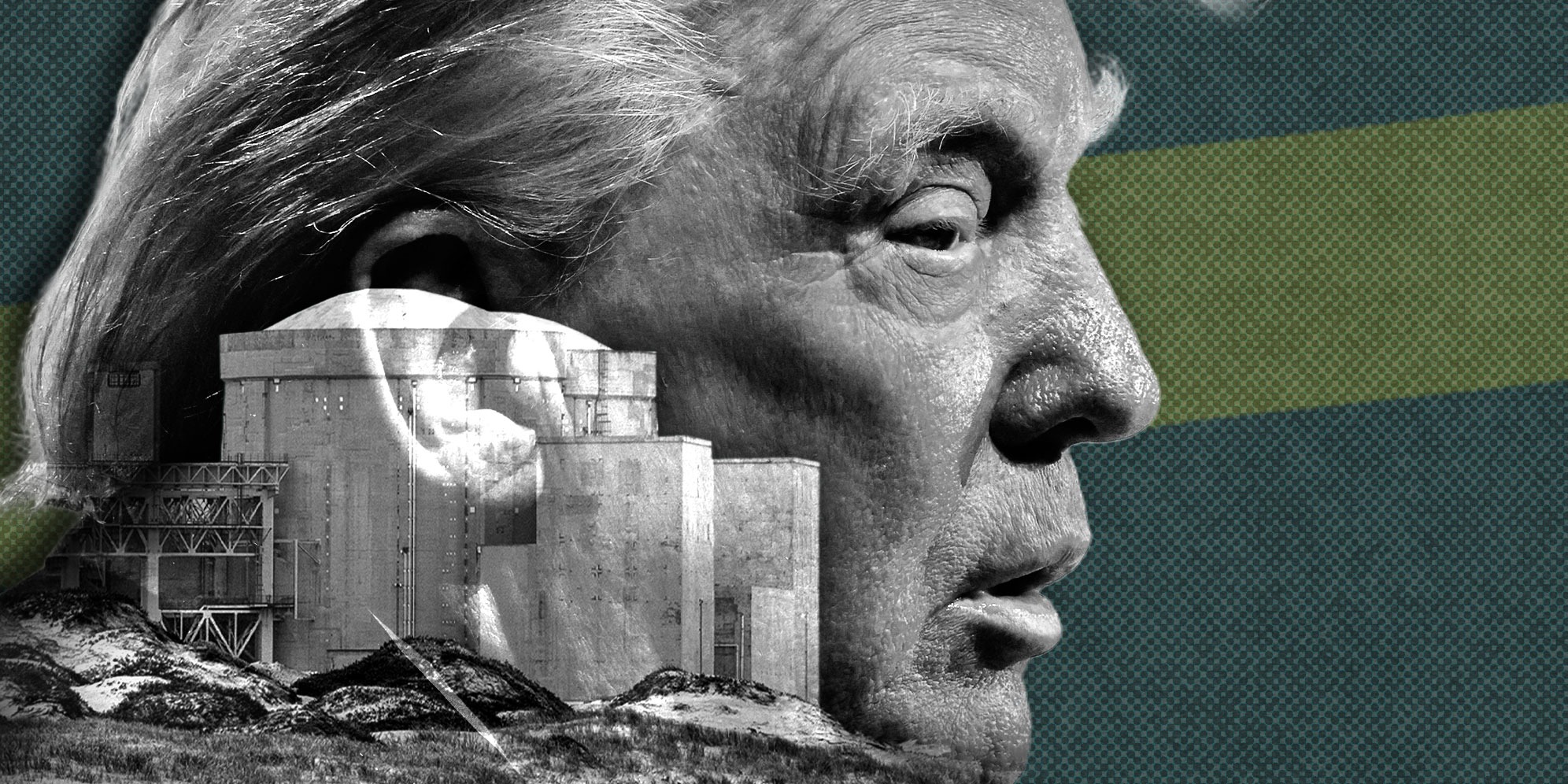
 Illustrative Image: US President Donald Trump. (Photo: Chip Somodevilla / Getty Images) | The Koeberg Nuclear Power Station. (Photo: Dwayne Senior / Bloomberg via Getty Images) | (By Daniella Lee Ming Yesca)
 Nuclear business is booming, but in a good way. “The new record electricity generation from nuclear energy in 2024 is a testament to the industry. To meet our global energy and climate goals, it is a record that needs to be bettered again and again, every year, by increasingly larger margins.”
Those are the words of Dr Sama Bilbao y León, director-general of the World Nuclear Association, in the opening paragraphs of the 2025 sector performance report.
Egypt, Pakistan and China are all at the atomic feeding trough. And where China dares to go – the country has three power plants currently under construction – the United States, under Donald Trump, will hastily follow to try to overtake it.
Read more: Trump goes full Don Quixote at Davos with Greenland dreams and windmill nightmares
“They’re starting to look at nuclear a little bit and they’re doing just fine,” the US president said of his assumed global adversary during his rambling WEF address in Davos on Wednesday. After, of course, announcing his country’s grander ambitions: “I’ve signed an order directing an approval of many new nuclear reactors. We’re going heavy into nuclear.”
Not enough to go around
Dr Yves Guenon, chairman of the French South African Chamber of Commerce and Industry (and seasoned nuclear engineer), told Daily Maverick that South Africa lost 17 years in the nuclear energy race because of failed 2008 plans. “You don’t have IP… Koeberg was built by the French, and now we [the French] are busy building in France, Europe and in America.”
In 2008, Eskom was on the verge of awarding a contract for two massive light-water reactors (the “Nuclear-1” project) to either France’s Areva or the US’s Westinghouse. But the deal collapsed when the price tag – a then staggering R120-billion – was deemed “unaffordable and uncompetitive” by a Treasury already nervous about the global financial crisis.
Fast forward nearly two decades, and that R120-billion looks like a bargain. By dithering for 17 years, South Africa didn’t just lose time; it lost its place at the head of the queue.
Read more: Wind is the big winner in Ramokgopa’s 2025 energy plan
As Minister of Electricity, Kgosientsho Ramokgopa triggers the procurement process for 2,500MW (en route to 5,200MW by 2039), he is walking into a global supply chain that is already oversubscribed, largely thanks to the voracious hunger of AI datacentres.
In the US alone, load growth forecasts have increased fivefold in two years. Tech giants such as Google and Amazon aren’t waiting for the grid; they are buying up nuclear capacity directly. This crowding-out effect means the very people South Africa needs to build its reactors, companies like France’s EDF, are currently drowning in their own domestic 1970s revival, which involves building up to 14 new reactors at home.
The skills gap and the madman theory
Guenon, speaking ahead of the Africa Energy Indaba, which will host the 15th Nuclear Forum in Cape Town in March, was candid about the human capital crisis. While South Africa has a foundation at Koeberg, the global bidding war for nuclear engineers is reaching a fever pitch.
He recalled a conversation with another African minister who claimed to have the engineers ready for a nuclear build. “I was smiling. I say this guy is mad. He is mad. He will never be able to do it himself.”
For South Africa, the challenge is twofold: scaling a regulator that needs to recruit between 150 and 300 highly specialised technicians almost overnight, and preventing a brain drain as international firms offer hard-currency salaries to Eskom’s top talent.
Pick your poison
With France oversubscribed and the US busy powering ChatGPT, South Africa is left with a difficult set of choices.
🇰🇷 South Korea (Kepco): Following a landmark January 2025 settlement of IP disputes with Westinghouse, the Koreans are the best option (did you know Samsung has a nuclear division?). They have a track record of building on time and on budget (look at Barakah in the UAE), and they carry the political blessing of the West.
🇨🇳 China (CNNC): They have the money and the supply chain, but choosing them is a geopolitical statement that might raise eyebrows in a Trump-led Washington.
🇷🇺 Russia (Rosatom): The politically favoured build-own-operate model is attractive to Eskom’s hollowed-out balance sheet, but it comes with the sanctions trap. As Guenon said, “If you have no financing, stay home,” but if that financing comes from Moscow, South Africa risks being severed from the global financial system.
Small reactors, big prices
While there is much hype around the revival of South Africa’s Pebble Bed Modular Reactor (PBMR) programme, the economics are currently against it. Small modular reactors carry a novelty cost premium of roughly $10,000/kW, compared with $6,600/kW for large-scale nuclear.
They are a long-term industrial dream, but they won’t solve the immediate baseload crisis cheaply. “If you decide to license small modular reactors, it’s more difficult... because it has not been done before... safety authority in South Africa can obtain licences [for big plants]... but you don’t have the same thing for the small modular reactor,” Guenon explains about the compliance headache.
Read more: A peek into our energy futures, and the democratic debate we must have
Unfortunately, in the era of the AI-driven nuclear renaissance, South Africa’s earlier hesitation has already become its most expensive policy.
As Guenon puts it: “Africa will be the hub of nuclear industrialisation... but who has an industrial economy? Nobody except South Africa.” The question is whether we can actually build the engine before the fuel runs out. DM