




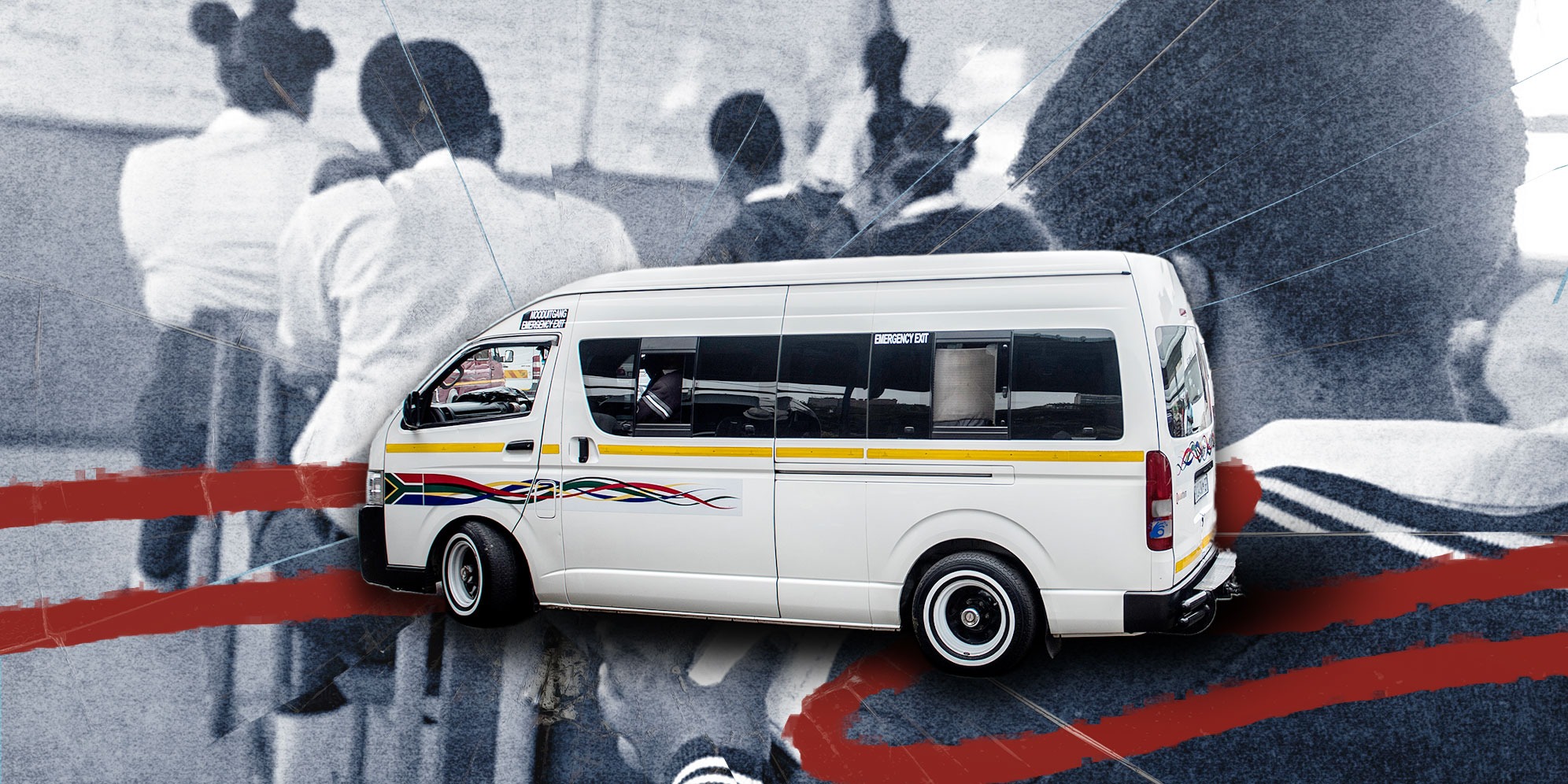
 Illustrative image: Schoolchildren. (Photo: Supplied / Bulungula Incubator) | Cracked glass. (Image: Freepik) | Taxi. (Photo: Shiraaz Mohamed / Gallo Images) | (By Daniella Lee Ming Yesca)
On Monday morning, Mmaki Josephine Mokhobo packed a lunchbox for her daughter, just as she had done countless times before. She watched her daughter, Bokamosa Mokhobo, a Grade 8 pupil, walk out the door. The teenager was vibrant, a “bubbly person” who loved to dance and talk.
“I saw her off that morning. She said, ‘Bye, girl, see you later’, and then I said to her, ‘Bye, bye, doll, I’ll see you later’,” Mokhobo recounted, her voice breaking.
“She was in a happy mood. I never thought this would happen to her.”
Hours later, Mokhobo’s phone rang. A friend alerted her to an accident in Vanderbijlpark.
“When I got to the accident scene … the taxi was in a horrible state, it was cut in half — there were schoolbags and shoes all around it, it was just horrible,” said Mokhobo.
/file/attachments/orphans/ED_592895_682444.jpg "Emergency personnel at the scene in Vanderbijlpark where a scholar transport vehicle collided with a truck on 19 January. (Photo: Sharon Seretlo / Gallo Images)")
Mokhobo said when the vehicle arrived to fetch her daughter, “It was not full, and when I looked at it, it was in good condition. She was supposed to take the public transport, but because of what’s happening now in our society, I trusted the scholar transport because it was going to take her from the gate of her house and take her again to the school gate, so she was safe in that way.”
It was only Bokamosa’s fourth day using the scholar transport.
“I was relying on that guy with all my heart to take my child to school and bring her back to me. Unfortunately, that didn’t happen, and it hurts me so badly. I’m broken, really, I am broken,” said Mokhobo.
Carnage on the R553
What began as a routine Monday morning school run ended in a scene of unimaginable carnage after the collision between the private scholar transport minibus and a side-tipper truck claimed the lives of 14 children, leaving families and a community devastated.
/file/attachments/orphans/ED_592901_131737.jpg "Parents and relatives at the scene in Vanderbijlpark where a scholar transport vehicle crashed on 19 January. (Photo: Sharon Seretlo / Gallo Images)")
/file/attachments/orphans/ED_592870_427152.jpg "A distraught mother at the accident site. (Photo: Sharon Seretlo / Gallo Images)")
According to preliminary information, the minibus ferrying learners to school attempted to overtake on the freeway before colliding with the truck. The impact was catastrophic.
/file/attachments/orphans/620278334_18065388848560415_1042461868455387955_n_100539.jpg)
The man entrusted with the children’s lives, the 22-year-old driver, Ayanda Dludla, who escaped the crash with only minor injuries, made a brief appearance at the Vanderbijlpark Magistrates’ Court on Thursday morning. He faces 14 counts of murder, one count of driving without a Professional Driving Permit, one count of driving an unlicensed vehicle and another of reckless and negligent driving.
Dludla abandoned his bail application, and the case was postponed to 5 March.
/file/attachments/orphans/ED_593165_380051.jpg "Ayanda Dludla (22) makes his first appearance at the Vanderbijlpark Magistrates’ Court on 22 January. (Photo: Sharon Seretlo / Gallo Images)")
At a media briefing on Tuesday, Gauteng Premier Panyaza Lesufi said that while public scholar transport was regulated, the private sector remained a chaotic grey area.
“An incident of this magnitude calls for a review of some of our legislation and regulations. We must eliminate this kind of behaviour within the transport sector,” Lesufi said.
Lethal disconnect
The Vanderbijlpark tragedy has laid bare the lethal disconnect between South Africa’s scholar transport laws and the reality on the roads.
On paper, the system is robust. The primary legal backbone for this service is the National Land Transport Act of 2009, which classifies the dedicated carriage of learners as a specialised public transport service. This is further supported by the National Learner Transport Policy of 2015, which was designed to standardise safety and accessibility across all nine provinces. Under these laws, the government is required to provide subsidised transport for learners who qualify based on specific criteria.
To operate a scholar transport service legally, drivers and owners must navigate a strict regulatory environment. Every operator is required to hold a valid operating licence issued by their Provincial Regulatory Entity, and drivers must hold a Professional Driving Permit with a category “P” (Passenger) designation. This permit requires the driver to be at least 21 years of age and undergo a criminal record check.
The safety standards for scholar transport vehicles are rigorous. The National Road Traffic Act outlines the illegality of transporting learners in the back of a bakkie or a delivery van. Authorised scholar transport vehicles must undergo a roadworthiness test every six months and must be equipped with a functioning seatbelt for every passenger. Furthermore, overloading is a criminal offence. Such vehicles are often required to display “Scholar Transport” decals and the contact details of a provincial complaints hotline.
/file/attachments/orphans/PHOTO-2026-01-22-08-51-02_251729.jpg "Minister of Transport Barbara Creecy conducted a traffic enforcement operation in Lenasia, after a tragic scholar transport accident in Vanderbijlpark. (Photo: Kopano Tlape/GCIS)")
The enforcement of these regulations is shared by the Department of Transport and the Department of Basic Education.
Despite policies and legislation aimed at ensuring learner safety, South Africa’s scholar transport sector faces persistent problems.
A 2025 study highlighted a “complex interplay” of policy failures and corruption. An implementation gap creates a critical disconnect between safety regulations and the hazardous daily realities for learners, forcing them into a theoretically regulated but practically dangerous system.
The study noted that a systemic failure within the sector had normalised reckless driving and the use of unroadworthy vehicles, placing learners at severe risk of injury or death. The industry is plagued by the use of inappropriate vehicles, such as bakkies, which are often involved in fatal accidents due to overloading and a lack of safety features like seatbelts.
There are also legal loopholes that further compromise safety by allowing vehicles to carry more children than there are seats, exacerbating the severity of accidents. These operational inconsistencies are compounded by drivers who often disregard traffic laws, leading to a high frequency of road accidents.
To resolve these crises, a holistic approach is required that prioritises stricter law enforcement, better funding for infrastructure and rigorous vetting of drivers.
The National Union of Metalworkers of South Africa’s spokesperson, Phakamile Hlubi-Majola, said the government bore ultimate responsibility for the Vanderbijlpark tragedy.
She argued that simply punishing the driver would be insufficient and called for immediate state intervention to enforce stringent regulations and consistent visible policing within the sector.
Hlubi-Majola said the deaths of the 14 learners must not be in vain, demanding that the government implement and uphold strict standards to ensure vehicles are roadworthy and drivers are qualified.
Not an isolated incident
The Vanderbijlpark tragedy was far from an isolated event. For years, the daily commute for thousands of schoolchildren has been a gamble with death, characterised by unroadworthy vehicles, overloading and reckless driving.
In July 2024, 11 primary school learners and their driver were killed when a private scholar transport minibus in Carletonville, Gauteng, was rear-ended by a Ford Ranger bakkie, overturned and burst into flames.
/file/attachments/orphans/ED_512797_270646.jpg "Family and friends at the memorial service at Carletonville’s Grace Bible Church on 16 July 2024 for the 11 learners who lost their lives in the Merafong crash. (Photo: Sharon Seretlo / Gallo Images)")
/file/attachments/orphans/ED_512623_998526.jpg "The accident scene where 11 pupils and the driver of their scholar transport vehicle died when it overturned and burst into flames after being hit by a bakkie. (Photo: Thulani Mbele / Gallo Images / Sowetan)")
In September 2022, in Pongola, northern KwaZulu-Natal, a heavy goods truck overtook another vehicle and collided head-on with a bakkie carrying children home, killing 18 learners (aged 5-12), their teacher and the driver.
While the nation was mourning the Vanderbijlpark victims on Monday, reports emerged from Pinetown, west of Durban, that nine learners were injured when the vehicle transporting them lost control and hit a tree.
In Ladanna, Limpopo, traffic officials on Wednesday stopped a seven-seater minibus crammed with 22 learners; the driver fled the scene. The next day in Lenasia, south of Johannesburg, a blitz impounded 60 minibus taxis for invalid permits, overloading and reckless driving.
/file/attachments/orphans/PHOTO-2026-01-22-08-51-03_679710.jpg "A traffic enforcement operation in Lenasia after the scholar transport accident in Vanderbijlpark. (Photo: Kopano Tlape / GCIS)")
Data from Statistics South Africa and the Road Traffic Management Corporation reveal the scale of the carnage:
- Between 2018 and 2022, more than 800 schoolchildren died in scholar transport-related accidents across South Africa.
- Road traffic injuries are a leading cause of death for South African children, with fatality rates that significantly outpace international norms. While the global average is approximately 17.4 to 18 deaths per 100,000 people, South Africa’s rate is between 25.1 and 26 per 100,000 people.
- Authorities estimate that nearly 80% of these crashes are due to human factors, including speeding, reckless overtaking and driver fatigue.
Peggie Mars, the founder of Wheel Well, a non-profit organisation dedicated to children’s road safety, said that referring to such crashes as mere accidents obscures the reality of the situation.
She stated that these crashes are largely preventable as they often arise from gaps in enforcement, inadequate vehicle inspections and drivers who are ill-prepared or unvetted. Most critically, they expose the disjointed nature of SA’s road safety efforts, where departments and agencies operate independently instead of collaboratively.
Mars explained how Regulation 231 of the National Road Traffic Regulations governs the number of passengers allowed in a vehicle by using the “3-for-2” rule, which legally permits drivers to carry more children than there are actual seats or seatbelts in the vehicle by calculating children as “fractions” of an adult passenger.
The standard breakdown is as follows:
- Children under three years: Do not count toward the passenger limit (provided they are not seated on a separate seat).
- Children aged 3-6: Two children are counted as one adult.
- Children aged 6-12: Three children are counted as two adults (the “3-for-2” rule).
- Children 13 years and older: Count as full adults.
“We need to address overloading children in vehicles with urgency, as a start. We are quite literally, legally overloading our children. There must be safe school transport with one bum per seat in vehicles transporting children,” said Mars.
She was equally critical of the regulatory blind spot surrounding the private sector. She highlighted that private operators function in a largely unmonitored grey market where vehicle fitness is only checked once a year (if at all) and driver vetting is nonexistent. She said the private sector must be brought under a rigorous compliance framework that includes year-round roadworthiness checks and mandatory driver training.
The human cost
While politicians debate policy reviews and courts process culpable homicide charges, the true cost of the crisis is felt in the silence of homes like Mokhobo’s.
The mother who trusted a driver to take her daughter from gate to gate is now left with only memories of a vibrant girl who loved to dance.
“She was a bubbly person, a loving person,” Mokhobo recalled. “We were always laughing together. I will always remember her for that.”
Until the implementation gap is closed and the “grey market” of private transport is strictly regulated, thousands of South African parents will continue to make that same gamble every morning, hoping their “see you later” is not a final goodbye. DM
What can parents do?
📋 Phase 1: Documentation
Legal scholar transport operators must carry these documents in the vehicle at all times:
Professional Driving Permit (PrDP)
What to look for: It is an additional permit included on the licence card.
Check: Look for the code “PrDP” on the licence card. It must be valid (it expires every two years).
Valid Operating Licence
What to look for: A special permit issued by the Department of Transport that allows the driver to transport passengers for profit.
Check: It should specify “Scholar Transport” or “Public Transport”.
Roadworthy certificate
What to look for: Scholar transport vehicles must undergo roadworthy testing every six months.
Check: Ask for the latest test date. If it’s older than six months, the vehicle is non-compliant.
Vehicle licence disc
Check: Ensure the disc on the windshield has not expired, and the licence plate number on the disc matches the vehicle’s actual number plates.
🚐 Phase 2: The vehicle (visual inspection)
Walk around the vehicle and look inside.
Tyres
Check: Tyres should not be smooth; you should see distinct grooves. Don’t forget to check the spare wheel if visible.
Seatbelts
Check: Every child must have their own working seatbelt. It is illegal for children to share a seatbelt or sit on the floor.
Seating capacity
Check: Count the seats. If the vehicle is licensed for 16 passengers, there should never be 17+ children inside. “Lap sitting” is illegal.
Windows and doors
Check: Do the doors open and close easily from both inside and outside? Are any windows broken or replaced with cardboard/plastic?
Safety equipment
Check: Is there a fire extinguisher and a first aid kit inside the vehicle?
Identification
Check: The vehicle should be clearly marked as “Scholar Transport” (often a sticker or magnet). DM