




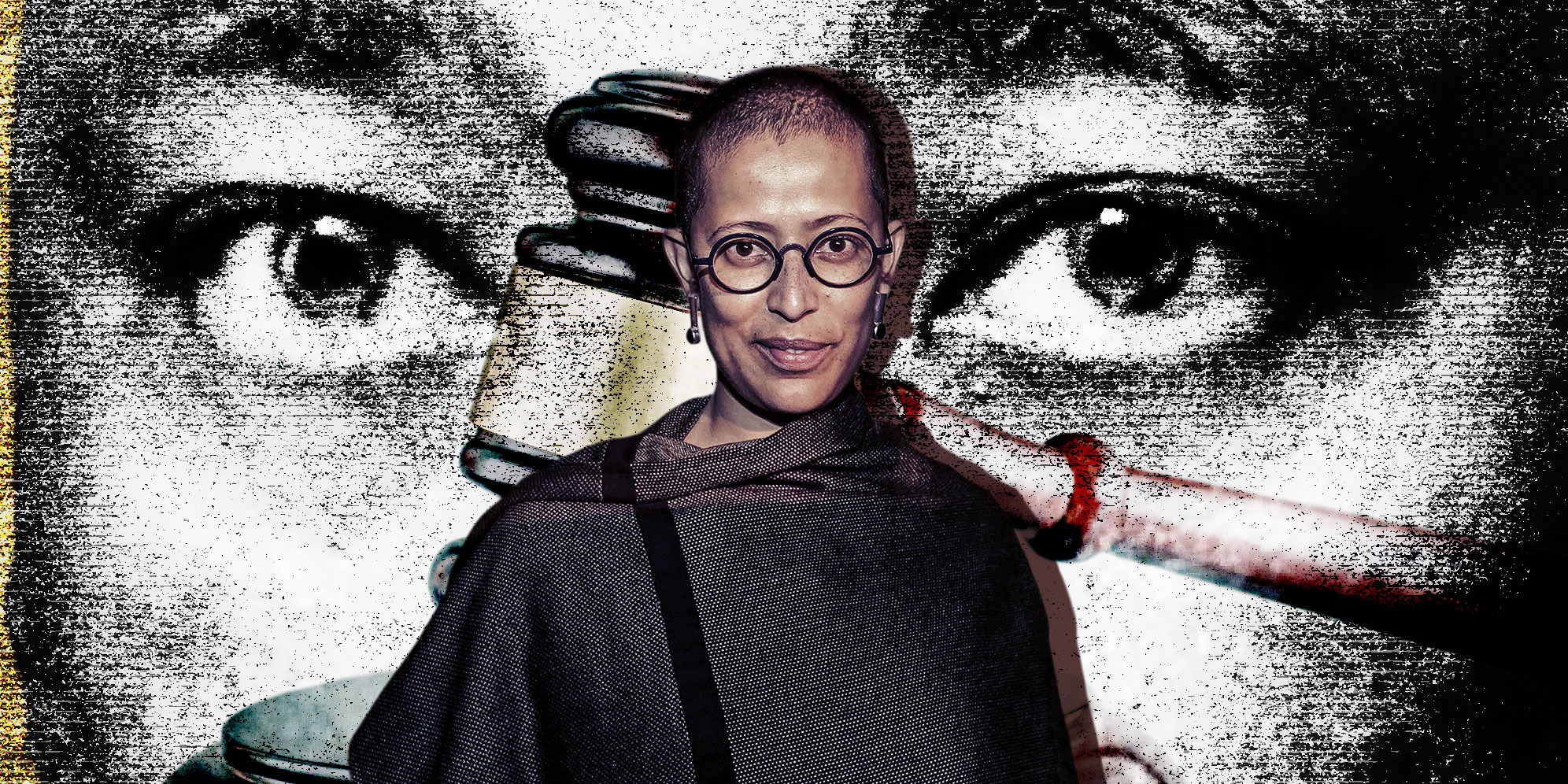
 Illustrative Image: Gabrielle Goliath. (Photo: Mark Wessels / National Arts Festival) | Gavel. (Photo: iStock) | Gayton McKenzie. (Photo: OJ Koloti / Gallo Images) | (By Daniella Lee Ming Yesca)
 Law and art collided on Thursday when Gabrielle Goliath filed an urgent application against Arts and Culture Minister Gayton McKenzie. She is seeking to have his decision to cancel her 2026 Venice Biennale selection declared unlawful and set aside.
In between late-night consultations with the legal team and drawing up the papers filed at the Gauteng Division of the High Court in Pretoria, Goliath, curator Ingrid Masondo and studio manager James Macdonald have been in Cape Town filming the final suite of the artwork, Elegy, which was unanimously selected as the sole South African representative at the Venice Biennale.
Goliath’s lawyers want the court to declare that McKenzie’s attempts to interfere with and obstruct the independent selection committee’s decision to select her work are unconstitutional, unlawful and invalid. Likewise, the minister’s cancellation of the selection for Venice. The team is also seeking to interdict McKenzie from taking any further steps to interfere with or obstruct Elegy from being showcased at the Biennale.
/file/attachments/orphans/ED_5852321_602977.jpg "Minister Gayton McKenzie. (Photo: Frennie Shivambu / Gallo Images)")
The Department of Sport, Arts and Culture had appointed the non-profit organisation Art Periodic to set up a selection process for participation in the Biennale. In her founding affidavit, Goliath argues that the decision by the selection committee appointed by Art Periodic constituted administrative action “which is binding and valid until it is set aside” by the courts. McKenzie did not approach the courts; instead, resorting to “unlawful self-help”.
Goliath’s affidavit further argues that McKenzie’s censorial conduct, followed by alleged attempts to replace Elegy with other work, “constitutes a breach of the doctrine of unconscionable state conduct” because it amounts to the minister reneging on a “public undertaking to follow a public and lawful tender process” — while simultaneously attempting to replace it with an opaque and “secretive” one based on his personal whims and fancies.
The final thrust of Goliath’s application argues that McKenzie’s actions demonstrate a worrying clampdown on the freedom of artistic expression, which is protected in South Africa’s Bill of Rights. She argues that McKenzie’s conduct “is incompatible with the right of freedom of expression and the rule of law”.
She further makes the point that because of the minister’s behaviour, South African artists are left with the impression that they “must self-censor to ensure that their work complies with the views and beliefs of those who happen to hold high executive office”. This erodes freedom of expression, she argues.
Shifting of goalposts
The papers are also critical of McKenzie’s constant shifting of goalposts regarding the reasons he sought to censor and obstruct Goliath. Initially, the minister had cited concerns about needing to protect South Africa against allegations of genocide, and so objected to work that addressed accusations of genocide — confirmed by the United Nations — against Israel because of its killing of tens of thousands of Palestinians in Gaza since October 2023.
But, in a statement released by the arts ministry on January 10, a day after Daily Maverick’s exposé, McKenzie alleged he had concerns about a foreign power hijacking the South African Pavilion for its own geopolitical agenda — the “country” was Qatar Museums, and the allegations were soundly refuted by a Daily Maverick investigation. This, Goliath argues, “fundamentally misrepresents the grounds upon which the minister purported to interfere”.
Then, in a letter to Goliath and the artistic and curatorial team on 20 January, McKenzie says he retains the power to ensure “new artists and first-time international exposure” for selection to the Biennale.
In a worryingly authoritarian move, McKenzie also states in the letter that he “enjoys a discretionary right to determine what artistic works or exhibitions may be supported, funded or displayed under [the department’s] banner”.
This shifting of goalposts and McKenzie’s retrospective application of criteria that were never publicly published, but used to disqualify Goliath, was “incoherent and irrational”, she stated.
‘Wholly unauthorised’
Goliath, whose legal team consists of media law expert Dario Milo and advocate Adila Hassim SC, argues that McKenzie has been engaged in “ill-conceived attempts at after-the-fact justification” for his cancelling of the selection and that it amounted to “contrived, unlawful interference”.
/file/dailymaverick/wp-content/uploads/2021/07/MC-LE-Adila-1.jpg "Advocate Adila Hassim SC. (Photo: Joyrene Kramer)")
“The minister’s conduct and the reasons offered for his conduct are wholly unauthorised and beyond the scope of his lawful powers. They are manifestly unlawful, irrational” and beyond his legal power, Goliath states.
Goliath’s affidavit paints a picture of a minister out of his depth and apparently wilfully ignorant of and anti the law.
Despite the unfolding legal action and the uncertainty surrounding the work being submitted to Venice, Goliath, Masondo and Macdonald decided to go ahead with creating the final piece of the artwork.
“Us being here in Cape Town demonstrates the persistence of art in challenging power,” said Macdonald after rehearsals on Wednesday night.
Goliath concurred and added that the experience had proven how “life-affirming Elegy is”. She has always been at pains to point out that Elegy is not about violence but about foregrounding practices of mourning, survival and repair.
There is a palpable sense that returning to the work and completing this vision of Elegy has helped the trio repair the corrosive effects of what she describes in her founding affidavit as a “blatant and egregious example of censorship and silencing dissent” by McKenzie.
/file/attachments/orphans/Elegy_7-ChannelVideoInstallation_FutureGenerationArtPrize_PalazzoCaTron_Venice_2019_photobyMaksimBelousov_156213.jpg "Gabrielle Goliath, ‘Elegy’, 7-channel video installation, Future Generation Art Prize, Palazzo Ca’Tron, Venice, 2019. (Photo: Maksim Belousov)")
The third suite
With two suites completed — one commemorating Ipeleng Christine Moholane, who was killed in 2014 (the very first version of Elegy), and the other dedicated to two Nama ancestors still named in the colonial archive — the team persevered with completing the third.
This is the suite which relates to the Israel Defense Forces killing women and children in Gaza, which McKenzie allegedly found so offensive that he sought to censor it, despite not having seen it.
/file/attachments/orphans/GabrielleGoliath_Elegy-JoanThabeng_2018_DoDisturbFestival_PalaisdeTokyo_photobyAykaLux_1_149457.jpg "Gabrielle Goliath, ‘Elegy - Joan Thabeng’, 2018, Do Disturb Festival, Palais de Tokyo. (Photo: Ayka Lux)")
The rehearsals with the group of female vocalists who perform in Elegy, some of whom have been working with Goliath since the first version in 2015, had been scheduled well before McKenzie attempted to dictate what kind of art should be at the South African Pavilion in Venice.
During rehearsals in the darkened theatre, a spotlight illuminates the dais on stage. A woman stands in that light holding a note, a B natural. It is piercing, clear, vulnerable, defiant … elegiac.
She goes silent. The absence of sound is intense. It hangs heavy in the room. The silence draws one into the “absent presence” of dead women and queers, of femme-presenting and lesbians, of children and grandmothers, of poets gone too young and those who died just because they went to the shops. Those black, brown and indigenous, who Goliath describe as “disavowed and ungrievable” because of a world where the yet to come is still not otherwise.
The vocalist steps off the dais and slowly makes her way to the side of the stage, where six other performers who had completed their roles in Elegy are sitting. After what seems like ages, there is a collective sigh and a deep “Yooooh” from the group of vocalists sitting both off and on stage. It is intense and heavy.
All the women participating in Elegy are classically trained. Those who spoke to Daily Maverick bridled against McKenzie’s suggestion that the work is “divisive” and does not tell South Africa’s story.
Thirty-six-year-old Noor Stuurman has been working with Goliath since the first iteration of Elegy a decade ago. She talks of the gender-based violence she suffered while experiencing substance abuse problems, and the violence against women she still witnesses in her Mitchells Plain community.
“McKenzie cannot say these are not our stories; we are women in South Africa connected to the ancestors who died in Namibia, and the women and children who are dying in Palestine now. Our story is one of pain; women are born into pain, wherever we are in the world, the minister has no right to tell us this is not our story,” said Stuurman.
Thandiswa Mpongwana (35) has also worked with Goliath since the very first Elegy 10 years ago. She described the sense of “entitlement” that men feel they have over women, which she sees daily on the streets of South Africa.
She feels that McKenzie represents that violent approach to female and femme-presenting people in South Africa and elsewhere. “For men like the minister, our cries are like nagging, and that element of ignorance and violence is what he is showing. Men don’t hear our cries. No one hears our cries. It is only our dead ancestors who can hear us, which is why this work is so important. It connects us and makes us heard.”
Daily Maverick sought comment from the Department of Sport, Arts and Culture spokesperson, Stacey-Lee Khojane, at 5.30pm on Thursday as to whether the minister had received the papers and was planning to defend the application. She had not responded by the time of publication. DM