




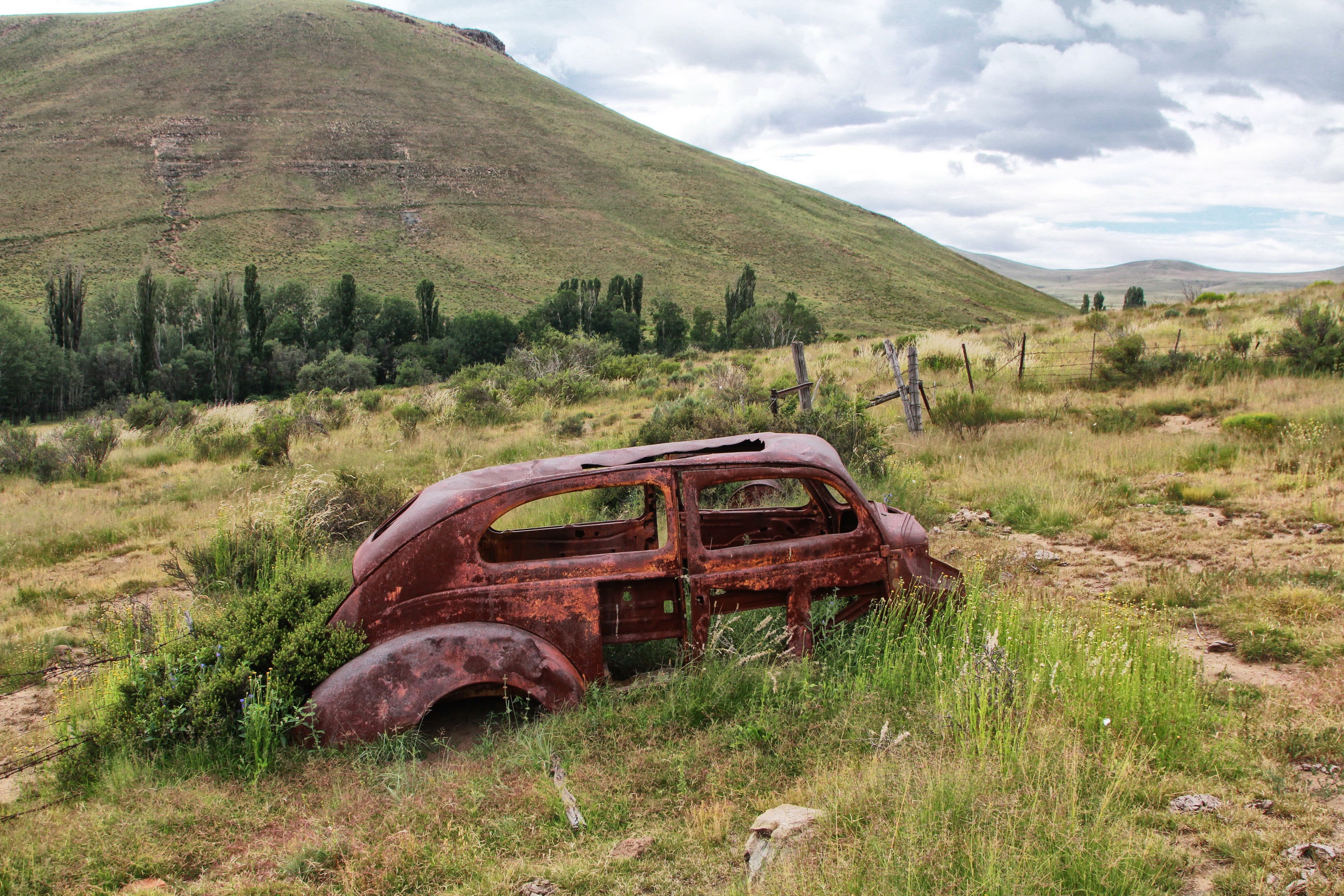
 Some things that were brought into the Sneeuberg mountains never left. (Photo: Chris Marais)
 The greater Sneeuberg massif includes the Camdeboo mountains, Meelberg, Koudeveldberge, Toorberg, Winterhoekberge, Lootsberg, Renosterberg and Agter-Renosterberg. It also includes the Wapadsberg, Tandjiesberg, Coetzeesberg, Bankberge, Aasvoëlkrans, Groot Bruintjieshoogte and Boschberg near Somerset East.
All along their east-west axis, these broad-shouldered crags intercept the high rain clouds, wring out their moisture in rain, snow, frost or mist, and send it trickling downstream. In summer, when the rains have been good, the land can look as green as the Scottish highlands.
In winter, its bones lie bare. Ironstone crowns rise above the snowfalls that settle along the long, level contourlines of ancient riverbeds.
Jutting head and shoulders above these great interlinked massifs is the distinctive ironstone peak of Compassberg (2,503m), the Matterhorn of South Africa and the Karoo’s greatest free-standing mountain.
Nardou, at 2,429m, is the next highest, but it does not have a distinctive peak, and is deep within the range. You’ll only see it from certain angles, but in winter it often wears a telltale skullcap of snow.
The headwaters of the Sundays River rise to its west, and the Great Fish River to its east.
Downstream, these rivers support hundreds of thousands of jobs, and billions in revenue from wool, mohair and citrus exports before they empty into the sea.
/file/attachments/orphans/HorsescangowherevehiclesandeventractorscannotFarminglivestockinthepartsoftheSneeubergmountainswouldbeimpossiblewithoutthem_ChrisMarais_993394.jpg "Horses can go where vehicles and even tractors cannot. Farming livestock in the parts of the Sneeuberg mountains would be impossible without them. (Photo: Chris Marais)")
/file/attachments/orphans/TheTuishuiseinCradockNxubawhereyoucanstaywithinanentirerestoredstreetscapedatingbacktothe1850s_ChrisMarais_417727.jpg "The Tuishuise in Cradock (Nxuba), where you can stay within an entire restored streetscape dating back to the 1850s. (Photo: Chris Marais)")
Heart of the Sneeuberg
Whatever the temperature is in our home town of Nxuba (formerly Cradock), it is invariably six degrees cooler in the heights of the Sneeuberg mountains. This range is basically a high-altitude island, surrounded by semi-desert.
We were there in high summer, and at first it didn’t really feel as if we were ascending any serious heights. We bounced along the increasingly rutted and eventually invisible track, but all along we were climbing steadily, from green valley to green valley. Each one seemed to have its own spring, water bubbling from the earth.
My husband Chris and I were heading off to Petrusdal Farm with our friend Gavin Holmes who wanted to check on his cattle. They graze on land rented from farmers Anton and Andalet Olivier.
In summer, this is heaven for livestock. It has moist uplands, and delicious and nutritious grasses.
Winter is another story. Shortly after the first frost comes, you move your animals downhill into the milder temperatures, or risk losing them. This is sourveld, and the veld doesn’t sustain much in the cold months.
The vegetation undergoes a discernible change as you climb. You start in Karoo shrubland, then move into grassland and fynbos. It even smells different up there, from the rosemary-like Karoo bossie rising up to the lavender-citrus scent of fynbos.
/file/attachments/orphans/Therailwayiserraticallyusedinthesepartsbutthesidingstillstand_ChrisMarais_463413.jpg "The railway is erratically used in these parts, but the siding still stands. (Photo: Chris Marais)")
/file/attachments/orphans/Hereandthereyoullfindabandonedfarmhousesoftenwithorchardsandshadetreesaroundthem_ChrisMarais_655236.jpg "Here and there you’ll find abandoned farmhouses, often with orchards and shade trees around them. (Photo: Chris Marais)")
Another world
Even further up are alpine plants you’d never imagine would be in the Karoo: Mountain Buttercups, Forget-Me-Nots and Harebells.
We have written previously about the four major biomes that intersect in these mountainscapes – Nama Karoo, grasslands, savannah and thicket. Cool, moist mountains in arid areas are often rich in endemics, and the Sneeuberg range is no exception.
In 2009, three botanists from Rhodes and Stellenbosch Universities (Victor Ralph Clark, Nigel Barker and Ladislav Mucina) wrote an article for the South African Journal of Botany, recognising this region as a new Centre of Endemism for its many unique plants.
There are other remarkable species, including a tiny but fierce adder and
a delightfully named butterfly, the Compassberg Skolly. This is also
where the Cape Mountain Zebra (Equus zebra zebra) was saved from
extinction after the declaration of the Mountain Zebra National Park in
1937.
/file/attachments/orphans/ThereareSanrockpaintingsallovertheSneeubergThisoneonSamaraKarooReservelooksdistinctlylikeapregnantcheetahorleopard_ChrisMarais_415409.jpg "There are San rock paintings all over the Sneeuberg. This one, on Samara Karoo Reserve, looks distinctly like a pregnant cheetah or leopard. (Photo: Chris Marais)")
Historic overgrazing in the well-watered heights has left bald patches, or what botanists call Badlands. Every now and then, you’ll see an old wagon, left to slump into the earth.
There are many uninhabited old farmhouses. Some of the gardens remain; the pear trees grew into giants that bomb down vrot fruit in midsummer. The peach trees are now small and wizened. But their ripe fruit, if you can beat the baboons to them, is intensely sweet. Near the farmsteads, very often, are old graveyards. They tell stories of premature deaths, people who were bitten by snakes or fatally injured by trains, and many who died in wars. DM
/file/attachments/2984/book-promo_675310_47c9ccf5bbdc7efa7ac10973cfb023d5.jpg "Karoo Space books by Julienne du Toit and Chris Marais.")
For an insider’s view on life in the South African Heartland, get the Karoo Quartet set of books (Karoo Roads I-IV with black and white photographs) for only R960, including taxes and courier costs in South Africa. For more details, contact Julie at julie@karoospace.co.za