



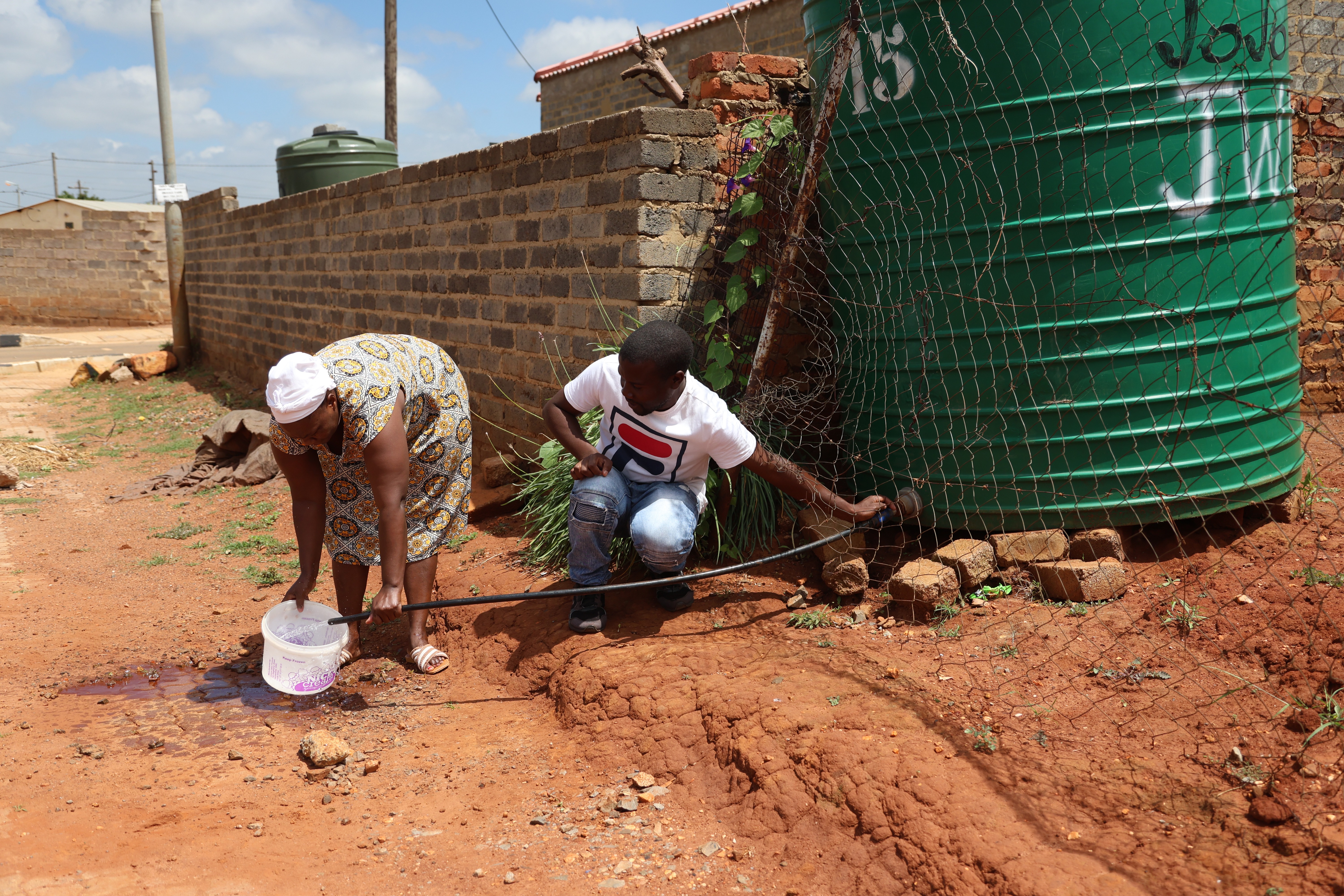
 Zinzi Mnguni and Vongani Metileni use a communal water tank in Drieziek near Orange Farm, south of Johannesburg, on 12 January 2026. (Photo: Felix Dlangamandla)
 “[Getting] water is like finding a job in South Africa for us,” said Nkele Dikeledi Modibogo, a resident of Drieziek Extension 3. Modibogo said that tap water used to be available in the mornings and switched off by nine or 10 in the morning. But since 2021, an increasing number of taps have been “totally dry” for months at a time. During the 2025 Christmas period many residents had no water at all.
For years, residents across Drieziek, near Orange Farm, have struggled to secure clean water. A Daily Maverick investigation into this area, in southwest Gauteng, found that it has been plagued by dry taps, water cuts and inconsistent supplies. Water tanks supplied to the area are filled infrequently and are not cleaned out or sealed, raising the risk of contamination.
Daily Maverick recently visited Drieziek, a peri-urban area on the outskirts of Johannesburg that is plagued by high unemployment and poor service delivery. The signs of neglect from the City of Johannesburg municipality are visible.
The roads are riddled with potholes, and in the mornings children can be seen pushing wheelbarrows full of water buckets to and from the nearby tanks. Residents who haven’t had water in weeks take bucketloads of laundry to rinse and hang out to dry in their neighbours’ yards. One of the residents we spoke to confirmed that his taps have been dry since 2016.
/file/attachments/orphans/6I1A1625_886171.jpg "Palesa (16) and Lethabo (2) Mokoena pull heavy buckets of water home from a communal tap in Drieziek on 12 January 2026. (Photo: Felix Dlangamandla)")
/file/attachments/orphans/6I1A1750_670449.jpg "Children play as they wait for water buckets to fill up in Drieziek near Orange Farm on 12 January 2026. (Photo: Felix Dlangamandla)")
Another resident, Thembi Ndlovu, said she lives in a house with seven family members and has to take many trips to the water tanks each morning to fill eight buckets a day, which the family use for bathing, cooking and cleaning. She lives next to a tank in Drieziek 3 which only has water for about three to four hours a day. When it runs out, she walks to Drieziek 6, about 20 minutes away, to fetch water.
She says that over the Christmas period there was no water at all. Now the water is turned on in the early mornings but turned off a few hours later. “You can’t sleep because you know that you have to fill up the buckets before the water is gone. If you could imagine someone who’s working, there are people who are leaving at five in the morning. They come back at six and they do not find water.”
Other residents have resorted to waking up early and driving to other areas of Drieziek that have water.
One of them, Samkele Nzimande (32), lives with his wife and two children in Drieziek 3. He said they used to have tap water in the mornings until 9am, but since November 2025 his taps have been dry. As a result, he drives to Drieziek 6 to fetch water, but the supply there ends at midday, forcing him to drive to Drieziek 4 if he doesn’t make it on time.
“If I drive a car, going [to fetch water] is like 20 minutes or 15. But if I walk, it’s an hour,” he explains. “If I don’t have petrol I have to use a wheelbarrow or a truck. [It takes] like two hours, if it’s far.”
As a result, elderly and disabled residents and those unable to fetch water during the hours it is available often resort to paying other residents R10 per bucket to collect it for them. However, this can be prohibitive for those who depend on the R370 Social Relief of Distress grant.
/file/attachments/orphans/6I1A1741_353106.jpg "Samkele Nzimande voices residents’ frustrations over access to water in Drieziek near Orange Farm on 12 January 2026. (Photo: Felix Dlangamandla)")
Water tanks carry risk of contamination
Even when water is available in the tanks, its quality can be a problem. Community activist and long-time Drieziek resident Ben Nkosi showed Daily Maverick one of the tanks and demonstrated how easily the lid can be lifted off.
“They only come and fill it whenever they like,” Nkosi explained. “Secondly, they don’t clean it. We are not guaranteeing the safety, because the tank is right on the street, so anyone can just open and throw anything.
“... we hear stories that some people find rats inside those tanks. So we don’t know what’s inside, actually, so we’re afraid. When we get water from the tank, we only use it for flushing and washing.”
/file/attachments/orphans/6I1A1633_913968.jpg "Ben Nkosi and one of the water tanks in Drieziek. (Photo: Felix Dlangamandla)")
Many residents said they don’t trust the quality of the water because they have seen sediment in it. Boiling water to decontaminate it requires more money for electricity – when it’s available – while it takes time to cool to a drinkable temperature. Residents who have water tanks in or near their yards reported that each tank serves up to 30 other households in the area, so the daily foot traffic tracks mud and damages taps and fences.
Residents say they’ve been complaining to the municipality and to their ward councillor, Mxolisi Ndzondzo, for years, without a result. When they raise their concerns they are told to save water, they say.
/file/attachments/orphans/6I1A1659_707995.jpg "Zinzi Mnguni carries a bucket of water home from a communal tank in Drieziek. (Photo: Felix Dlangamandla)")
‘This is another modern kind of apartheid’
The water in Drieziek is supplied by Johannesburg Water and Rand Water. Residents complain that areas supplied by Rand Water, including Drieziek Extension 4 and 6, have a more consistent supply, whereas those supplied by Johannesburg Water – extensions 3 and 5 and Drieziek Proper – haven’t had a consistent supply for years.
Residents and civil society organisations say the water crisis began with the installation of prepaid meters, which were introduced in the early 2000s. The move was opposed by community activists, who saw it as the beginning of water privatisation. Nkosi said Johannesburg Water introduced the meters as a pilot project in 2001 and later rolled them out throughout the community without consultation, with the roll-outs escalating in 2021.
“With prepaid, when you don’t have money, you don’t have water,” Nkosi said, expressing concerns that the prepaid meter system will not allow residents to gain access to the 6,000 litres of free basic water that each household is entitled to under national policy. He cited the 2001 cholera outbreak in KwaZulu-Natal that claimed more than 200 lives and was driven by those who could not afford to pay for water meters and used water from unsafe sources such as rivers.
/file/attachments/orphans/6I1A1724_763588.jpg "Paulina Sgaza maintains her garden near the reservoir amid ongoing water challenges in Drieziek. (Photo: Felix Dlangamandla)")
/file/attachments/orphans/6I1A1681_193146.jpg "Water shortages force Karabo (19) and Bohlali (12) Madibogo to do their washing at a neighbour’s house in Drieziek. (Photo: Felix Dlangamandla)")
/file/attachments/orphans/6I1A1777_362358.jpg "Drieziek residents gather at a communal tank to collect water on 12 January 2026. (Photo: Felix Dlangamandla)")
The memory of that outbreak has driven local activists to fight against the installation of prepaid meters.
Richard “Bricks” Mokolo, the coordinator of the Orange Farm Human Rights Advice Centre, said that in 2009 the organisation joined a court action in solidarity with residents of Phiri in Soweto who were forced to transfer to a prepaid system. The residents lost the case but the fight against prepaid meter installations has continued.
“Johannesburg Water was installing prepaid metres in order to promote privatisation of water, making profit out of water,” Mokolo argued. “So those who got money, they can access water. Those who don’t have money, this is another modern kind of apartheid.”
/file/attachments/orphans/6I1A1706_930057.jpg "Two reservoirs are meant to supply residents with water amid shortages in Drieziek. (Photo: Felix Dlangamandla)")
But Johannesburg Water has defended the meter roll-out. Spokesperson Nombuso Shabalala said that rolling out water meters is part of a 10-year “programme of projects” designed to strengthen the water system, which she said has been strained by high demand. Areas like Drieziek 1, 3 and Proper, being high-lying areas, further contributed to low water pressure.
“The Orange Farm water system is under pressure because overall water demand is very high. This is due to various factors such as leaks and illegal connections from three of the informal settlements within Orange Farm,” said Shabalala.
“This makes it difficult for the Daleside Pump Station to refill the Orange Farm reservoir, which often runs empty overnight. As a result, the reservoir is closed at night to help it recover so that water can be available during the day.”
The planned projects included:
- A pipe replacement programme to reduce water losses and improve reliability of the system, which will two to five years;
- Construction of a new bulk pipeline to the Ennerdale reservoirs to divert the supply from all direct feeds in Orange Farm (except the Creche direct feed) from being fed directly by Rand Water to being supplied from the Ennerdale reservoirs. This will take an additional five to 10 years.
Joburg Water did not respond to questions about the residents’ objections to the water meters or about the residents who still don’t have water despite having meters installed.
Approached for comment, ward councillor Ndzondzo redirected us to Joburg Water. DM