




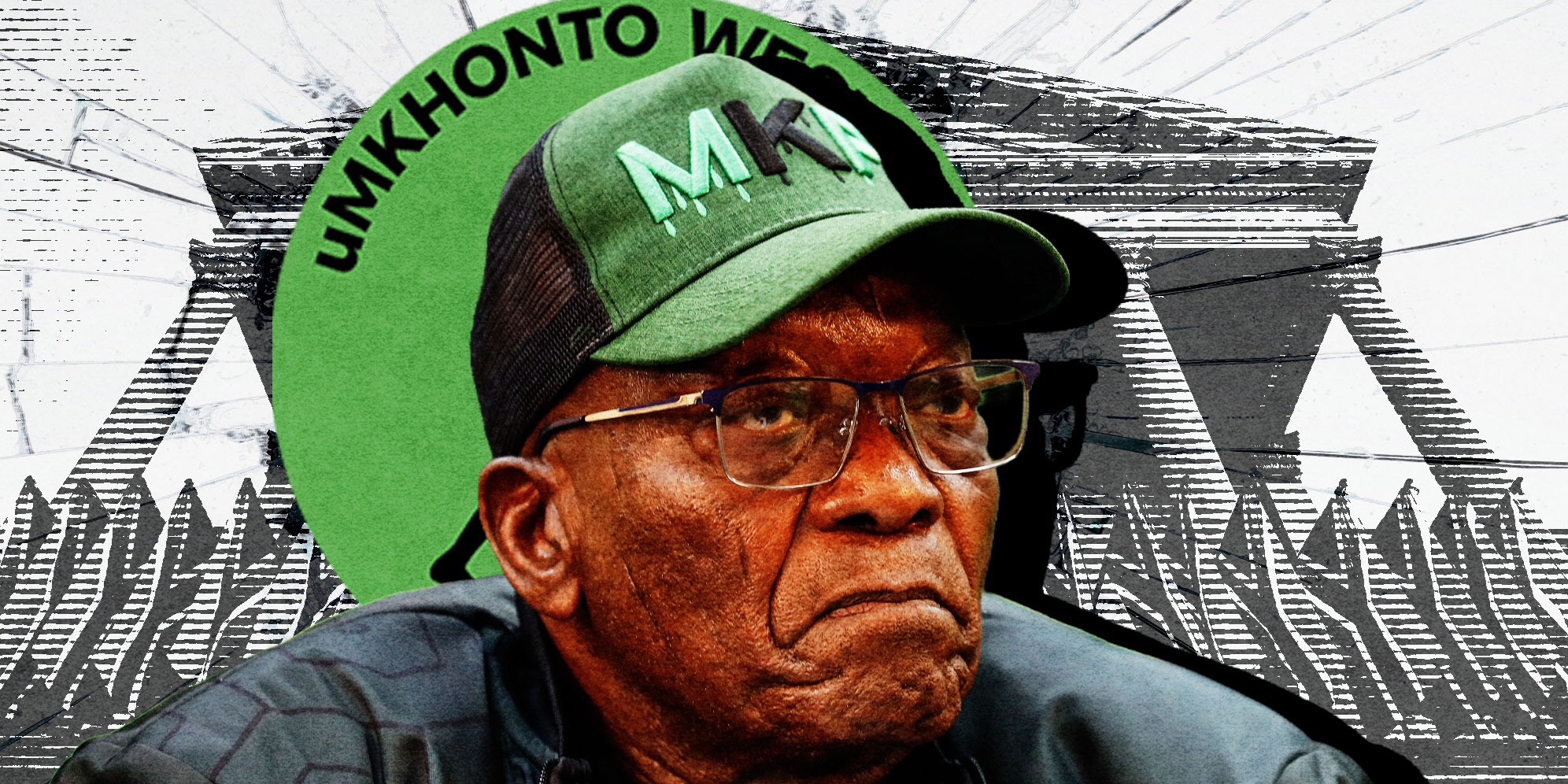
 Illustrative Image: Jacob Zuma. (Photo: Gallo Images / Sharon Seretlo) | MK Logo. (Image: Wikicommons) | Building with flags at the Official Opening Of The 7th KwaZulu-Natal Legislature (KZN) Legislature at KZN Legislature Chamber on July 30, 2024 in Pietermaritzburg, South Africa. (Image: Gallo Images / Darren Stewart) | (By Daniella Lee Ming Yesca)
 /file/dailymaverick/wp-content/uploads/2025/10/label-analysis-2.jpg)
The spectre of a chaotic uMkhonto Wesizwe (MK) party being in charge is a diversionary political expedient by partners in the KwaZulu-Natal government of provincial unity (GPU) to the reality that since the dawn of freedom, stability in the corridors of power has been an exception rather than the norm.
While the Constitution allows for a maximum two five-year terms in office for a premier, in three decades the province is into the tenure of a 10th incumbent. That has more to do with internal ructions in the ANC and the IFP than the will of the electorate.
More importantly, the facade of unity in support of the National Freedom Party’s sole member in the legislature, Mbali Shinga, who defies her party to prop up the GPU, is unsustainable precisely because of the origins of the organisation and the alleged hand of MK president Jacob Zuma’s in its formation in the first place.
/file/attachments/orphans/Greg-mbali-mk_374259.jpg "Illustrative Image: MEC for Social Development in KwaZulu-Natal Cynthia Mbali Shinga. (Photo: Facebook / @Hon. Cynthia Mbali Shinga) | Building with flags at the Official Opening Of The 7th KwaZulu-Natal Legislature (KZN) Legislature at KZN Legislature Chamber on July 30, 2024 in Pietermaritzburg, South Africa. (Photo by Gallo Images / Darren Stewart) | (By Daniella Lee Ming Yesca)")
As the ANC, the IFP, the National Freedom Party (NFP) and the DA slug it out for power in the coming crunch local government elections, the veneer of decency in their mutual disdain will evaporate.
That is the kind of environment that has resulted in the province largely failing to sustain stability in governance over the years. The high turnover of premiers has invariably come with a revolving door circus of Cabinet reshuffles.
Before we try to understand how we got here, it is important to state upfront that MK is simply not ready to govern the province. It can’t manage its own house.
The majority of the cohort of members currently deployed in the legislature could never constitute a decent government among themselves. With the exception of a handful, they lack experience to understand legislative processes and the implications of postures of defiance and disregard for the rules. Frequent changes in leadership while in a hostile environment has deprived them of an opportunity to learn the ropes in the face of a thoroughly condescending attitude from legislature old hands in government.
But the question is whether an MK government would be any more unstable than what we have seen since 1994. History is instructive.
/file/attachments/orphans/DR-FRANKMDLALOSEjpg_499104.jpg "Former KwaZulu-Natal premier Frank Mdlalose. (Photo: @kzngov)")
By any measure, inaugural premier Dr Frank Mdlalose was a noble gentleman, a steady hand who sought to hold together the mandatory government of provincial unity of the IFP, ANC and the National Party.
Those were difficult times. Enmity between the ANC and the IFP was palpable in the corridors of power while their members were being murdered in the thousands outside.
The IFP dismissed Mdlalose. He was perceived by hardliners within the party as being “too soft” towards the ANC.
/file/attachments/orphans/ED_271782_452595.jpg "File photo of Dr Ben Ngubane at the state capture inquiry. (Photo: Gallo Images / Bebe Kabvundura)")
His successor, Dr Ben Ngubane, lasted all of two years. As a medical student in Durban, he had been in the forefront of the evolution of the Black Consciousness Movement with Steve Biko and was extremely comfortable in his own political skin.
The IFP replaced him with Dr Lionel Mtshali after the 1999 election. Those were tumultuous times in the provincial government. He did not hesitate to dismiss senior ANC members from his executive council, Dumisani Makhaye and Michael Mabuyakhulu. He replaced them with the DA’s Roger Burrows and Wilson Ngcobo.
/file/attachments/orphans/LionelMtshali2_273838.jpg "Lionel Mtshali, former Inkatha Freedom Party (IFP) National Chairperson and KZN Premier. (Photo: Thembinkosi Dwayisa/Sunday Times)")
At least Mtshali completed his term, as did his successor, the ANC’s Sibusiso Ndebele, who took over in 2004.
Although the parties served together in government, the relationship was fraught with tension and mutual disrespect. An example was in 2007 when the IFP was joined by the DA in boycotting a legislature sitting in Vryheid as part of “taking the government to the people”. Chairs had been thrown when violent conduct erupted between the ANC and the IFP.
The next ANC premier in 2009, Dr Zweli Mkhize, did not complete his term either as his organisation redeployed him to party headquarters as treasurer-general.
/file/attachments/orphans/ED_582071_625220.jpg "File photo: Zweli Mkhize at the Special Official Funeral for Ambassador Nathi Mthethwa at Siyabonga Sangweni Sport Complex on October 12, 2025 in Umfolozi, South Africa. (Photo: Gallo Images / Darren Stewart)")
Thereafter chaos ensued in the provincial government.
Senzo Mchunu, who replaced him in 2013, was fired by the ANC in 2016. Willies Mchunu was in charge until 2019. After the election that year, Sihle Zikalala was assigned, only to be kicked out in 2022.
While hailed as the first female premier in a province that is notoriously patriarchal, Dr Nomusa Dube-Ncube was famously undermined in public by her party bosses during her caretaker role until the 2024 election when the people of KwaZulu-Natal decisively rejected the ANC in favour of MK.
/file/attachments/orphans/ED_568456_943425.jpg "Nomusa Dube-Ncube( Deputy Minister of Higher Education) addresses the media at the Ronnie Mamoepa Media Centre in Hatfield. (Photo: Frennie Shivambu / Gallo Images)")
And so it came about that the IFP’s Thami Ntuli is now leading a government hanging by a thread.
Its partners are desperate to salvage the NFP from imploding further and throwing in its lot with Zuma’s MK. The NFP is a very sensitive matter within the IFP. The late IFP leader and founder, Mangosuthu Buthelezi, bitterly blamed Zuma and other senior ANC leaders for the wedge in the IFP that resulted in former national chairperson Zanele kaMagwaza-Msibi forming the breakaway party in 2011.
/file/dailymaverick/wp-content/uploads/2021/09/Des-obit-zanele-NFP-option-6.jpg "National Freedom Party founder Zanele kaMagwaza-Msibi. (Photo: Gallo Images / The Times / Tebogo Letsie)")
Speaking during the National Assembly debate on the 2011 State of the Nation Address, Buthelezi said:
“There is clear evidence that leaders of the ANC have provided their political assistance, massive financial resources and moral support to the efforts to destroy the IFP and oust me as its leader.
“The rift that opened in the IFP may have begun with Mrs KaMagwaza-Msibi’s personal ambition. But certain ANC leaders saw the fracture, took up a chisel and dealt a terrible blow to the IFP. They did it with money and propaganda. They did it to finally destroy their old opponent. And they did it while laughing at me, believing they had finally defeated Buthelezi.”
The NFP defeated the IFP in the heartland of Zululand and KaMagwaza-Msibi became district mayor. When the NFP won seats in the National Assembly in 2014, President Zuma rewarded her with a deputy ministerial post. There was no Government of National Unity then, and Zuma had no obligation to elevate her. Despite her being incapacitated by a major stroke that year, Zuma retained her in government.
Many in the IFP, including current leaders, would not have forgiven the NFP for working with the ANC to cripple it.
It is in this context that the IFP today is not keen to entertain NFP demands for the Zululand mayoral chains in exchange for its support of the GPU.
“The GPU arrangement does not extend to local government,” has been its firm stance, while denying that it ever made such promises.
/file/attachments/orphans/944781894_985341.jpg "Prince Mangosuthu Buthelezi speaks during the memorial service for Winnie Mandela at The Orlando Stadium on April 11, 2018 in Soweto, (Photo: J. Countess / Getty Images)")
The ANC refuted Buthelezi’s allegations, but it was obvious that KaMagwaza-Msibi would have had at her disposal considerable resources for her party to perform as well as it did.
Now the ANC and the IFP are working together to stop MK from toppling them from government.
The attempt to remove the premier through a vote of no confidence last month failed. MK and EFF members plunged the legislature sitting into chaotic scenes of singing, taunting and unruliness after the Speaker ruled against a secret ballot.
With the NFP’s Shinga voting with the ANC, the IFP and the DA, the vote of no confidence would not have succeeded.
However, if Buthelezi was correct in his understanding of how KaMagwaza-Msibi was used by Zuma to destroy the IFP from within, and how MK moles mobilised within the ANC to remove it from power in 2024, it would have been risky to allow a secret ballot.
What is certain is that MK will be relentless in its pursuit of power in KwaZulu-Natal, particularly as the province builds up to the local government elections.
The challenge will be to sustain to the voters a message of cohesion and unity of purpose within the GPU while deflecting MK accusations that the premier is failing to act against corrupt ANC leaders in government.
As the IFP cautioned last week: “Differences will arise in any coalition or unity government, but they must be resolved through dialogue, discipline and adherence to agreed processes and not through public posturing or destabilisation which plays into the hands of the MKP which does not have the interests of the people of KZN at heart.”
It is going to be difficult to sustain that discipline.
/file/attachments/orphans/ED_581787_477330.jpg "SA President Cyril Ramaphosa with Thami Ntuli, KZN Premier at the Special Official Funeral for Ambassador Nathi Mthethwa at Siyabonga Sangweni Sport Complex on October 12, 2025 in Umfolozi, South Africa. (Photo: Gallo Images / Darren Stewart)")
The ANC is unhappy that the IFP is failing to rein in “loose-cannon” MEC for corporative governance and traditional affairs Thulasizwe Buthelezi for “targeting” IFP municipalities and ANC deployees in the government.
In turn, Buthelezi has described the ANC’s issues with him as “political imbecility”.
As late as last week when the ANC attributed the outstanding KZN matric results to its “progressive policies” and the hard work of its leaders in government, the DA decried the dysfunctionality of the provincial education department.
But what would have happened had Ntuli been voted out of power? MK does not project itself as an attractive alternative proposition to lead the province.
Yet those who draw political inspiration and wisdom from Zuma are not unduly concerned.
They point out that when the ANC came into power in 1994, even President Nelson Mandela had no experience to run the country. Ministers learnt along the way.
The reasoning seems to be that much more critical is a capable and qualified civil service as the engine of service delivery.
Except that the unruliness on display in the legislature last month would suggest that small matters such as the Public Finance Management Act and other “inconvenient” regulations might not endear ethical bureaucrats to an MK party so desperate to exercise political power.
The resultant instability in governance will, however, be nothing new.
KwaZulu-Natal has lived through it since the dawn of democracy.
Premiers and their members of the executive council just don’t survive long enough to complete whatever they start.
An MK premier on this well-trodden path would be no exception. DM
Cyril Madlala is a former editor of Umafrika and The Independent on Saturday in KwaZulu-Natal. Over the years he has reported extensively on provincial and national politics, particularly the transition from apartheid to the democratic dispensation.