
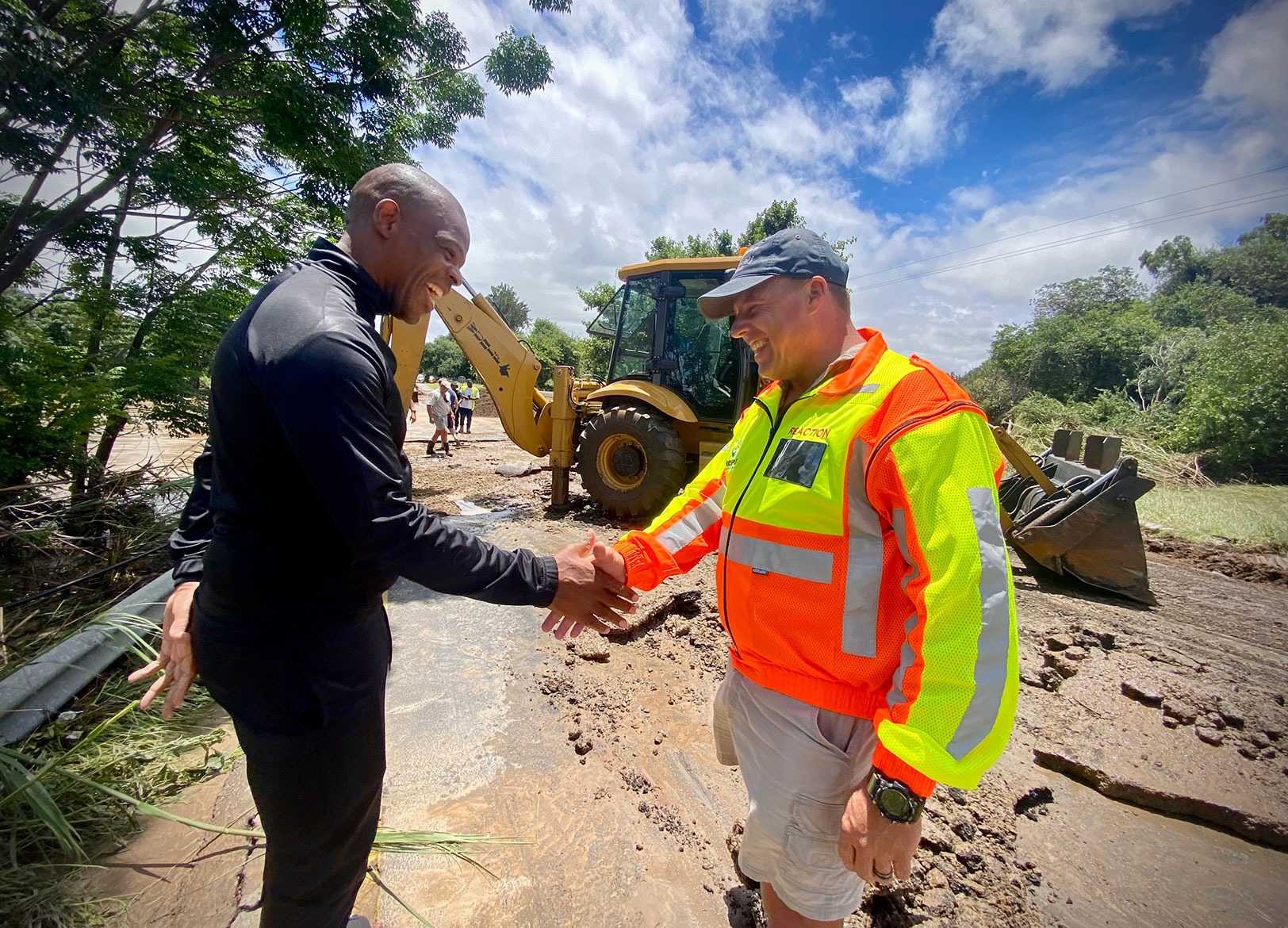
 Maruleng Mayor Tsheko Musolwa (left) and Hoedspruit Farm Watch Reaction Head Lafras Tremper (right) discuss the reconstruction of the Zandspruit Bridge on the R527, Hoedspruit, Limpopo, 15 January 2026. (Photo: Tiara Walters)
By Sunday, the full extent of the damage was still unclear, but the signs of lingering devastation wrought by this week’s flood disaster were now unavoidable. Although Kruger National Park’s southern section would reopen Monday, its northern section was still closed to day visitors.
It is this stretch of a celebrated, Israel-sized reserve that has been particularly badly rocked by days of relentless rain. On the park’s central-western flank, Eskom was still working to restore power to the remote town of Phalaborwa. Rivers still ran brown and fast, roads vanished beneath the flood waters.
And yet, amid the uncertainty brought on by a Mozambique low-pressure system, a mobilisation had been under way days before the flooding arrived in Hoedspruit — the small but vibrant town that serves as a gateway to central Kruger.
Early preparedness was not driven by press briefings or photo opportunities, Daily Maverick learnt from disaster volunteers in the safari capital. It was driven by radio crackles, WhatsApp alerts, soaked boots and people who had learnt unforgiving lessons about what rising waters could mean.
‘We remembered 2012’
By the height of the emergency last week, scores of residents and at least 150 “farm watch” volunteers were actively working through the night, drenched to the bone. They monitored rivers, pulled stranded vehicles from mud, helped evacuate tourists and residents and watched flood-prone crossings until the ashen dawn.
A volunteer safety and response network known as Hoedspruit Farm Watch, this group of several hundred members has become the backbone of the area’s disaster readiness.
“We didn’t wait to see if it would be bad,” reaction unit head Lafras Tremper told Daily Maverick. “We remembered 2012.”
Memories of the 2000 and more recent 2012 floods, also triggered by extreme weather in Mozambique, still haunted the region. Last week, farmers and residents began clearing dam spillways and weirs and opened all possible drainage channels. The logic, as they saw it, was simple: a blocked spillway upstream could mean a broken dam downstream. One failure could catastrophically cascade into another.
/file/attachments/orphans/WhatsApp-Image-2026-01-18-at-12053_750416.jpg "The Crocodile Bridge landscape in southern Kruger just before dawn, 17 January 2026. (Photo: SANParks)")
/file/attachments/orphans/WhatsApp-Image-2026-01-18-at-1205_439902.jpg "The Shalati Train on the bridge over the Sabie River in Skukuza. (Photo: SANParks)")
When the heavens finally did open over the Lowveld on Saturday, 10 January, all they could do was have faith that the groundwork had been done.
One emblem of this town’s community gees (spirit) has turned out to be the Zandspruit bridge. Perched on the R527 leading west out of the town, this is the pivotal link that many tourism operators, lodges, farms and residents count on.
By Tuesday, 13 January, Daily Maverick was on the scene as the Sandspruit River completely overtopped that connection to the outside world, swelling and spilling east and west.
Tar lifted, earth washed away. To some in this town and surrounds, access to Hoedspruit now seemed disastrously and indefinitely severed. For a bushveld dorp whose entire economy thrives on just three main roads, the risk was as immediate as it was severe.
Fixing what the water broke
Using their own volunteer funds, Farm Watch teams moved in with their tractor-loader-backhoes and other big machines as soon as water levels dropped enough to work safely. Loose tar was stripped away, temporary surfacing laid, compacted and sealed. It was not a permanent fix, but it was enough to restore access, Tremper said.
By Thursday afternoon on 15 January, two days after the bridge went under, Hoedspruit Farm Watch was able to send out a notice. The road was open again.
A surprise visit by Daily Maverick found Maruleng Mayor Tsheko Musolwa and the South African National Roads Agency on site during reconstruction. There were no cameras set up, no speeches planned. They were simply working with the Farm Watch crews, discussing river flow and how quickly businesses and packhouses could reconnect.
/file/attachments/orphans/Mayor-with-Farm-Watch_278051.jpg "Maruleng Mayor Tsheko Musolwa, left, and Hoedspruit Farm Watch Reaction Head Lafras Tremper, right, thrash out reconstruction plans for the Zandspruit Bridge on the R527, Hoedspruit, Limpopo. 15 January 2026. (Photo: Tiara Walters)
<br>")
Without road infrastructure, the mayor acknowledged, livelihoods stalled.
“We mobilised the community to help us open the road. We have experience with this rain and know how to deal with it,” he said. Hoedspruit would be back in the running as one of the country’s most pothole-free towns by the end of January, he vowed.
“We have over 45km of game reserves. We live side by side with wild animals. We have a lot to preserve in Hoedspruit,” Musolwa said. “Competing with the most travelled places like Durban and Cape Town, we have eight aircrafts landing at the Eastgate Airport every day. The flight cancellations were an inconvenience, but we’ll soon go back to normal.” (The airport has since reopened.)
In central Hoedspruit, a veterinarian made a personal calculation as water levels had risen around her home on a nearby reserve. With roads at risk of closing, she packed a contingency bag and chose to stick it out with her colleagues at Hoedspruit Animal Hospital (formerly ProVet).
“I’d rather be stranded in town where I can take care of our patients than be at home,” Dr Debbie Coetzee told us earlier this week. Due to cut-off roads, the hospital had received minimal casualties so far. “Many clients from surrounding areas can’t get out because roads are cut off. People are being cautious due to the amount of water around.”
What made the response work, volunteers told us again and again, was communication.
“We’re a community who have lived and grown together,” said Farmwatch’s Cristiena Kruger. “It doesn’t matter if we like you or we don’t like you. The moment there’s trouble, we are there.”
At least 3,000 residents were already linked on the Farm Watch network through shared radio channels and WhatsApp groups. When a river rose or a crossing became unsafe, the message spread instantly.
/file/attachments/orphans/Christiena-Kruger_951835.jpg "Farm Watch Member Christiena Kruger, who took part in the rescue and recovery effort, at Zandspruit Bridge on the R527, Hoedspruit, Limpopo. 15 January 2026. (Photo: Tiara Walters)")
/file/attachments/orphans/Hoedspruit-15-Jan_552364.jpg "The Hoedspruit town centre was returning to normal on Thursday as businesses started reopening and goods were delivered anew. 15 January 2026. (Photo: Tiara Walters)")
Minister announces relief fund
Rains were a significant challenge but somewhat less severe in Sabi Sand Nature Reserve, the enclave of private luxury reserves buttressing south-western Kruger.
While the reserve pitched in to support broader efforts, it stayed open for business. This, said reserve manager Riaan Kruger, was a reminder that the region was responding, not collapsing.
“It’s not our first rodeo, if you can call it like that. We had an early disaster meeting and put all our tools and equipment in place,” he said. Some fences were damaged but fixed “immediately”. He was quick to point out, however, that Sabi Sand had not been hammered by rains similar to 2012 or 2000.
“I’ve just spoken to some of my friends living up the Olifants River further north. They flooded worse than in 2012,” he observed.
Inside the national park itself, safety was still the clarion call, Minister of Forestry, Fisheries and the Environment Willie Aucamp said at a press conference this weekend. Aucamp visited the flood-hit park, commending South African National Parks (SANParks) for a “safety-first, human-centric” response.
/file/attachments/orphans/Anti-poachers-rescue_591546.jpg "Members of Sabi Sand Nature Reserve's anti-poaching unit were airlifted from \"an extended clandestine patrol in a strategic position\" during the rains. The aerial operation was executed by pilot Paul Lombard from Mpumalanga Helicopters. 15 January 2026. (Photo: Sabi Sand Nature Reserve)")
/file/attachments/orphans/WhatsApp-Image-2026-01-18-at-12051_590965.jpg "Letaba High water Bridge on 18/01/2026. (Photo: SANParks)")
Despite dramatic disruptions, said Aucamp, no loss of life was recorded inside the park. Staff and guests were evacuated “smoothly”, he said.
Aucamp also announced the establishment of a Kruger Relief Fund. To be “independently audited”, its vision was to support emergency supplies and longer-term recovery inside.
John Marsh, Lowveld chair of SANParks honorary rangers, told Daily Maverick the organisation had more than 2,500 volunteer members throughout the southern tip of Africa. The corps, Marsh said, was ready to pitch in with the recovery.
/file/attachments/orphans/WhatsApp-Image-2026-01-18-at-12052_571000.jpg "The status of Nsemani Dam near Satara Rest Camp, central Kruger on 17 January 2026. (Photo: SANParks)")
What reopens, what remains closed
The park had been closed to day visitors, but southern parts would reopen on Monday, 19 January due to “significantly improved” weather conditions, SANParks said on Sunday.
Day visitors were “encouraged to bring along their own essential supplies to ensure a comfortable visit” as shops were currently “low on stock”.
Northern Kruger remained inaccessible “at this stage, as several roads and bridges have been washed away. These areas will remain closed until it is safe to reopen them.”
Entry into the southern park would now be allowed through several gates. Visitors were “strongly requested” to stay off gravel roads.
‘We’ll fix it again’
More than 400mm of rain may have pelted down on Hoedspruit and its farms and wildlife estates alone in the past week, Farm Watch’s Tremper estimated.
But there is one story from recent days that will probably stay fresh in the minds of many here who never wanted to see “another 2012” in their lifetime.
It is one of a people who worked around the clock without pay or praise.
What would they do if the river reclaimed the bridge again?
The good-nature Tremper — whose handshake feels like it can crush bone like a hyena’s jaw — smiled and shrugged. “We’ll bring our vehicles. And we’ll fix it again.”
Daily Maverick also spoke with Hoedspruiters who said they were frustrated by wildly swinging rain predictions from multiple sources and apps. These, they said, seemed out of step with the downpour that people captured in their rain meters.
Rivers rose and roads vanished. But that instinct — to show up — may have been the most effective flood defence of all. DM