
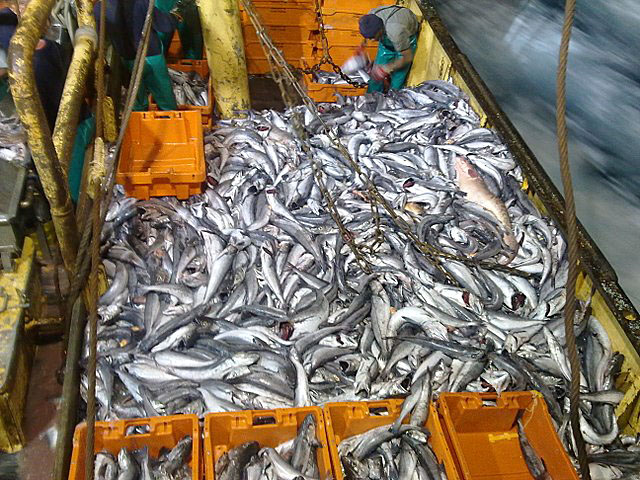
 A trawler catch. (Photo: Wikipedia Commons)
 /file/attachments/2985/TroubledWaters_405609.jpg)
Emeritus Professor Doug Butterworth is one of the world’s leading fisheries scientists. Trained as a physicist before becoming an applied mathematician, he now heads the Marine Resource Assessment and Management (Maram) Group at the University of Cape Town. His pioneering work helped shape the management procedure approach to fisheries regulation – a model adopted worldwide for balancing catches with sustainability.
Recognised with South Africa’s Order of Mapungubwe (Silver) and Japan’s Order of the Rising Sun, Butterworth is a global authority on how to keep fish stocks healthy while keeping fishing industries viable. I caught up with him to talk about quotas, total allowable catch (TAC), government policy, and the future of South African fisheries.
To start with the basics — what’s the difference between a TAC, a quota and an allocation?
People often confuse these terms. The TAC is the total allowable catch – the overall amount of fish that can be caught from a particular stock in a year. A quota, at least in our literature, is a share of that TAC. Allocations are essentially the same thing. The big challenge isn’t just calculating the TAC; it’s how those shares are allocated over time and how secure they are for industry players who must invest in boats and infrastructure.
/file/attachments/2985/ProfDougButterworth_970137_e15e3c25264d32e3295f3107972ab8dc.jpg "Professor Doug Butterworth.")
SA’s quota rights are currently issued for 15-year periods. Is that a good system?
In principle, long-term rights make sense. But 15 years creates a cliff-edge problem. For the first five years, everyone is happy – they invest, plan and build vessels. By year 11, uncertainty kicks in, investment grinds to a halt, and industry sits in limbo waiting to see what the minister will decide. It’s a shambles.
Ideally, rights should be phased – a portion gradually put back into a reallocation pool each year. This keeps things flexible for new entrants while giving existing players confidence to invest. Right now, we have people holding rights who don’t fish at all – they simply sell their allocation back to the industry at a premium. That’s a free lunch, and it drives up costs for consumers.
How do you actually figure out how much fish we can safely catch?
The principle is simple: take the interest, don’t touch the capital. You want to harvest the annual “growth” of the stock without depleting the underlying population. But it’s trickier than managing a bank account, because we don’t know exactly how much capital is in the ocean.
/file/attachments/2985/CollapseofPataghoniantoothfisheryasaresultofillegalfishingboatsDFFE_908464_e95061b832fbe3663bb8acb371dde419.jpg "The collapse of the Patagonian toothfish fishery as a result of illegal fishing boats. (Graph: Department of Forestry, Fisheries and the Environment)")
/file/attachments/2985/CollapseofAgulhassolecatches1920-2023DFFE_102365_15085e203847c25e5105d5e50ad4c957.jpg "The collapse of Agulhas sole catches 1920-2023. (Graph: Department of Forestry, Fisheries and the Environment)")
I often say fisheries management is like having an uncooperative bank teller. He’ll only tell you your balance once a year, and he gives it to you in rubles without the exchange rate. He’s off by ±20%, and even the “interest rate” – how fast the stock is growing – might be negative this year. Yet, despite all this, we still have to make decisions.
What kind of data goes into that decision?
There are two main approaches. First, we look at catch-per-unit-effort (CPUE) – essentially how much fish you catch with a standard amount of fishing effort. If trawlers have to work harder to fill their nets, it usually means the stock is going down. The good thing about CPUE is it’s cheap – the industry collects the data. The bad thing is it can be biased if fishers shift to areas with higher catch rates.
The second approach is scientific surveys. These are expensive, government-run research cruises that use the same vessel, gear and timing every year to get unbiased estimates. The problem is precision: you might only get a few surveys a year, and a single breakdown of the research vessel can throw the whole monitoring programme into disarray.
Once you have the data, how do you actually set the TAC?
We use what’s called feedback control. We start with a TAC based on our best estimate of biomass and growth rate. Then we adjust annually: if the resource index is up, we raise the TAC; if it’s down, we cut back. The size of those adjustments is tuned using computer simulations, so that even when our assumptions are wrong, the system self-corrects over time.
What about poaching and illegal fishing — how big a problem is that?
Enormous for species like abalone and rock lobster. Poaching got so bad in the early 2000s that legal quotas were slashed to near zero just to try to keep populations from collapsing completely. The market demand from the East makes this incredibly lucrative. The department simply doesn’t have the resources to police it effectively.
How strong is South Africa’s fisheries science compared with other countries?
Scientifically, we punch above our weight. The scientists within the fisheries section are very good, but there are too few of them, and their numbers are dwindling. Strategically, the department is weak. Ministers come and go, and there’s no long-term planning. What we really need is a standing strategic council – made up of retired scientists and industry experts – to advise on the long-term picture.
Globally, are things getting better or worse?
In many parts of the world, they’re getting better. The North Atlantic has seen major recoveries thanks to strict management. But in Southeast Asia, it’s still chaos. South Africa is somewhere in between – we have the systems, but not always the resources or the political will to apply them consistently.
Who is ultimately going to save SA’s fisheries — government or industry?
Probably industry. The big vertically integrated companies have the resources and the incentive to keep stocks healthy – their own survival depends on it. The government is too slow and too constrained financially to do it alone. But we have to guard against putting the fox in charge of the henhouse. There needs to be strong oversight, and the science must stay independent.
Are you optimistic about the future?
Cautiously. The hake fishery – which is the most valuable – is in decent shape. There’s slow but steady investment in new vessels. The small pelagic fishery is trickier because of natural variability, and the penguin debate has been a huge distraction. But with proper data, good science and industry buy-in, we can keep these fisheries sustainable. The worst thing we could do is lose faith in science or give up on managing them. DM
Tomorrow
Colin Attwood: Counting the uncountable and the science of tracking fish
Previously
Setting up the series: Untangling South Africa’s fishing industry
Mark Wiley: South Africa’s vanishing fish
Tim Reddell: Steering Viking Fishing through South Africa’s troubled waters