




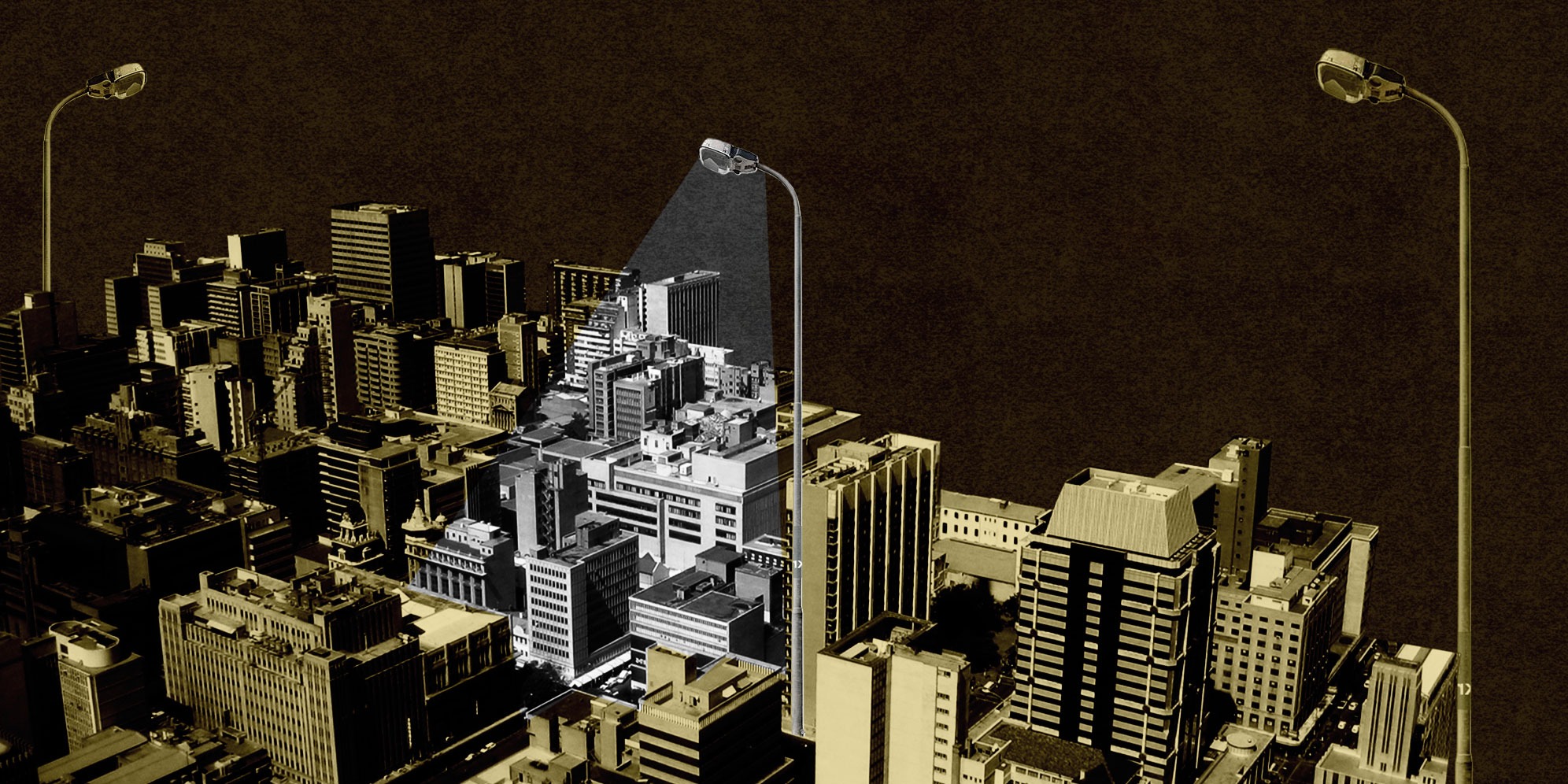
 Illustrative image: Johannesburg residents streetlights in some areas have been broken for years, leaving residents in darkness and amping up their safety concerns. (Photos: Flickr and Istock | Compiled: Daniella Lee Ming Yesca)
 Streets across Johannesburg lie in darkness as residents wait weeks for the municipality to repair broken streetlights. And the waiting times are only getting longer. Data shows that repair times for streetlights have more than doubled in the space of a year – from 7.8 days on average to 15.95 days.
The City of Johannesburg has formally acknowledged the issue. In late November 2025, Mayor Dada Morero unveiled a Christmas lights display on De Villiers Street in Johannesburg CBD as a signal of the City’s attempt to address its dark streets. Morero argued that the display showed the City’s commitment to service delivery and fixing infrastructure that had been left to rot during 10 years of volatile leadership and mismanagement.
“We want to bring a sense of security so that people can feel safe and take their phones out while walking the streets without fear,” Morero said. “But we also deal with bringing confidence to our communities […] especially dealing with the trust deficit between ourselves as a municipality and our communities.”
/file/attachments/orphans/IMG_7717_183745.jpg "The City of Johannesburg displayed Christmas lights in Main Street, Marshalltown, on 26 November 2025, signalling its commitment to fixing streetlights. (Photo: Naledi Mashishi)")
Nearby, however, the streets were dark – a sign that the City has its work cut out for it. A community investigation by Daily Maverick has uncovered a severe failure in infrastructure maintenance across Johannesburg, where hundreds of streetlights have been left in a state of disrepair for months, keeping residents in darkness and stoking concerns about security.
While the City cites the cause as rampant crime and intentional vandalism, particularly noting an increase before the G20 Summit in November, resident reports indicate the service delivery crisis predates the summit and has worsened in recent years.
Repair times skyrocket
The provision and maintenance of streetlights falls under City Power, which operates various service delivery centres. An analysis of the organisation’s annual reports reveals a dramatic disparity in service and a severe decline in performance in 2023/2024.
In 2022/2023, City Power exceeded its target for motorway streetlight repairs, averaging just 0.8 days against a two-day target. However, repairs on secondary roads were already lagging, averaging 7.8 days against a six-day target. Service varied widely by area, with Bryanston averaging two days and Hurst Hill recording an average of 10 days.
These figures worsened significantly in the 2023/2024 financial year. The average repair time for motorways increased to 2.7 days and the average time for secondary roads, main arterials, and area lighting skyrocketed to 15.95 days. The decline occurred even though the spending on public lighting remained constant across both financial years at R45.2-million.
The worst-performing areas reflected this dramatic collapse: Lenasia B recorded an average repair time of 26.92 days, followed by Lenasia, Soweto, Reuven Depot, and Hurst Hill.
Inadequate funding flagged
The problem is partly attributed to chronic underspending. A 2024 report by the Johannesburg Community Action Network (JoburgCAN) found that the City has “consistently underbudgeted for repairs and maintenance”.
JoburgCAN referenced a January 2014 National Treasury circular advising that a metro municipality should spend at least 8% of the carrying value of its assets – property, plants and equipment (PPE) – on maintenance. Yet, the 2025 medium-term budget published in May showed the budget allocated to repairs and maintenance currently averages only 6.9% to 7% of PPE.
“The level of repairs and maintenance are therefore considered inadequate to prevent breakdowns and interruptions to service delivery,” JoburgCAN said, adding that the figures could also indicate the municipality is facing cash flow problems that prevent adequate expenditure on assets.
Morero told Daily Maverick that the City has increased the maintenance budget from 4.5% of PPE to 7% within the last financial year and intends to increase it to 8% by next year, with ambitions to push it to 10% in the following years.
“We also want to increase our capital expenditure. It’s sitting just below R8-billion now. But for us to invest seriously into our infrastructure, we need to push it between R10-billion–R15-billion. So the intention is that by next year, we want to push it to R10-billion,” Morero said.
Residents left vulnerable for years
Johannesburg residents are struggling to cope with these systemic service failures. Zarina Motala, a community activist and former ward councillor in Lenasia, told Daily Maverick that entire areas have been in the dark for months, and in some cases, years.
“If I look back to at least maybe two years, there are some areas that streetlights haven’t been fixed at all,” Motala explained.
She highlighted the particularly dangerous state of Nirvana Drive, a busy taxi route next to a large wetland.
“All the lights are off on Nirvana, every single light [along] one whole stretch. Two years and all [our] main roads, there are no lights at all. [...] It’s a safety risk for everybody.”
Motala confirmed that resident appeals, including reporting outages and asking for solar installations, have often proved fruitless, with queries closed without the lights ever being fixed. She said that intentional vandalism of streetlights and illegal connections to informal settlements have worsened the problem. A video she provided to Daily Maverick shows a man intentionally vandalising a streetlight, in all likelihood to steal cables.
While City Power claims that restoration times in 2025 have improved to an average of 24–48 hours, Daily Maverick readers reported more than 105 faulty streetlights across Johannesburg, with 57 having been broken for a month or more, and 15 for a year or more. Three residents indicated that some streetlights have remained broken for five years or more.
Mountain View resident Sally Gallagher told Daily Maverick that the streetlights in her area have been on and off for six years. Residents have repeatedly appealed to the City to fix them, but in recent years their appeals have been ignored.
“There are a lot of trees in the road and it is very dark indeed at night in the road. The whole street was out several times, and we used to report it and City Power would come and replace cables underground and above ground. Then it would all go dark again,” she said.
“We have actually given up on lodging complaints with Johannesburg City Power because they just stopped responding.”
‘Unprecedented vandalism’
Acts of vandalism have been flagged by City Power for years. City Power spokesperson Isaac Mangena confirmed that theft and vandalism reached “unprecedented levels” during the 2023/2024 financial year, further delaying restoration times.
Criminals specifically target valuable components, such as area bundle conductors, which are used to facilitate illegal connections in informal settlements. They even steal from underground infrastructure in areas where illegal miners operate.
“The findings indicate that individuals have been illegally creating medium-voltage distribution networks and using stolen streetlight components to illuminate informal settlement pathways, a major driver of ongoing theft and vandalism in surrounding areas,” Mangena said.
He cited an operation in October 2025 at Pipeline Informal Settlement where authorities recovered 150kg of stolen aluminium bundled cable (worth roughly R250,000) and multiple streetlight fittings.
Mangena said that in high-risk areas, criminals intentionally sabotage streetlights to create dark spots for robberies, hijackings and break-ins.
Mangena noted this leads to a destructive cycle. “These hotspots experience repeated vandalism, where lights repaired on one day are often destroyed again within 24 hours. This cycle severely affects restoration timelines, [...] creating the perception of underperformance when the real driver is sustained criminal activity.”
/file/dailymaverick/wp-content/uploads/2025/07/WFD_0709.jpg "Vandalised streetlights along the R82 (Old Vereeniging Road), south of Johannesburg, on 14 July 2025. (Photo: Felix Dlangamandla)")
However, data on the exact number of cases is hard to find and has been flagged by the opposition party. DA Johannesburg caucus leader Belinda Kayser-Echeozonjoku said there has been a systemic failure by the City to adequately protect its infrastructure. She added that there is a “transparency issue”, and the City has not been clear about how many cases it has opened and what action it has taken to address crime and vandalism.
“Successive mayors have indicated that Johannesburg has more than 5,000 cameras across the city, yet these are not being effectively used to safeguard critical infrastructure, particularly along major routes where vandalism is common. The absence of camera monitoring, bylaw enforcement and available facial-recognition tools has significantly weakened the City’s ability to deter crime and protect assets.”
She said the DA had proposed the establishment of an infrastructure protection unit, but this was not adopted by the City.
Non-profit steps up with solar solution
To fill the service gap, the non-profit organisation Jozi My Jozi launched its Light Up Jozi campaign in 2023, beginning by lighting the Nelson Mandela Bridge. The organisation has since expanded its Gateway Project, installing solar-powered lights fitted with anti-theft tracking systems across the Braamfontein and Ellis Park precincts.
/file/dailymaverick/wp-content/uploads/2024/08/AV_00031971.jpg "The lighting on Nelson Mandela Bridge in Johannesburg is thanks to civil society organisation Jozi My Jozi. (Photo: Sydney Seshibedi / Sunday Times / Gallo Images)")
Wayne Dawson, who leads the organisation’s safety and security team, believes the solar lights are critical for creating a “24-hour city”, noting that the lights need just six hours of sunlight to operate for up to four days.
Jozi My Jozi has installed almost 1,200 solar lights throughout the CBD and plans to install another 500 by the end of the year. After an initial crowdfunding campaign failed, it has secured partnerships with the public and private sectors.
The City has acknowledged the utility of this approach, giving Jozi My Jozi the greenlight to install 7,000 more lights around the CBD. The municipality itself has also committed to solar solutions, installing 78 solar high-mast lights, 300 solar-powered streetlights, and retrofitting 1,800 existing streetlight units with solar power during the 2024/25 financial year. DM