




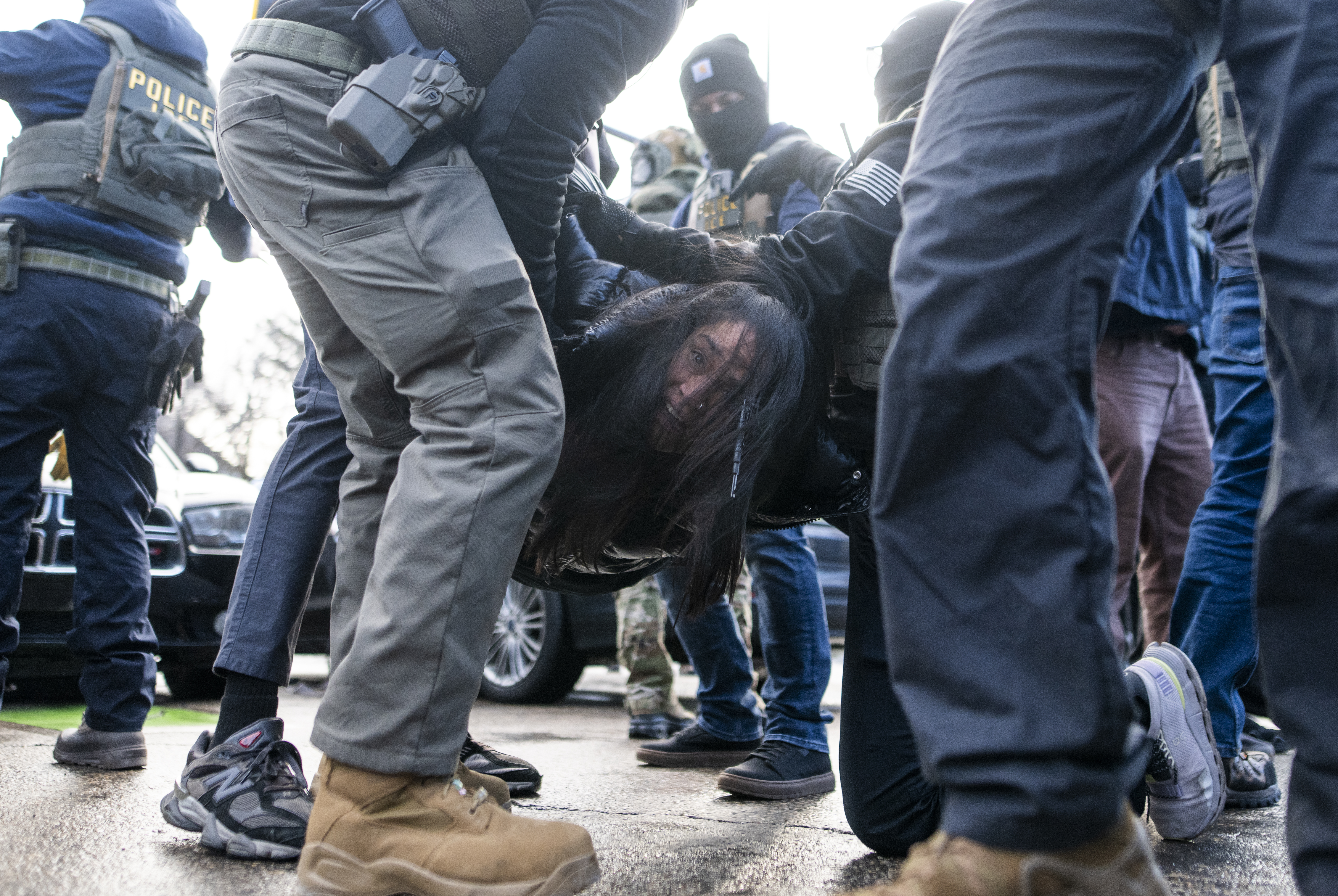
 ICE agents detain a woman after pulling her from a car on 13 January 2026 in Minneapolis, Minnesota. The Trump administration has deployed more than 2,400 Department of Homeland Security agents to the state of Minnesota in a push to apprehend undocumented immigrants. (Photo: Stephen Maturen / Getty Images)
 /file/dailymaverick/wp-content/uploads/2025/10/label-Op-Ed.jpg)
Donald Trump really doesn’t like Somalis. He has repeatedly called them “garbage” and says their country stinks. “We don’t want ’em in our country,” he told a cabinet meeting. They should “go back to where they came from.”
Trump seized on a fraud investigation in Minnesota to single Somalis out for “ripping off” welfare and fraud systems, then unleashed the right-wing media pitchfork brigade – with Elon Musk enthusiastically lighting the way.
/file/attachments/orphans/5018827_890004.jpg "A Somali woman weeps after being told that her sister might have been killed during a riot in the predominantly Somali neighbourhood of Eastleigh in Nairobi, Kenya, 19 November 2012, after Kenyan youths blamed ethnic Somalis for a series of attacks in the country. (EPA / Daniel Irungu")
Of course, Trump had other reasons to target Minnesota. It is a Democratic state whose governor, Tim Walz, was Kamala Harris’s vice-presidential running mate.
But Somalis were the perfect scapegoat to rally the Maga faithful. They are Muslim. They are dark. They are largely poor. And the country they come from is the embodiment of a failed state.
Having stripped thousands of Somalis of their temporary legal status, the White House’s deportation machine launched Operation Metro Surge into Minnesota to hunt down, round up and brutalise brown-skinned people. Undocumented immigrants, as well as many citizens and even Native Americans, were caught in the dragnet.
The crackdown became a national flashpoint when a white woman protestor, Rene Good, was shot dead by an ICE agent on 7 January. Rather than slowing down, the administration escalated, sending hundreds more ICE agents into the Twin Cities, Minneapolis and St Paul.
The invasion of Minnesota has been met with spirited resistance. An organised network of ordinary residents now shadows ICE agents, filming their every move in an effort to prevent abuse and violence. Many of them are middle-aged white women, dubbed Awful (Affluent White Female Urban Liberal) by Maga.
/file/attachments/2986/GettyImages-2256106050_491415.jpg "Tear gas tossed by federal immigration agents fills the air as agents clash with residents while trying to retreat following a house raid on January 13, 2026 in Minneapolis, Minnesota. The Trump administration has sent an estimated 2,000 federal agents into the area, with more on the way, as they make a push to arrest undocumented immigrants in the region. (Photo: Scott Olson/Getty Images)")
The fear is that the over-the-top aggression is deliberate: a strategy designed to provoke chaos. A rerun of the Black Lives Matter protests of 2020 would give Trump the pretext to invoke the Insurrection Act, dramatically expanding his power and his ability to deploy the military nationwide.
But it is a political battle that Trump is losing. Turning Minnesota into a war zone is not popular. Most Americans blame the violence on the administration’s tough anti-immigration policies, once Trump’s strongest issue.
Writing in The New York Times this weekend, Jamelle Bouie put it plainly: “When I look at the ICE operation in Minnesota, I don’t see an administration exercising strength. I see a White House that is panicking and that is losing. I think that this aggression represents political weakness…”
‘What is Somaliland?’
/file/dailymaverick/wp-content/uploads/2024/11/12625438.jpg "Voters line up outside a health centre to cast their votes for the presidential election in a health centre in Hargeisa, self-recognised Somaliland, 13 November 2024. (Photo: EPA-EFE / Isak Abdiamin)")
Yet even as Trump fixates on Somalis as disposable people, he appeared genuinely baffled when, one day after Christmas, Israel became the first country in the world to grant recognition to Somaliland, an autonomous region of Somalia.
“Does anyone know what Somaliland is, really?” Trump reportedly asked a New York Post reporter who informed him of the development.
Somewhere in his brain, he might have made a mental note to ask Prime Minister Benjamin Netanyahu why he coveted a country populated – in Trump’s own terms – by the same “losers” he is trying to run out of Minnesota, and one with no obvious jackpot of rare earth minerals or oil.
Netanyahu would have explained that Somaliland sits along the Gulf of Aden at the doorstep of the Bab al-Mandeb – the narrow gateway between the Indian Ocean and the Red Sea/Suez Canal system – through which a large share of global commerce and oil flows daily. Control, access and influence here shape shipping costs, energy security and military reach across Africa, the Middle East and Europe.
Somaliland’s economic lifeline is the port of Berbera, managed and operated by Dubai Port World, which has invested $500-million in turning it into one of the most technically modern ports in the region. Berbera is also a vital link in the chain of an Emirati coastal empire that includes more than a dozen key ports around Africa.
Israel’s interest in the Horn is not new. But the need for a military footprint to protect maritime access acquired new urgency in late 2023 when the Houthis began attacking commercial shipping and naval forces in the Red Sea and Gulf of Aden, in protest against the killing of Palestinians in Gaza – imperilling the route to Israel’s southern port of Eilat.
Recognition of Somaliland is also part of a new great game in which Turkey has surpassed Iran as Israel’s most consequential regional rival. A shadowy contest now runs through Syria, Gaza, the Balkans, the Eastern Mediterranean and the Horn. Turkey maintains its largest overseas military base in Somalia and is steadily expanding its influence across Africa.
The great rupture
Israel’s recognition of Somaliland was part of a broader regional gambit seemingly devised with Sheikh Mohamed bin Zayed bin Sultan Al Nahyan (MBZ), the President of the United Arab Emirates and ruler of Abu Dhabi.
A few days before the recognition, UAE-backed forces of Yemen’s Southern Transitional Council, on the opposite side of the Gulf of Aden, launched an offensive to capture two large provinces – one bordering Saudi Arabia – as a prelude to creating a separatist state in southern Yemen. Had it succeeded, the Israeli Emirati axis could have controlled both sides of the Gulf of Aden – a reminder of why Somaliland and Aden came to be British colonies in the first place.
According to David Hearst, editor of the London-based publication Middle East Eye, the long-term Israeli Emirati plan is to fragment Arab states, dominate key trade routes like Bab al-Mandeb and plant military bases across the region. Had they succeeded, Hearst argues, they would have secured “lucrative military and financial control for the rest of the century.”
But the move in Yemen was a bridge too far for Saudi Crown Prince Mohamed bin Salman. He backed a counter-offensive by forces loyal to Yemen’s government that swept in to capture Aden. The Saudis bombed a shipment of Emirati weapons in the port of Mukalla, and MBZ was forced to withdraw his forces from Yemen.
It marked a fundamental schism between two long-term allies – and it immediately rippled into Africa.
Saudi Arabia and Egypt moved to cut UAE-linked weapons networks running through the Libyan desert that have been feeding the Rapid Support Forces in western Sudan, dealing a blow to Hemedti in the middle of his offensive against El Obeid and in other parts of the country.
In Somalia, authorities cancelled Abu Dhabi’s security and port agreements and shut down Emirati military facilities. Somalia’s stance was backed by virtually the entire UN, the African Union and China – which has its largest military base in Africa in neighbouring Djibouti (as does the United States).
Egypt cut links with General Khalifa Haftar, the UAE-backed warlord who controls eastern Libya, and Bloomberg reported that Saudi Arabia is building a new military coalition with Somalia and Egypt, which has the potential to rewire Africa’s conflict zones.
The hope that other countries would follow Israel and recognise Somaliland – Ethiopia, Morocco, Kenya and India were all being lobbied – quickly evaporated.
Waiting for Donald
With the UAE’s shadow empire embattled and Israel’s recognition of Somaliland finding no other takers, the Somaliland gambit now hinges on which way Donald Trump will jump.
In Washington, think tanks like the Hudson Institute and the Wall Street Journal editorial page are pushing hard for Somaliland’s independence. And it is true: Somaliland has a legitimate claim to statehood. It was a British colony that was briefly independent in 1960 before voluntarily joining the former Italian colony of Somalia in the south.
The French historian Gérard Prunier’s book, The Country That Does Not Exist, tracked Somaliland’s three decades of democratic elections, peace-building, and distinct national identity – an arc that stands in stark contrast to the chaos in neighbouring Somalia.
Somaliland was never allowed to formally secede because of the African Union’s foundational policy of preserving colonial borders. That doctrine was designed to prevent endless fragmentation. Yet Somaliland has always been its most vexing case – as Prunier wrote, the collapse of the “united” Somali state opened a legal gap in the post-colonial logic, a situation where reality and legality no longer coincided.
The problem with Israel’s recognition is that it does not bring reality and legality closer. It turns sovereignty into a weapon. The Cold War taught Africa a brutal lesson: when a fragile country is used as a football in a bigger geopolitical game – when borders become bargaining chips for outsiders chasing leverage over ports, shipping lanes and military reach – violence spreads and the local population pays the price.
The ghosts of that era are returning – not with Soviet flags or American proxy armies, but through ports and bases, drones and shipping lanes, covert influence and recognition diplomacy.
Trump faces a dilemma of his own. The choice of recognition of Somaliland is between defying Turkey’s Recep Tayyip Erdogan and MBS on one side, or MBZ and Netanyahu on the other.
Throughout his first term, Trump has oscillated between supporting Netanyahu’s war agenda and MBS’s vision of a reordered Middle East. During his trip to the Gulf last May, he seemed to be dumping the neocons and aligning with MBS, only to be pulled back into Netanyahu’s orbit when he joined the bombing of Iran during the 12-day war in June.
Saudi Arabia’s pushback acquired a critical urgency in the new year as the demonstrations in Iran rapidly turned into an insurrection, and fear grew that an American intervention would destabilise the region.
Out of these events is emerging a new regional alliance of Muslim states – Saudi Arabia, Turkey, Qatar, Egypt and nuclear-armed Pakistan. They might have different agendas, but all have an interest in keeping the peace.
The Gulf states hold more cards – and have more gifts to offer a transactional president – than Netanyahu. Just last week, Trump deposited $500-million in profits from the sale of Venezuelan oil into an offshore Qatari bank account. His hesitation on bombing Iran, seemingly at the behest of the Saudis, has already reportedly caused consternation in Jerusalem.
Asked in a wide-ranging interview with The New York Times whether there were any limits on his global powers, Trump replied: “Yeah, there is one thing. My own morality. My own mind. It’s the only thing that can stop me.”
The United States may have overwhelming military power. But the past few weeks have shown that the Middle East’s future will increasingly be shaped on MBS’ terms, not America’s.
Ghosts of the Cold War
One of the faces of community resistance in Minneapolis is Ilhan Omar, the combative representative from Minnesota’s Fifth Congressional District, who has been the target of Maga vitriol amid calls for her to be denaturalised and sent “home” to Somalia.
Elon Musk – obsessed with the conspiracy theory that Democrats imported tens of millions of illegal immigrants to vote for them – claims Omar wins elections because “a large number of relatively recently arrived Somalis will elect only a Somali to Congress in that Minnesota district.”
Like many things Musk posts, this was false and inflammatory, and Omar shot back: “You are one of the dumbest people on earth. My district is literally a majority white district.”
Musk and Omar are both immigrants from Africa. But while Musk grew up in an upper middle-class home in Waterkloof, Pretoria, Omar spent her early years in the Dadaab refugee camp in Kenya before moving to the United States.
Her family fled Somalia’s civil war perpetrated by the brutal regime of Mohamed Siad Barre, whose security forces massacred tens of thousands of civilians. The worst atrocities were committed in the north, with a genocide directed against the Isaaq clan in what is today Somaliland.
It was this repression – alongside the near-destruction of Hargeisa and Burao – that convinced Somalilanders to break with Mogadishu and declare their own independent nation. It was these same events that drove hundreds of thousands of Somalis to seek shelter in the United States. The majority ended up in Minnesota.
Though it is easy to forget in the fog of all that has happened since, Siad Barre committed these excesses while he was a client of the United States. He started as a surrogate of the Soviet Union, but switched sides after his mortal enemies in Ethiopia came under the control of a pro-Soviet Marxist-Leninist military government, which overthrew America’s ally, Haile Selassie.
Somalia’s civil war cannot be understood outside the prism of the Cold War, which exacerbated local problems born of clan rivalries and colonial borders that sliced Somali territory into five countries.
The Somalis of Minnesota are not the freeloaders of Trump’s imagination, but a community of immigrants struggling to get by. Many still help support families nearly 13,000km away, who survive in one of the most hostile environments on earth.
Last week, US Treasury Secretary Scott Bessent tightened oversight of money transfers from Minnesota’s Somali community, including those sent back to Somalia through the so-called Hawala system.
This gratuitous act of cruelty exposes a deeper truth tying Minneapolis to Mogadishu, Berbera, and Bab al-Mandeb. The people Trump treats as expendable – the “wretched of the earth”, the refugees, the hawala senders, the ones he tells to go back – do not exist on the margins of history.
They are the connective tissue of global politics. And in the age of chokepoints and deportation raids, recognition diplomacy and armed borders, they are the ones who absorb the blows first – until the rest of the world finally realises it is standing in the blast radius too. DM
Phillip van Niekerk is the managing partner of Calabar Consulting, a risk consulting company specialising in Africa. The views expressed are his own. He also publishes Africa Unscrambled on Substack.