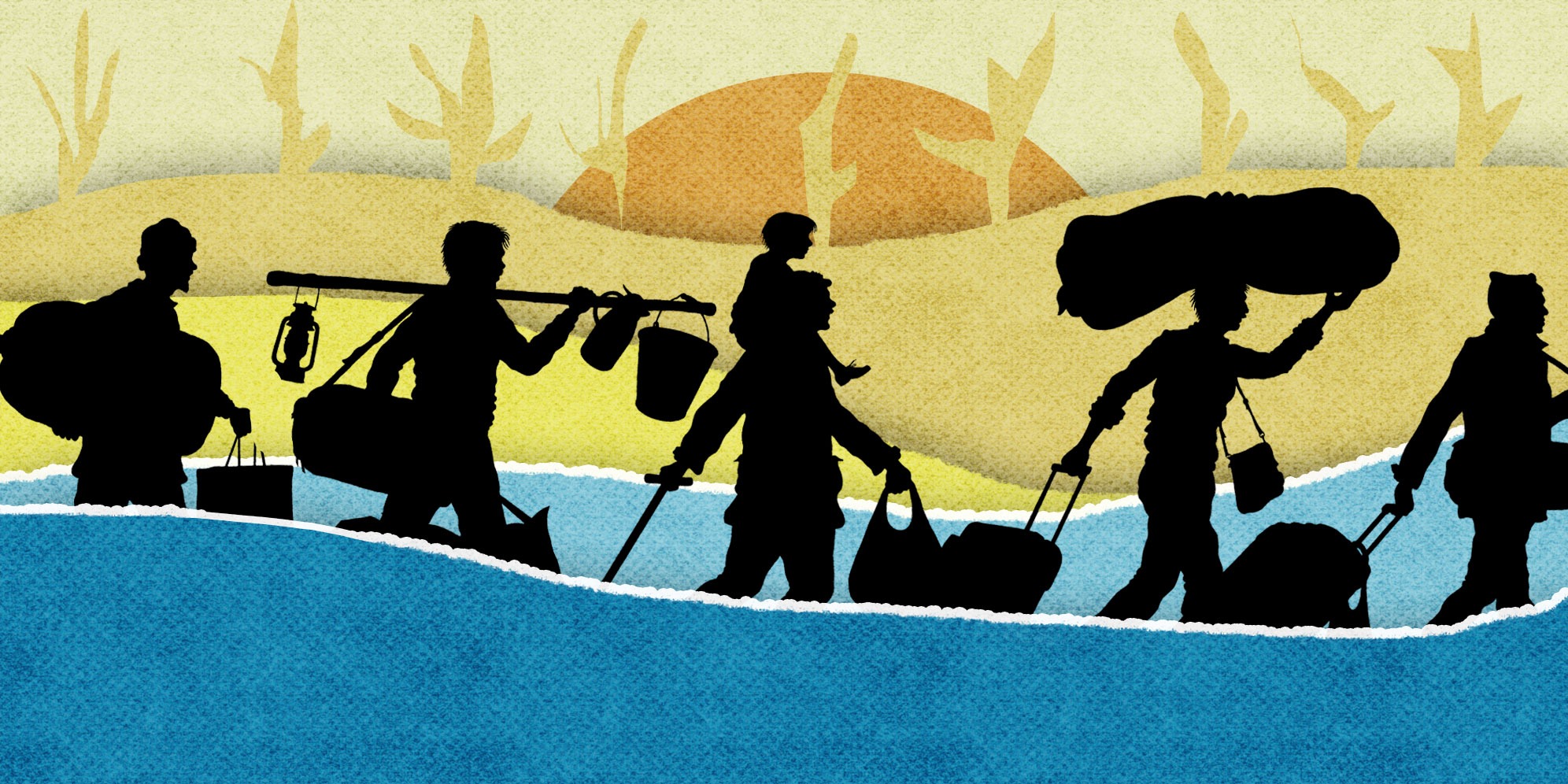
 Illustrative Image: People migrating. (Image: iStock) | (Graphic: Daniella Lee Ming Yesca)
 ‘Crop yield, livestock failed. That’s why we came to South Africa confident of a fresh start,” says Joshua Tuso (41), an undocumented migrant from Zimbabwe.
But “it has been an ugly reception here”.
He bemoans two cold choices he now faces in South Africa: returning to impoverished lands in Zimbabwe, or being constantly on the move around South Africa to survive “under the table”.
Blighted land
In 2024, we followed a dozen refugees from Zimbabwe, Malawi and other regional nations who had paid to be smuggled into South Africa via the notorious forest paths that line the Limpopo River at Beitbridge.
A common thread ran through their stories: the extremely punishing drought of 2024 (fuelled by the El Niño weather effect) was not a one-off event but a growing phenomenon of extreme weather wreaking havoc on small-scale rural crop and livestock farming families in frontier countries such as Zimbabwe and Malawi.
“We are being whacked by the weather. Everything is in peril – topsoil, groundwater and grazing grass… the farmer’s family that must sell their assets, move to cities or down to South Africa,” says Chimwene Phiri (35), a former rural carrot and maize cultivator from Shire Valley in southern Malawi, a “bread basket” region where extreme droughts and floods are ruining small-scale farmers.
We were shown how smuggler networks along South Africa’s vast borders with Zimbabwe and Mozambique are thriving, easily shuttling migrants, political refugees and former farmers fleeing failing lands into South Africa. And as the punishing heat dramatically lowers levels in the fearsome Limpopo River, smugglers have an easy time bringing more undocumented migrants into South Africa, they told us.
Somebody broke into his shack and scrawled ‘kwerekwere’ (a derogatory word for foreign nationals) on the window.
“We arrived in South Africa with big, bumper hopes,” says Tuso, who lost his fourth straight harvest and saw most of his goats die in the 2024 drought. He hoped to start “decent” work immediately, earn money and send some back to Zimbabwe to process passports and bring his family here. He headed to Cape Town where an uncle had promised him a job as a trucker’s assistant for a farmer who supplies fresh potatoes to supermarkets.
Nightmare
But their new livelihoods in South Africa have been a mirage, say Tuso and Phiri.
The job Tuso’s uncle promised turned out to be a sham. His uncle switched off his phone and was nowhere to be found. Without money, Tuso was stranded and forced to sleep at a mall. After seven days he called the farm and told them his uncle had promised him a job. “The company manager told me a local xenophobic labour leader on the potato farms was incensed that ‘foreigners’ were driving potato trucks, and threatened to take ‘action’. The farm owner became unsettled and my uncle was fired for stealing a bucket of potatoes.”
Desperate, Tuso sold his two cellphones and rented a one-room shack in Khayelitsha where he carried household coal sacks for about R400 per week.
Xenophobia reared its head again.
On his street a local gang leader with ties to a xenophobic outfit was issuing subtle threats to landlords who rented rooms to “non-South Africans”. Four weeks later somebody broke into his shack and scrawled “kwerekwere” (a derogatory word for foreign nationals) on the window.
Read more: Inside the Musina-Zimbabwe smuggling network
“I knew it was probably petty thieves but I couldn’t take a chance on the hate message,” he says of his decision to hitch a ride on a lorry back to Johannesburg where he now rents a room, alternating between idleness and occasionally directing cars in the East Rand Mall car park, “fiercely competing” with more established, and undocumented, Malawian migrants “who don’t want to see me on their turf”.
Loren Landau, the former chairperson of the Consortium for Refugees and Migrants in South Africa and past member of the president’s Immigration Advisory Board, says that when foreigners arrive in areas within host countries that are already poor, “it’s often a recipe for disaster” in terms of community relations.
Compounding his woes, Tuso’s family in Zimbabwe – five children and two wives – have been frantically calling, asking for money for food, school fees and medicine, and wanting to know “when will I organise visas for them to follow me in South Africa”.
“I’m so ashamed,” he says, adding that he avoids their calls.
My family must not know that I am this idiot loser in South Africa.
Tuso is thinking about boarding a bus back to Zimbabwe where he has heard there is a boom in the construction of suburban “cluster homes”, fuelled by the earnings of illegal gold miners and the country’s diaspora. He hears workers are urgently needed for plastering, bricklaying and tiling. However, there is a steep cost: besides bus fare he would need R3,000 to bribe South African policemen on the N1 highway and South Africa Border Management Authority officers at Beitbridge, as well as Zimbabwean immigration officers, to avoid being jailed for sneaking into South Africa illegally in the first place.
Though he entered through informal “border jumping”, taking the illegal Limpopo River route is out of question now, he says, because he heard the guma guma smugglers have started using violence again to extract money from their clients as Christmas and the new year approach.
“My family must not know that I am this idiot loser in South Africa, and I am privately wanting to return to Zimbabwe,” says Tuso, revealing that he knows of 20 Zimbabweans from his village who have become disillusioned by conditions in South Africa and are willing to return to Zimbabwe to try their luck in the booming illegal gold mining sector.
“For each trip back to Zimbabwe, each bus from Newtown to Zimbabwe we pack 40% of its passengers, (35 adults) being clients without passports and visas living under the table in South Africa, hopeless of the situation here,” says Ed “Sticks” Goto, a well-known bus tout at the Newtown cross-border bus terminus in downtown Johannesburg.
‘A scrap of a life’
Phiri too has found the going tough in South Africa. He spends his days hanging out at the Springs Hotel, a popular licensed brothel in Springs, a decaying post-industrial town 60km east of Johannesburg. The hotel is a liquor draw for migrants from Zimbabwe and Malawi. There is not much for him to do at the brothel besides sometimes cleaning patrons’ cars, for which he is sometimes paid in beer by stingy clients.
When he arrived in South Africa in 2024, a Malawian friend told him that he earned money at the hotel by hustling out the competition from dozens of other young Malawi men polishing wheels. “It’s a scrap of a life and once I was tempted to steal a toolbox from the boot of a brand-new BMW I was cleaning. I got an embarrassing clap.”
Phiri stayed for a week with his friend in Reiger Park, a township in Boksburg on the East Rand that is notorious for gangs settling scores via massacres. The gangs “quickly spot and flag down a new face and will get suspicious if they know you’re a foreigner, because foreigner to them means police informer”. He and his friend now alternate between sleeping in the public foyer in the nearby OR Tambo Airport arrivals section and a back room at a taxi rank behind the Springs Hotel.
They must keep an eye out for police and immigration officers who raid the hotel, usually at month end, to extract bribes from undocumented patrons.
Phiri is adamant that he won’t go back to Malawi, despite the dramatic recent change of government. “In Malawi we eat once a day in my village – here I can manage [with] three meals and be idle afterwards,” he says.
Though the hard data is not being tracked, deepening poverty brought by extreme droughts and floods are creating a wave of migrants who are stuck between remaining on the periphery in a hostile South Africa and returning home “where subsistence farming is increasingly pointless”, says Tapuwa Nhachi, a veteran climate campaigner and former analyst at the Zimbabwe Center for Natural Resources Governance.
“These are the missing demography whenever relief agencies and governments are proposing climate-proof solutions to keep stressed rural farmers on the land in frontier countries to South Africa. Their agricultural skills honed in families for decades are eventually lost to illegal migration,” he says of the plight of people like Tuso and Phiri. DM
Reporting for this story was supported by the Pulitzer Center.
This is the second of two articles on how climate change and extreme weather is pushing rural farmers off the land in countries such as Malawi and Zimbabwe and forcing them to migrate to South Africa. Read the first article here.