




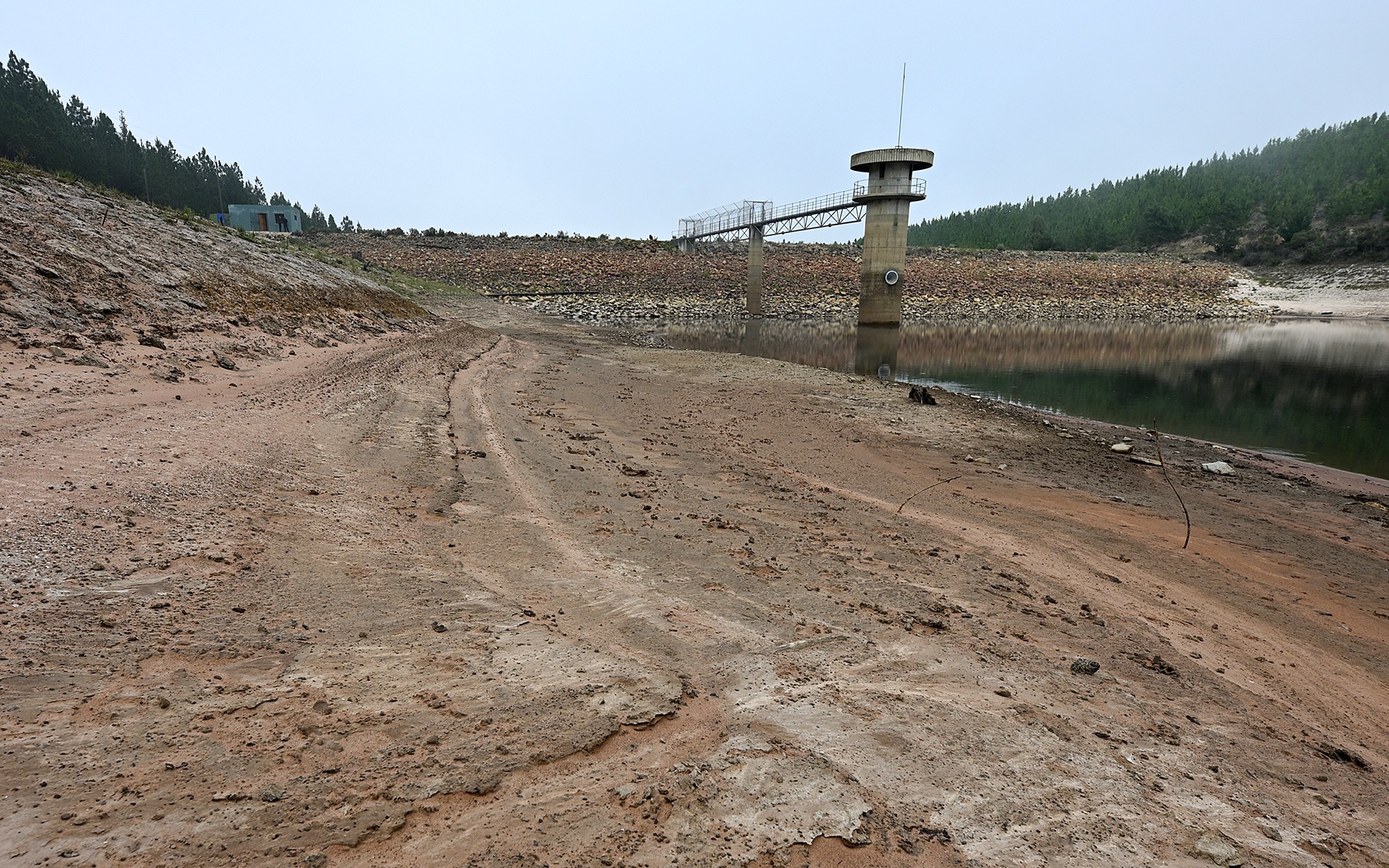
 On 13 January 2026 there were only 10 days of drinking water for Knysna left from the Akkerkloof Dam. (Photo: Mark Taylor)
 As of Friday, 16 January, Knysna’s Akkerkloof Dam – the town’s main source of water – was around 15% full, which, at the current consumption and wastage rate, means the town has just 10 days before the taps run dry.
The crisis, however, has been building for years, with half of the municipality’s water revenue lost due to leaks and illegal connections, as well as buckling infrastructure that hasn’t been upgraded in decades.
A joint operations committee (JOC) has been set up to coordinate the response to the crisis. It brings together national, provincial and local government bodies to assess water levels, plan interventions and monitor progress. It includes the Knysna Municipality, the Western Cape Department of Local Government, the National Department of Water and Sanitation and the Garden Route District Municipality.
The worst-case scenario, in which water use is not curbed and more flows out of the Akkerkloof Dam than what comes in, is referred to as Day Zero – a situation that occurred in Cape Town in 2018 but was narrowly averted as taps almost ran dry.
/file/attachments/orphans/Mark_Taylor_AkkerkloofDam_D24_759173.jpg "On 13 January there were only 10 days’ drinking water left for Knysna in the Akkerkloof Dam. (Photo: Mark Taylor)")
“In the event of Day Zero, the reticulation system of water will be shut. Taps will be dry and residents will have to fetch water from collection points in the town,” Western Cape head of department for local government Graham Paulse said in a JOC press briefing on Tuesday, 13 January.
Western Cape local government MEC Anton Bredell said that he would be “going on his knees” to Treasury and Cabinet next week to have the Knysna water crisis declared a provincial disaster, which would expedite funds from the national government to alleviate the situation.
He said that drought conditions had caused Garden Route dams to be significantly lower than usual: “Garden Route dams [combined dams for the area] are 43.5 % full this year compared to 90% this time last year.”
Knysna Mayor Thando Matika warned that the water situation was “a crisis” and that to avoid Day Zero, cooperation between national, provincial, private and public and the whole community was needed urgently and immediately.
On Friday, the Knysna Council declared the Greater Knysna Municipal Area a local disaster.
“This allows for much-needed national and provincial interventions. It also allows the mayor to authorise unforeseen and unavoidable expenditure in emergency or exceptional circumstances for which no provision was made in the approved budget,” Matika said.
He said while the area experienced 50mm of rainfall on Thursday, “this is insufficient to overcome current supply challenges”.
/file/attachments/orphans/Mark_Taylor_AkkerkloofDam_20260111D8_800601.jpg "Akkerkloof Dam at 15% full on 13 January 2026. (Photo: Mark Taylor)<br>")
Emergency measures
Matika said the municipality and province were “working very hard” to avoid Day Zero and short- and long-term solutions were being urgently deployed.
While the Balancing Dam is currently at about 90%, the JOC said this does little to offset the rapid depletion of the Akkerkloof Dam, which remains the primary source for the system. Rain predicted for Thursday may help nominally, but not nearly enough to save the day.
The current use of potable water from the Akkerkloof Dam is 12 megalitres per day, which is more than the water coming in. During the holiday season, this increased to 16ML per day.
Currently, Level 4 water restrictions are in place, with each household restricted to 6 kilolitres per month, which in a household of four works out to 50l per person per day.
Knysna residents are urged to stay within their limits and adhere to Level 4 restrictions, while the top 100 businesses in the town have been warned in writing to curb their use.
Although the names of the companies were not divulged, it was made clear at the meeting on Tuesday that the municipality will not hesitate to publicly “name and shame” companies and even individuals who waste water, said Johnny Douglas, Knysna Municipality’s director of community services.
Douglas said there would be weekly readings to check whether these companies were compliant.
The JOC is focusing on short-term initiatives to add additional water to the supply system.
These include: the development of several springs with good-quality water; the refurbishment of seven boreholes that need cleaning and new pumps; investigating in establishing more boreholes; the finalisation of an agreement to use 10 boreholes on private land owned by PG Bison; and an agreement to get access to water from a borehole at the Knysna mosque.
Other measures:
- Water meters will be installed in homes where there are none or they are broken. Illegal water connections will be tackled;
- Extra plumbing teams have to come on board immediately, so water leaks can be dealt with urgently. There will also be a rapid response team so leaks can be stopped and water saved as soon as possible; and
- The possibility of a dam being built at the Charlesford catchment area is being investigated. Three bigger pumps are needed there to pump at the required capacity.
There’s also a plan to distribute bins to residents to catch rainwater, Ward 11 councillor Russel Arends told Daily Maverick.
Discarded wheelie bins, at least 1,000 of them, which were intended to be issued to all residents for rubbish collection, have been lying unused in the industrial area of Knysna for several years. Residents call this the “bin graveyard” in Vigilance Drive. These will be issued to residents to catch water.
The plan for how they will be distributed has not been divulged yet.
/file/attachments/orphans/Mark_Taylor_BinExcess_20260113_0008_D_598137.jpg "The Knysna Municipality plans to distribute bins to residents to catch water. (Photo: Mark Taylor)")
All these will cost hundreds of millions of rands, which Knysna does not have, meaning provincial help is so desperately needed, said Bredell.
Knysna’s economy is heavily dependent on tourism and such restrictions could significantly dent the area’s economy.
However, Colleen Harding of Hideaway Guest House and Knysna Accommodation Establishment, a local industry body of guesthouses, B&Bs, self-catering properties, boutique hotels and related tourism businesses in Knysna, said Knysna is still open for business.
“There will be flyers explaining the water situation in rooms so that guests understand the importance of water rationing.”
Kate Christie, general manager of the Turbine Hotel, said there had not been significant booking cancellations. “On arrival guests will be told about Level 4 water restrictions and they won’t be able to use the baths in the hotel.”
Infrastructure decay
Due to years of infrastructure decay and maintenance neglect, the crisis was predictable. More than 50% of the water being used is not accounted for and described as “lost”.
“We know of at least 8,000 households which bypass water meters with illegal connections, and in other instances meters are broken,” said Bredell.
No revenue is recouped from this lost water.
Frequent pipe bursts and water leaks account for more water wastage. “At this rate, if we don’t add to the water levels of the dam and draw more than what goes in, we will run out,” Bredell added.
/file/attachments/orphans/GushingWasteofWater_805273.jpg "Water gushes from a broken pipe in Knysna. (Photo: Supplied / Peter Bester)")
Arends, who chairs the Knysna Municipality Infrastructure Committee, gave Daily Maverick an exclusive interview. He explained that the critical water situation Knysna faces was inevitable.
“The original water infrastructure was built decades ago for a population of 60,000 people and there are now in excess of 100,000 living in Knysna. The infrastructure has not been upgraded for more than 30 years, while the demand on it has grown hugely.”
Arends said: “There is a network of old asbestos pipes carrying water as long as the distance from Knysna to Cape Town. While a few of these pipes have been replaced with PVC, the system is very old in some places and the whole thing needs replacing.”
There are breaks in water pipes around Knysna at least every two days, which causes long outages for residents in various areas. Then the pipes need to be bled to get the air out, which wastes more water, he explained.
“When we fix the pipes as they break, we then need to bleed them for air, otherwise they break again and this process also takes time and uses more water.”
/file/attachments/orphans/Cllr-Russel-Arends-ANC-Ward-11-682x1024_693333.jpg "Ward 11 councillor and Knysna Municipality Infrastructure Committee chairperson Russel Arends.<br>(Photo: Supplied / Russel Arends)")
(Photo: Supplied / Russel Arends)
Other problems included inadequate pumps at Charlesford, the town’s main water catchment area.
“There are three pumps here, two duty (they pump all the time when there is enough water) and one on standby for breakages.”
From here water was pumped to the balancing dam which fed Akkerkloof Dam.
/file/attachments/orphans/Mark_Taylor_CharlesfordWeir_20260113_DSC_4004_423279.jpg "Water is pumped from the Knysna River at Charlesford, but the pumps need to be replaced so that they function optimally. The possibility of building a dam at Charlesford is being investigated. (Photo: Mark Taylor)")
“Not enough water is being pumped from this source because when the new pumps were installed in 2025 they were smaller than the original ones. To install new pumps by design [the pumps that need to be there] will cost millions of rands,” Arends said.
There are three dams in Knysna, nine water treatment facilities, 49 reservoirs and 55 pump stations – all of which require attention and upgrading, he added.
A shortage in skilled technicians to fix water leaks was also a problem.
“The municipality has a budget in the organogram for 65 technicians to deal with water and wastewater, but only employs 38, short of 27 bodies. We were so short-staffed over the holiday season that we had to increase the overtime pay from 40 hours to 80 hours.”
Knysna Municipality, being a Grade 3 council, did not pay as well as other municipalities, “so technicians come to us and when they are fully experienced, they leave for better money elsewhere”.
The instability of the municipality was another factor that had contributed to the water crisis.
“Since 2021, there have been 10 acting municipal managers, which means there is a lack of continuity and situations can’t be followed through and solved.”
The suspension of the post of water and waste manager in 2022 had not helped. There had been an acting manager until February 2025 when the director of infrastructure services, Regenald Wesso, was appointed.
Long-term ‘failures’
Ward 10 councillor Peter Bester told Daily Maverick he has been dealing with water leaks and outages for five years and has been warning the municipality that the day will come when Knysna runs out of water.
“The severity of the current water crisis is the direct result of long-term operational and management failures, poor planning, inadequate budgeting and a lack of accountability. Until the way this municipality plans, budgets for and manages its water infrastructure fundamentally changes, residents will continue to suffer avoidable water disruptions,” he said.
“For the past five years, I have consistently raised serious concerns with the municipality regarding Knysna’s water infrastructure and the way it is managed. These concerns have been formally raised during council debates, particularly during budget processes for both capital and operational expenditure.”
/file/attachments/orphans/Cllr-Peter-Bester-DA-Ward-10-684x1024_464356.jpg "Knysna Ward 10 councillor Peter Bester.<br>(Photo: Supplied / Peter Bester)")
(Photo: Supplied / Peter Bester)
Bester explained that the current water crisis is not the result of a single incident or unforeseen event: “It is the cumulative outcome of prolonged management failure and underinvestment in critical infrastructure. We face ongoing pipe bursts, failures in monitoring systems, staff shortages, inadequate tools and equipment and a chronic lack of essential spares such as pipes, valves, clamps and pressure management devices.”
A key issue was the replacement of ageing pipelines that failed repeatedly.
Bester noted that in the current financial year some funding has again been allocated for pipe replacement, but it is insufficient and will not even replace a third of the pipeline earmarked for renewal.
“When I raised this with the water manager, it became evident that the costing was inadequate and not based on realistic engineering assessments. This pattern of poor planning and ‘thumb-suck’ budgeting has become characteristic of how water-related issues are addressed by management.”
Bester said operational failures further exacerbate the crisis.
“Reservoirs regularly overflow or run dry because staff are required to manually operate valves to regulate levels. Given their excessive workload and staff shortages, valves are often attended too late, resulting in water loss or supply interruptions. For example, the Old Place Reservoir monitoring system was vandalised several years ago.
“Despite repeated assurances from management that it would be replaced, this did not happen. Even after I was informed late last year that a contractor had ‘fixed’ the system, the reservoir continued to overflow and run dry, indicating that the problem was never properly resolved.” DM