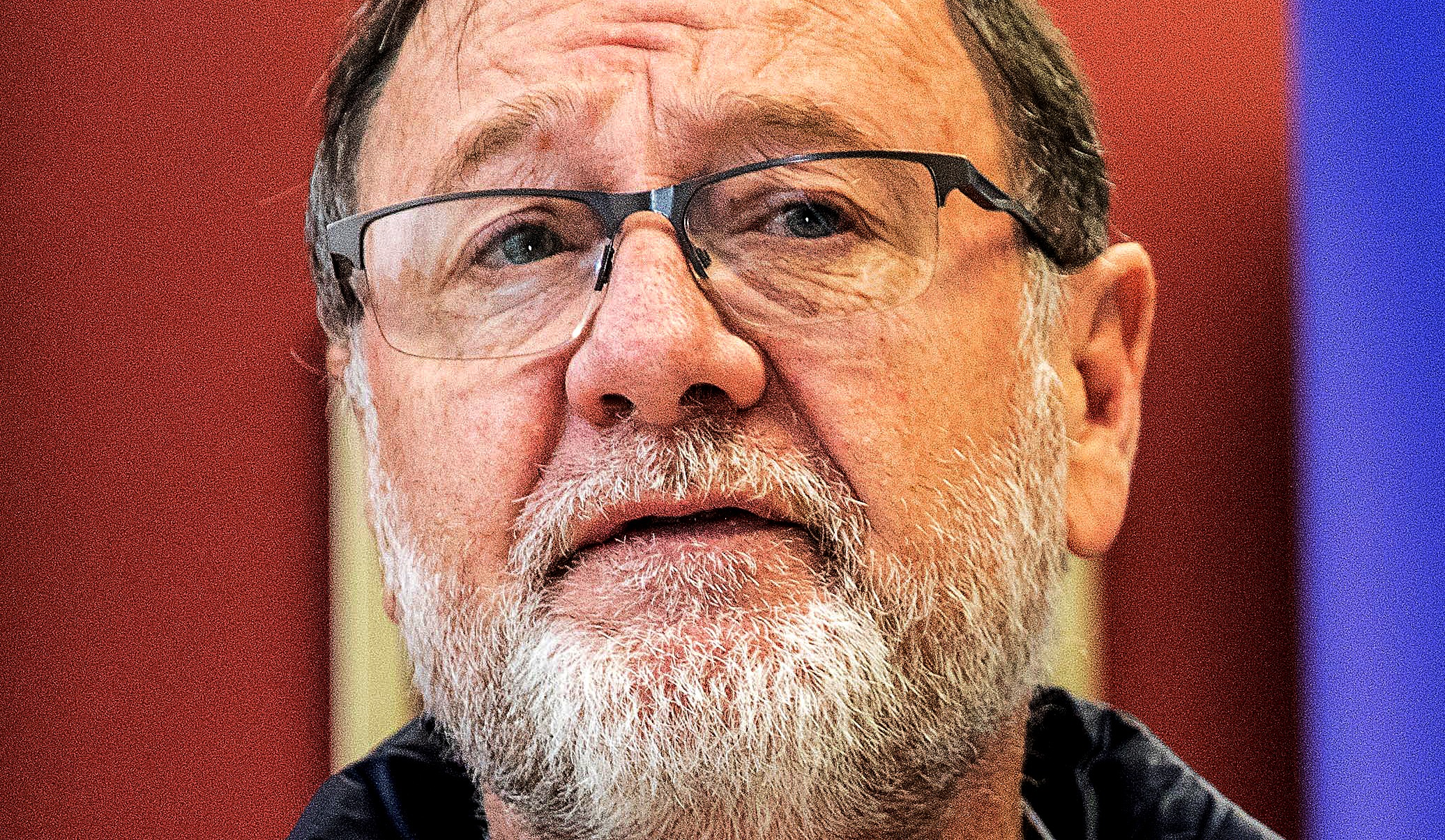
 Minister Anton Bredell (Environmental Affairs and Development Planning) provides an update to the Premier of the Western Cape on the coordinated response to the recent flooding in some parts of the province on June 20, 2023 in Cape Town, South Africa. The initial focus of the response was to mitigate the impact of the disaster, save lives, and the provision of humanitarian aid. (Photo: Gallo Images / ER Lombard)
 “Yes, we’ve lost some houses, 35 dwellings in Mossel Bay, we’ve lost in Franschhoek, a guesthouse, etc. We’ve lost two cottages in Overstrand – but we haven’t lost a life yet. The damage could have been much worse if we weren’t prepared,” said Anton Bredell, Western Cape MEC for Local Government, Environmental Affairs and Development Planning.
Since December 2025, a dry, hot summer has led to several problems in the Western Cape. There have been wildfires in parts of the Cape Winelands and Overberg. In the southern parts of the province, there are water shortages and threats of “Day Zero” across municipalities.
Bredell spoke to Daily Maverick in the days after an announcement that he would be asking the provincial government to declare a state of disaster. This would be tabled at the next Cabinet sitting of the Western Cape provincial executive, scheduled for Wednesday, 21 January.
Bredell said the provincial executive will decide on the issue. Then the province would classify a state of disaster, and ultimately, the national government would declare the disaster.
A year of disaster
It’s not hard to understand why this decision has been taken by Bredell. In April 2o25, he had warned that if the predictions for a below-average winter rainfall season occurred, this could be trouble. Then by December, several municipalities raised alarms over their water supply. Swellendam had less than 40 days of drinking water left. In early January, it was Knysna warning of less than two weeks of drinking water.
Read more: Knysna has days of water left after years of ‘long-term operational and management failures’
As Knysna’s water woes continued, alarm was sounded over raging wildfires in the Overberg and Cape Winelands regions. So far, Bredell said 10,000 hectares had been destroyed.
/file/attachments/orphans/614071886_1215883877386422_2565786054125785678_n_255823.jpg "On 11 January, residents of Eluxolweni informal settlement in the Overstrand municipality were evacuated following devastating fires within the Pearly Beach area. (Photo: Supplied / Overstrand municipality)")
Now, Bredell is dealing with another problem: calls from Mossel Bay for assistance with fodder for animals.
Bredell told Daily Maverick about the dry season: “We sit through it, we know that climate change is real, first of all. We know that the next drought, we’re going to move into cycles, so you’re going to get three or four or five good rainy years, and then you’re going to go into a dry, dry cycle.”
Bredell said: “I’ve always said that water is a long-term strategy. You need to always think about water, think about how can we save water, how we can get new water into the systems.”
Read more: Wetter skies to ease heat in 2026 but raise flood risk across SA’s interior provinces
The weather service, according to Bredell, predicts “that we’re going to get less than normal rainfall for the next four months, meaning that the already under-pressure system is, it’s going to take more strain”.
Relief options
Regarding the water issues in the southern parts of the province, Bredell said a new desalination plant would be a solution, but within the short term, borehole extraction would be underway to assist municipalities through this season.
But it’s not just the weather.
Bredell also touched on the crisis unfolding in Knysna, and stated: “It’s not only a water problem, but it’s also a management problem, a leadership problem.”
In 2025, due to leadership instability and governance failures, which resulted in a near collapse of services, Bredell wanted to dissolve the council, but this had been rejected by the National Council of Province delegates, following consultations with various stakeholders from within the community.
“During December, myself [and] the mayor, we had various meetings to see how can we get through the season… I said to him, listen, I know there’s people that will point fingers and will play the blame game. It’s not a finger-pointing exercise now, we need to solve this issue, otherwise the economy will collapse within Knysna,” said Bredell.
The department’s geo-hydrologists and engineers worked throughout December with the municipality.
Now, it’s a case of determining low-hanging fruit: “How do we get extra water quickly in the system?”
Bredell said there’s a spring and seven boreholes which could be tapped into and which could pump some five megalitres of water into the system. Another possible solution would be speaking to a private landowner for another borehole, which could deliver three megalitres of water.
Then there is asking the public to save water – to get people down to 50 litres of water per day.
In addition, there are challenges to address, such as water losses and water leaks.
“We need to look at the 8,000 households who bypass their water meters and to get that metering back into the system.”
When asked if he spoke to municipalities about long-term planning around budgets for infrastructure, Bredell said over the years, during discussions around budgets, population pressures have not been put into these systems.
“Therefore, we haven’t put enough money aside to maintain the current system and then because of our history, the lack of services in the communities, we had to address that.”
“So you would rather put new services in, and then your existing services fall behind. So it’s rebuilding of a new system, even in a place like Knysna, there’s a lot of pipe bursts in certain areas, there’s still asbestos pipes, and you actually need to replace all those pipes.
“You cannot just fix it because where you mix materials, where you now fix an asbestos pipe or PVC pipe, it’s not going to work. It’s again going to burst. So yeah, you can point fingers, but the country’s got a lot of challenges,” he said.
A balancing act — and planning
Thus far, his department has already spent its R15-million budget for aerial firefighting deployment.
“Where I sit currently, I’ve already spent my aerial firefighting budget. I’m over my budget already, but I can’t stop because there’s big fires in Pearly Beach, Stanford’s still up and running, and Oudtshoorn, there’s now a fire in Swartberg that’s got a fire front of 3km, and we need to attack those fires, otherwise it will spread, it will spread into households,” he said.
Bredell continued: “I mean, if I look at the budget and I look at what we’ve accomplished the other night by saving the town of Elim – imagine we’ve lost everything, the history, everything, I mean, that was a miracle because we had to operate in winds of 70km per hour. We’ve managed to save the informal settlement.”
Read more: Strangefoot: the last elephant of Knysna — and the hope that refuses to die
The calls for a state of disaster would mean funds would be unlocked to assist the province. If this did not occur, the funds needed would be taken from other line items within the province.
“I must take it from either education, health, or social services; that’s the three big budget items. I cannot take it from anything else,” he said.
“So yes, alien invasive species clearing is a problem, but where do I get R30-billion for that? It’s half our provincial budget if you really want to eradicate and that must be a recurring budget. If you, if you really want to get all the fire breaks up and running as it should be, then you need another R5-billion. Where do we get that?” he said.
Bredell said he had been talking to municipalities to find solutions, such as during budget cycles, he asked that money be put aside for maintenance and possible disaster relief when dealing with infrastructure plans.
“If you look at our disaster management system, we’ve built it now for over 15 years,” he said.
“Since 2015, for instance, we’ve as a province provided 102 fire trucks, ” he said and explained that this was an example of building a system which, if there was a fire in an area like Pearly Beach (which actually occurred in early January), support could be given from neighbouring municipalities.
/file/attachments/orphans/616396081_1200345575605715_922294250058970723_n_540673.jpg "Fire line above Stettynskloof dam in the Cape Winelands District Municipality. Over the past week, firefighters have fought blazes in various Western Cape regions, including this region. No human fatalties have been reported thus far. (Photo: Supplied / CWDM Fire Services)")
“But I need to talk to cabinet honestly and I’m going to invite weather services also to tell them what I know, that we’re entering into at least four months of less than normal rainfall, meaning that we need to extend our fire season and remember all the helicopters and the water bombers. We pay a holding fee, and I need to extend those kind of things,” he said.
“It’s that system that we built of partnerships that will take us through, and if we’re honest with our partners, they will come to the table, they will tap in as we speak.”
Bredell made the comparison to the Day Zero in Cape Town in 2017, where there were communication and public awareness campaigns working with the government when it came to water-saving measures and behavioural changes.
“It’s going to be difficult, but we will pull through if everybody works together.”
Cost of it all
In a media release on Friday, the Garden Route District Municipality said the water stress and fires inflicted “trauma” on residents.
“Although the recent fires were predicted months in advance due to extremely dry conditions and persistent winds, the ferocity and reach of the blazes left many residents shocked. With several dry months still ahead, the likelihood of further fire incidents remains high.”
“The financial cost of fighting multiple large-scale fires is staggering, while the physical and emotional strain placed on firefighters and disaster management personnel working around the clock cannot be quantified,” the release continued.
“The Garden Route’s firefighting and disaster management capacity is widely regarded as world-class, built on years of planning, training and constant preparedness. These efforts deserve recognition and sincere appreciation.” DM