




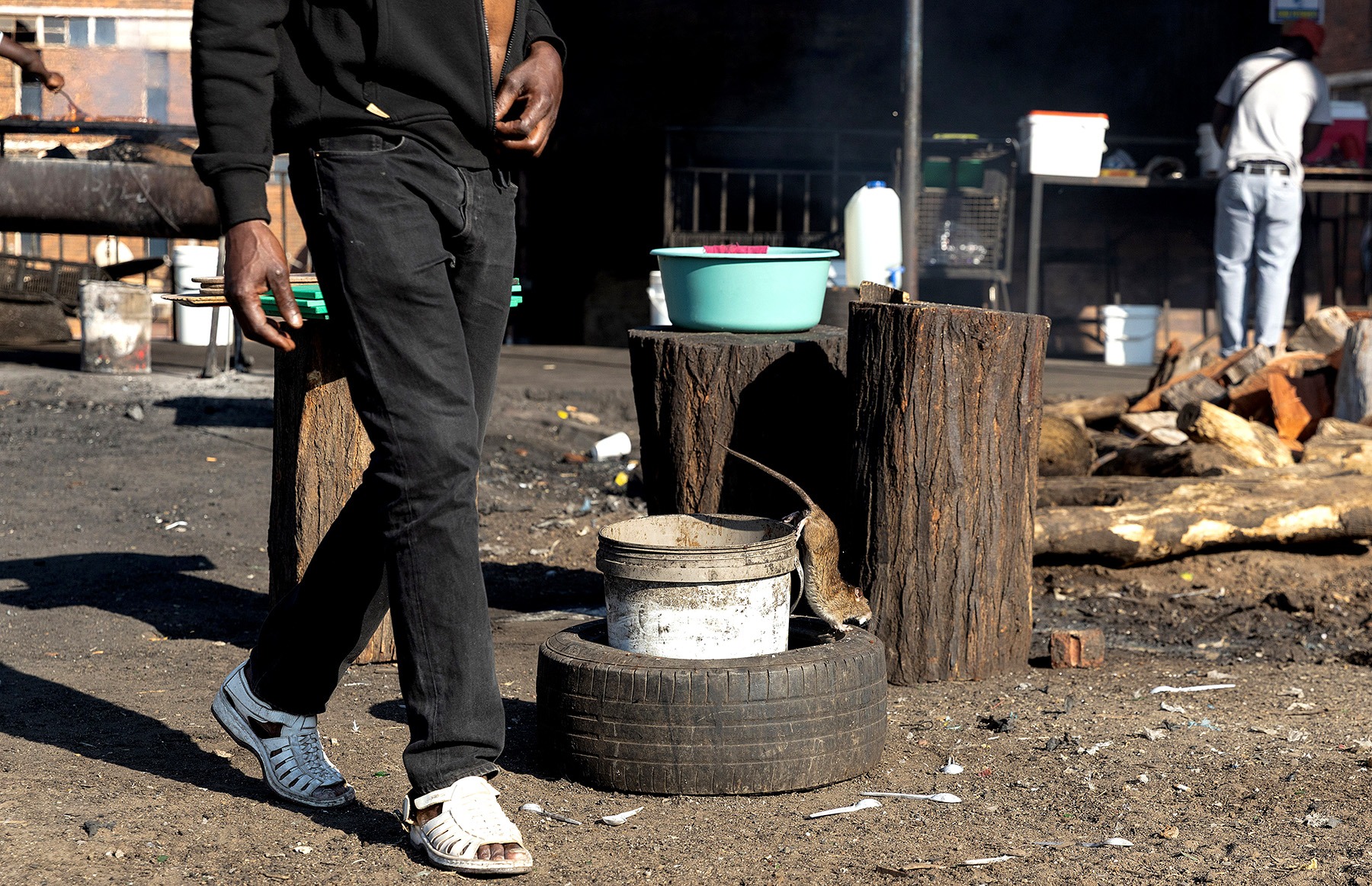
 A rat looks for food at a shishanyama at Madala Hostel in Alexandra township, Johannesburg, South Africa. August 29, 2025. (Photo: OUR CITY NEWS / James Oatway)
 There was once a showdown between the City of Joburg and a bunch of inventors and it came down to who had the better body count.
The inventors had come up with a simple rat trap that worked like a swing-top dustbin lid. The lid was placed flush with the ground, and bait – a chicken bone or piece of pap – positioned in the middle of the lid. When a rat walked across the lid its weight caused the door to open and it would fall into a bucket filled with water.
It was called the Hamelin trap and in 2018 there was a competition between its creators and the Joburg City Council. The battleground was Msawawa, an informal settlement near Honeydew, which had a big rat problem. The rules were simple: whoever collected the most dead rats won.
After two weeks the score ended on 81 rats to 21. The Hamelin had a kill ratio of 4-1 over the City’s traditional wire traps.
But the Hamelin, like a host of other initiatives like the Integrated Rodent Control Project pilot, fell by the wayside and Joburg still has a rat problem. However, the City says it is still in the fight.
“Rodent Control is a complicated aspect of Pest Control and the Department of Health does its best to deal with the matter. The City is currently looking into developing the approach,” City spokesperson Ayanda Radebe said.
She added that the City’s Pest Control Section dealt with rodent complaints and monitoring. One of the programmes the City is considering revising in its new approach is the Integrated Rodent Control Project, which was launched in 2014 and piloted in Alexandra. It involved a multipronged attack against rodents that included a barn owl project, an educational component and a trap-laying campaign.
/file/attachments/orphans/OCN_rats_02a_780509.jpg "A rat loooks for food at a shishanyama at Madala Hostel in Alexandra township, Johannesburg, South Africa. August 29, 2025. (Photo: OUR CITY NEWS / James Oatway)")
Johannesburg is not unique. Recently the UK and several US cities, including Washington DC, San Francisco and New York City, have experienced rat number spikes. The concern is that these rats can carry diseases including the hantavirus, leptospirosis salmonella and rat-bite fever.
But getting on top of Joburg’s rat problem would take a committed approach, says rodent exterminator Diederik van’t Hof. He believes the problem lies in those areas of the city where there is no or little refuse collection.
“I don’t care what you do in the pretty suburbs, rats will move in from poorer areas because daddy rat holds territory and he chases off his offspring and that is where they will ultimately go.
“Unless you wipe out that nucleus, you are going to have an endless rat problem,” he explained.
Van’t Hof was part of the team that designed the Hamelin trap, and he believed it was an effective way of tackling Joburg’s rat problem because it was cheap, effective and didn’t use poison.
“We actually had people starting to grow their vegetable gardens again because they weren’t being destroyed by the rat plague every night,” Van’t Hof said of the pilot project they ran in Msawawa.
The SPCA, said Van’t Hof, also had a problem with the traps because they were inhumane, in that they drowned the rats. The National Society for the Prevention of Cruelty to Animals, on its website, says it is opposed to the killing of rats through poisoning, beatings or drownings.
/file/attachments/orphans/OCN_rats_01a_354936.jpg "A rat loooks for food at a shishanyama at Madala Hostel in Alexandra township, Johannesburg, South Africa. August 29, 2025. (Photo: OUR CITY NEWS / James Oatway)")
Surprisingly, while rats and humans have had a long, shared history there is still much to be learnt about these pests. Recently PhD candidate Gordon Ringani conducted a study that took a peek into the daily lives and dietary habits of Jozi’s rats.
He used carbon and nitrogen isotope analysis to get an understanding of what these rodents were eating. His focus was on four different sites, in Hammanskraal, Alexandra, Tembisa and the University of Pretoria Experimental Farm.
To his surprise he discovered that at each site one of three invasive rat species dominated.
Alexandra and Tembisa had become the stronghold of the brown rat, while at the experimental farm the black rat held sway. Hammanskraal, meanwhile, is the home of the most recent rat immigrant. The Asian house rat was only discovered to be in South Africa in 2011 and so far is found in Gauteng and Mpumalanga, where it lives in more rural settings.
Ringani found that the isotope signatures showed that Asian rats feed on a wide variety of foods typical of foraging in a rural setting. The black rat had a similar isotope reading to the Asian house rat, although this could be because of the farm setting. The brown rat, however, had a less-diverse, grain-based diet, most likely because it feeds on scavenged human food.
Ringani, who is at the University of Pretoria, hopes that his research will not only reveal how indigenous species are coping with this alien rat invasion but also provide some insight in how the City of Joburg can better fight the brown rat. Their human food addiction, he believes, is their Achilles heel.
“It does indicate that discarded food is the biggest issue here and this is where you find the highest concentrations of rats. So this is what needs to be addressed,” he explained. DM
This story is produced by Our City News, a nonprofit newsroom that serves the people of Johannesburg.
/file/attachments/2985/WhatsAppImage2025-11-21at1946001_346702_1cea9e715c05dc0a538fc79753ac3401.jpeg)