




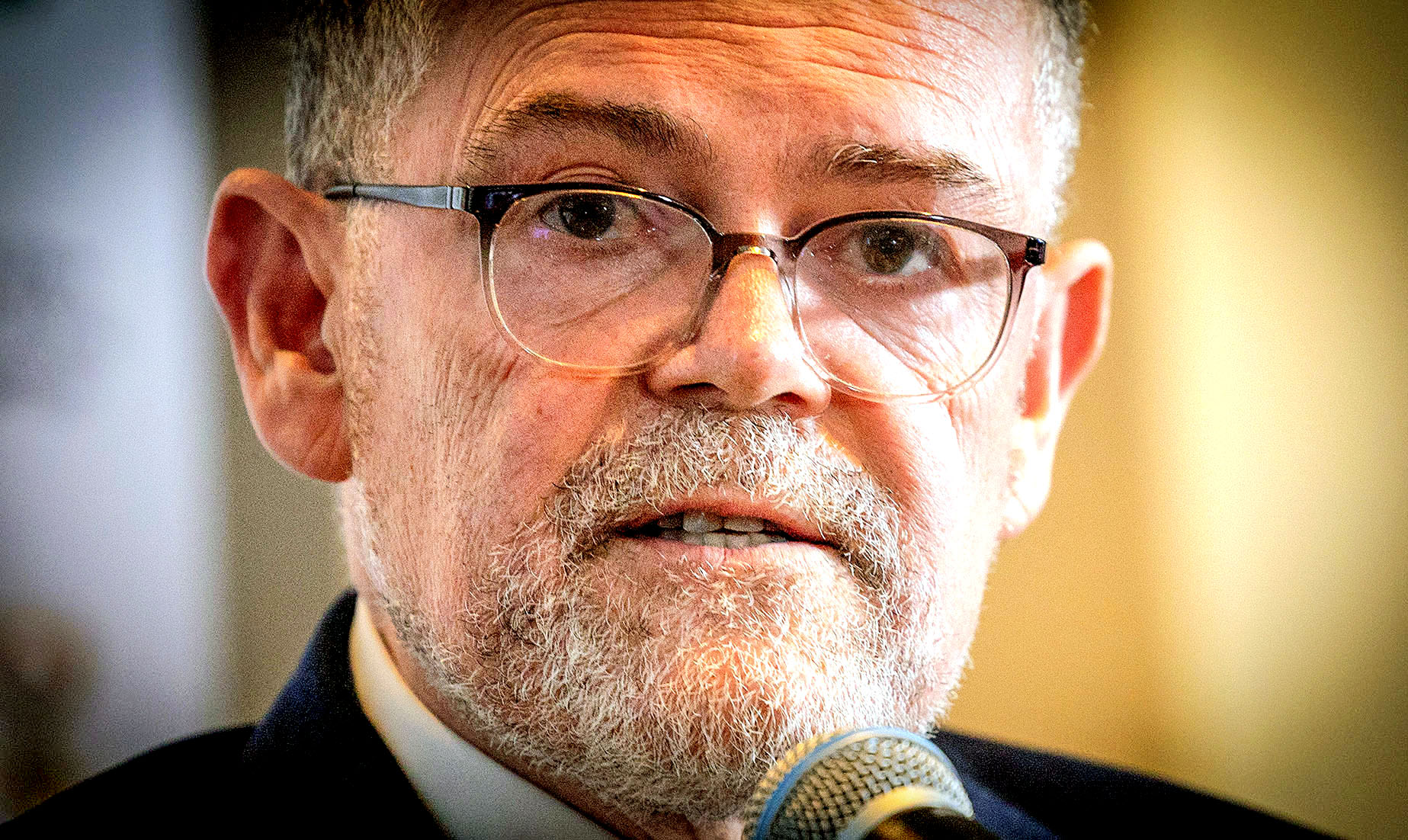
 DA federal finance chair and former minister Dion George resigned from the party on Thursday, 15 January 2026. (Photo: Gallo Images / Luba Lesolle)
 /file/dailymaverick/wp-content/uploads/2025/10/label-analysis-2.jpg)
When Dion George decided to resign – not just as the DA’s federal finance chair, but also as a Member of Parliament and as an ordinary party member – he would have considered multiple options of how to do it, ranging from the most benign to the most nuclear.
The most benign option: some kind of polite joint statement with DA leader John Steenhuisen or DA federal executive chair Helen Zille, announcing neutrally that George has chosen to tender his resignation, which the party has regretfully accepted.
The most nuclear option: to read a resignation letter live on national TV at midday on Thursday, containing multiple incendiary allegations about the DA leadership and Steenhuisen in particular.
That the usually mild-mannered George went with the second choice is a statement of just how badly this DA veteran feels himself to have been betrayed, given that he would know exactly the damage this might do to the political party to which he has dedicated the majority of his professional life.
For the DA’s part: by Thursday afternoon, trying to click on George’s profile on the DA website already produced a “Page Not Found” notification. George had been officially erased.
/file/dailymaverick/wp-content/uploads/2025/11/ED_582200.jpg "Then Environment Minister Dion George at the G20 Environment and Climate Sustainability Working Group Technical and Ministerial Meetings in Cape Town on 13 October 2025. (Photo: Gallo Images / Misha Jordaan)")
George knows where bodies are buried
George is far from the first member of the DA’s higher echelons to depart shooting bullets. And as Helen Zille likes to remind journalists, high-profile resignations and defections happen in every political party.
There are particular aspects to the George case, though, that may present the party with greater headaches than previous departures.
The first is that George’s resignation letter alleged not just that Steenhuisen was incurring irregular expenses on the DA party credit card – as has been widely covered – but also that for the party’s federal legal commission to conclude that the expenditure on the card had been “fully reconciled”, the records must have been retrospectively tampered with.
Read more: Why I have chosen to leave the DA — Dion George
Zille’s brief statement on George’s resignation made no mention of whether this claim would be probed. But since George was the federal finance chair, he may well have kept his own records – and now, freed from the DA’s gag order, has nothing to lose by releasing them.
That raises a second aspect: as the party’s main money man for the best part of a decade, George presumably knows where any financial skeletons – if they exist – are buried. He has intimate knowledge of the party’s donors, its war chest, its tax affairs, the salaries it pays and has paid…
It is, in short, hard to think of a more risky person to so badly alienate, in any organisation.
If other DA leaders believed they could count on lingering party loyalty or old friendship ties to secure George’s future discretion, the nature of his Thursday resignation must surely have made them think twice.
It is the DA’s donors, however, who may be the greatest problem.
George’s resignation letter stated that he had been able to raise “record amounts” from donors due to the “reputation [George] helped to build for the DA of integrity, strong financial controls and sound stewardship of the money entrusted by our donors”.
Since public disclosures became mandatory, the DA has routinely pulled in the highest quantum of donations – and, importantly, recurring donations – of any South African political party, which does suggest that donors must have felt a high level of confidence in George’s financial management.
What are these donors to do now that the party’s finance chair, associated with high levels of financial probity, is telling the world not just that the party leader misused his credit card – even if the amounts in question were utterly pitiful – but that financial records were subsequently tampered with to protect him?
Read more: Mired in opacity — 10 hard truths about SA’s political party funding
Disciplinary investigation still pending
Some will feel that the most definitive way for the DA to put this mess behind them is for both George and Steenhuisen to go, but this is far from straightforward due to the shortage of compelling candidates to succeed Steenhuisen.
As Zille’s statement on George’s resignation noted, a disciplinary inquiry into Steenhuisen will still proceed.
But there are two stark dates for the party ahead: April, which is when the leadership election will be held; and November, which is the earliest possible date for the local government elections.
If Steenhuisen does not stand for re-election in exchange for retaining his ministerial post in the GNU, as some party insiders consider possible, the DA will be left scrambling for the right person to lead the party in an election year.
Read more: Steenhuisen’s leadership stability threatened by internal dynamics and Zille’s Joburg aspirations
Cape Town mayor Geordin Hill-Lewis, as has been widely discussed, is almost certainly the only candidate with sufficient national brand recognition, favourable public sentiment and internal popularity to steady the DA ship. Hill-Lewis would probably also be able to maintain the all-important Cape Town mayoralty simultaneously, as per the precedent set by Zille.
Hill-Lewis is known to have mixed feelings about the prospect of assuming the party leadership, although insiders say donors are already leaning on him to avail himself for election.
/file/dailymaverick/wp-content/uploads/2024/11/ED_535277.jpg "Cape Town Mayor Geordin Hill-Lewis is seen as a possible contender to run against John Steenhuisen for the DA leadership. (Photo: Gallo Images / Brenton Geach)")
It is something of a statement on the DA’s difficulty in retaining political talent over the past years, however, that it is hard to think of another potential candidate whom both the party and the public might greet with excitement. (This same critique could, of course, be levelled at multiple South African political parties.)
Other names being floated in the media of late would seem to either lack the necessary public profile – such as Werner Horn, despite his position as National Assembly house chair in the GNU – or be too divisive a figure within the party, such as DA Minister of Public Works and Infrastructure Dean MacPherson.
It is very likely, however, that succession discussions will gain new momentum after George’s public display – and that the fallout from Thursday’s broadcast will linger for some time. DM