



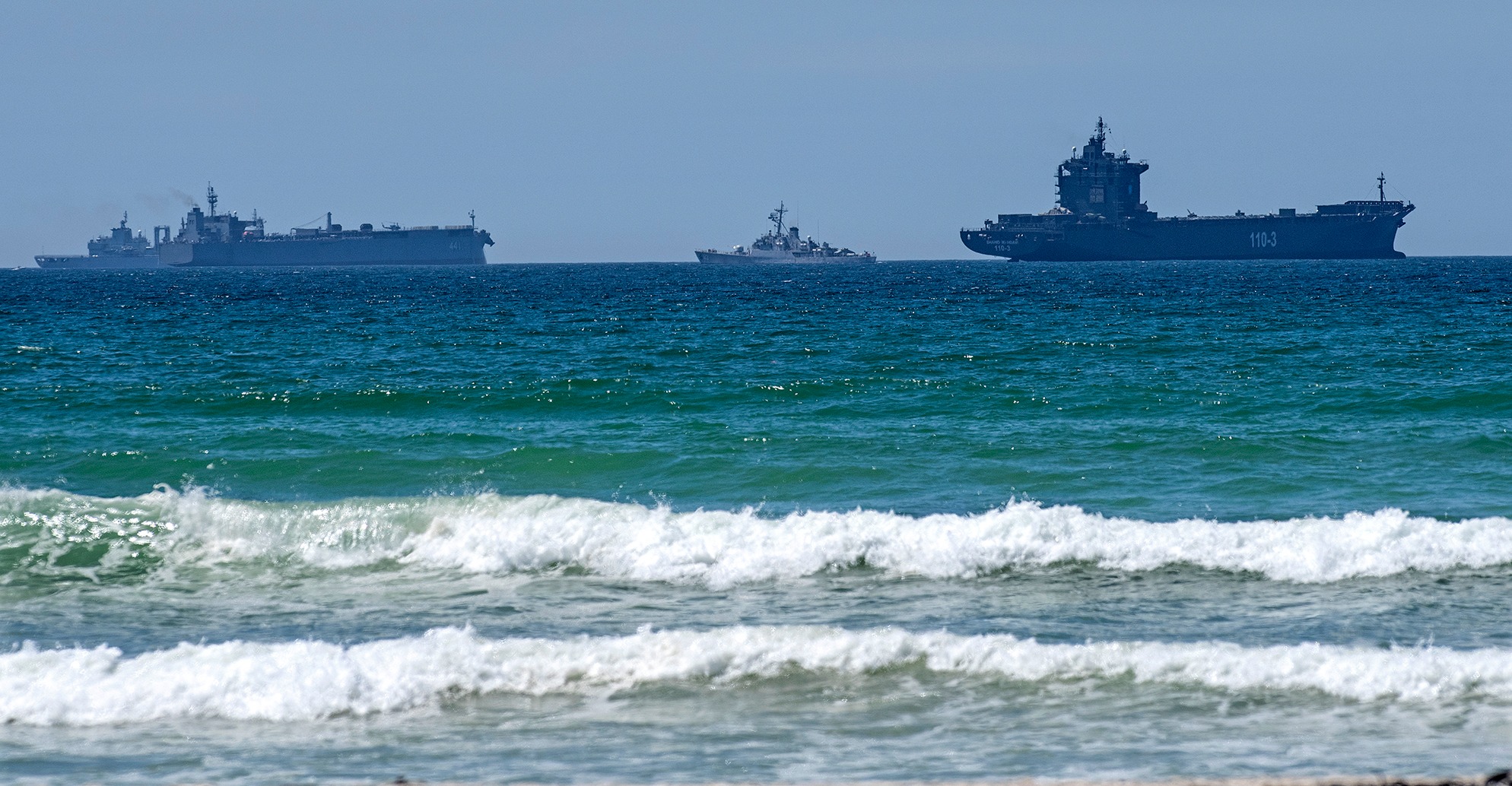
 Three Iranian navy ships in False Bay on 13 January. (Photo: Brenton Geach)
 /file/dailymaverick/wp-content/uploads/2025/10/label-analysis-2.jpg)
On Monday evening, Daily Maverick’s Peter Fabricius reported that Iran had been asked to withdraw from the Will for Peace 2026 maritime exercise taking place off Simon’s Town.
Then, on Tuesday, images emerged of an Iranian vessel at sea during the exercise.
/file/attachments/orphans/iranships_3298_137364.jpg "Three Iranian navy ships in False Bay on 13 January. (Photo: Brenton Geach)")
On Tuesday evening, News24 reported there was speculation that this was the result of the intervention of Defence Minister Angie Motshekga. It said President Cyril Ramaphosa had told Motshekga to ask Iran to withdraw and act only as an observer.
Diplomacy undone
The political message of the image of an Iranian military ship sailing alongside one of ours will be much more powerful than any comments by officials.
While this was happening off Simon’s Town, in Iran it’s been reported that more than 2,500 people have died in anti-government protests.
The Iranian government has cut off internet access, which only a government that does not believe in freedom for its people does (something similar is happening in Uganda, where the internet has been cut ahead of a crucial election).
Considering that many leaders in our government profess to love democracy, and many ANC figures will remind voters that their organisation helped to bring freedom, this leads to obvious questions about whether there are contradictions here.
Members of the Trump administration, looking for a new target after abducting Venezuelan President Nicolás Maduro, will be very aware of this.
Given Ramaphosa’s studied response to US President Donald Trump and the way he has handled international relations in the last few months, it is unlikely that he would be happy to see this image.
Ramaphosa managed the G20 carefully and achieved important victories. In his direct dealings with Trump, he has appeared to be trying to be the adult in the room, refusing to give Trump a reason to be outraged (thus forcing Trump to make up his reasons and manufacture his outrage).
/file/dailymaverick/wp-content/uploads/2025/06/13068549.jpg "US President Donald Trump meets with President Cyril Ramaphosa in the Oval Office of the White House on 21 May 2025. (Photo: Jim Lo Scalzo / EPA-EFE)")
Ramaphosa would surely want to avoid giving the US any excuse to act against South Africa, particularly when Trump is thinking aloud about acting against the leaders of the Iranian regime.
All of this might strengthen the impression that Motshekga disobeyed him. But, if that is the case, why would she do that?
Especially for a second time, as this follows the controversial visit by the head of the SANDF, General Rudzani Maphwanya, to Iran last year.
While there are many conspiracy theories about the ANC’s relationship with Iran, no one has produced evidence of anything untoward.
Projecting power
At the same time, Iran’s leadership would have a very real interest in being seen to be taking part in this exercise.
Given the intense pressure on Iran’s leaders, it is crucial for them to demonstrate to the world that they still possess military strength.
The message from Iran participating in this exercise, or even just having military ships in South African waters, will be interpreted in many different ways.
First and foremost, it will tell Iran’s opponents, including the US, that Iran still has significant military assets, which it can move and control as far away as South Africa. Considering the power it has to choke 20% of the world’s oil supplies travelling through the Straits of Hormuz, this is important.
Pattern of defiance
For Ramaphosa, the impression that he has been disobeyed, or even the fact that some people might believe that Motshekga or the SANDF disobeyed him, is a major problem.
First, it follows a pattern.
Ramaphosa’s failure to remove Maphwanya is not just about the SANDF chief’s trip to Iran.
It is also about the fact that Maphwanya is supporting SANDF officers accused of assassinating Hawks investigator Frans Mathipa.
/file/dailymaverick/wp-content/uploads/2025/08/ED_504233.jpg "SANDF chief General Rudzani Maphwanya received three official rebukes in the wake of his controversial visit to Iran. (Photo: Frennie Shivambu / Gallo Images)")
He must be responsible for the fact that the SANDF is paying for the lawyers of those officers.
And Ramaphosa has taken no action against him.
At the same time, as the various inquiries into the police have shown, it is clear that some leaders of the SA Police Service (SAPS) believe they can break the law with impunity, which gives the impression that there is no tight civilian control of the SAPS.
Now, the same impression has been given by the SANDF — that its senior leaders and the minister responsible can break the law or disobey the President.
Democratic risk
The risk here is not just to Ramaphosa — it is a threat to our democracy.
This is because, as Afrobarometer has found, just under half of the people in South Africa believe a military government would be better than the democratic government we have now.
KwaZulu-Natal SAPS Commissioner Nhlanhla Mkhwanazi was surely tapping into this when he wore military-style fatigues during his famous press conference that led to the current inquiries into police corruption.
All of this might well strengthen the temptation of a military leader at some point to consistently disobey civilian authority.
The risk of this might well increase in an era of unstable coalitions, or when a government falls. Some strongman, emboldened by the fact that they have been able to disregard civilian authority before, might well seize the chance.
Of course, it’s unlikely that military rule could survive for long in South Africa. It is very difficult to govern here democratically; it’s probably impossible to govern through a military-style dictatorship.
It is entirely possible that Ramaphosa and Motshekga and the SANDF will find a way to explain this week’s events away.
But the memory of the idea that the SANDF can disregard civilian authority might remain. And that could contain the roots of much bigger trouble in the future. DM