




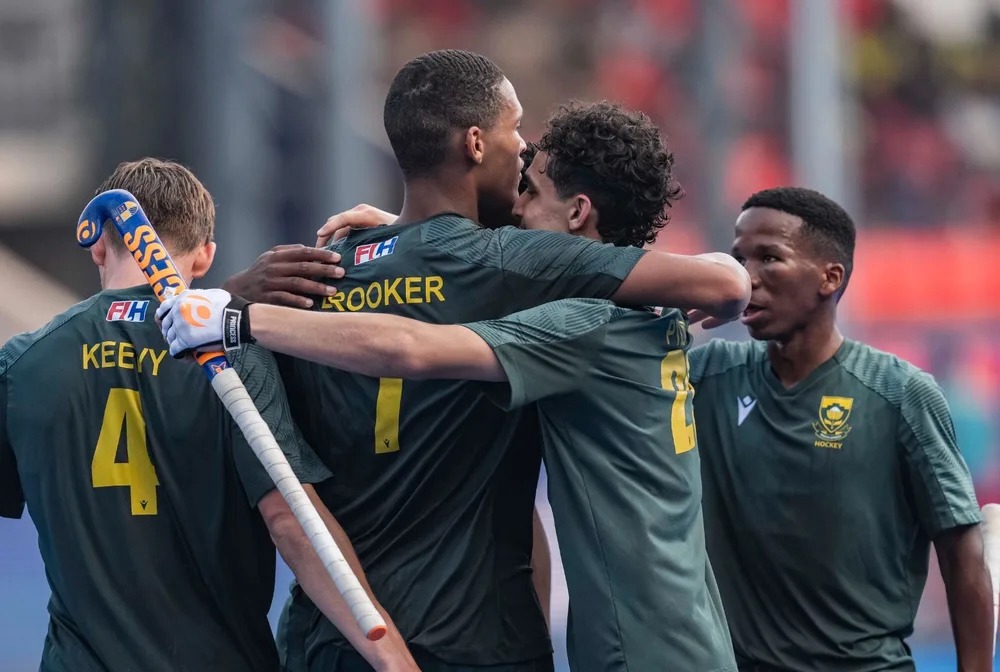
 South african players (from left) Casey Keevy, Jaydon Brooker, Ozair Pillai
and Leruo Ditlhakanyane at the FIH Junior Hockey World Cup in India in 2025. (Photo: FIH Website)
South african players (from left) Casey Keevy, Jaydon Brooker, Ozair Pillai
and Leruo Ditlhakanyane at the FIH Junior Hockey World Cup in India in 2025. (Photo: FIH Website) Hockey in South Africa is bordering on a Cinderella sport. It is stuck on the margins; noticed only during big moments but still unable to break through financially or structurally into major-sport status.
Over the past decade, however, new media has revolutionised the way sport is being consumed and the way athletes engage with fans. Social media, for instance, has allowed small teams and amateur sports to realise their commercial potential by serving as cost-effective platforms for driving visibility and creating diverse revenue streams that were traditionally difficult to access at non-professional levels.
The world saw it with Wrexham AFC in 2021 after Ryan Reynolds and Rob McElhenney bought the club and used social media as the club’s personal megaphone, so much so that their social media following across multiple platforms rose from 45,000 to 4.5 million. This is according to the Financial Times. As a result, Wrexham took on major partners through the likes of TikTok, Meta Quest and United Airlines.
On a much smaller, but still impactful scale, the South African U21 men’s hockey side utilised social media to acquire four sponsorships in just two weeks, paving the way for a larger investment that helped ease financial pressure for the players before the FIH Junior Hockey World Cup.
/file/attachments/2986/Image01_621828.jpg "The South African junior men’s squad before their FIH Junior Hockey World Cup campaign in India last November. They raised money and found sponsorships for apparel and nutrition through a smart commercial campaign. (Photo: Supplied)")
U21 men’s side: A case study
In the closing stages of 2025, the junior men’s side showcased hockey’s commercial potential when it managed, through the help of Ziyaad Solomons, to acquire four sponsors in the span of two weeks.
On 1 September, the squad announced via their Instagram page their first partnership with Snapp.Bags. This was followed by Kecks, an active underwear brand, ProTouch Hockey and Science in Sport, a global brand in performance nutrition.
According to Solomons, these sponsors are value-based sponsors where the partner provides the team with products such as hockey grips and bags in exchange for content output.
“We kind of became this content generating machine,” said Solomons.
Although he has been on the hockey scene as a photographer and videographer for the past six years, Solomons only became exclusively part of the U21 staff as a commercial manager in September last year – not even three months before the team left for the FIH Junior Hockey World Cup in India.
His aim was to start small by targeting local small- to mid-sized companies and build long-term partnerships with the South African Hockey Association (Saha) through product-based sponsorships that could eventually develop into investment partnerships.
All the team needed was one brand to have faith in them; for the U21s to showcase what they could bring to the table in terms of quality and consistent content and to get the ball rolling from there, said Solomons.
In a matter of two months, they were able to harvest the fruits of their labour when Discover Sport entered a partnership with the squad; this time it was an investment-based sponsorship.
This was just two weeks before the Junior Hockey World Cup, which was going to cost them just short of R2-million.
While the government provided half that amount it was still up to the U21s to come up with R800,000. When Discover Sport signed on, it provided the team with funds to use at their discretion, which they ultimately settled on using for kit.
“Once we had that sort of profile built on value on the product, basically, no money, only then would we be able to show other sponsors this is what we can do; but we don’t want product, we want investment,” Solomons said.
/file/attachments/2986/Image02_584404.jpg "Snapp.Bags were just one of four sponsors to partner with the U21 junior men’s side. As a product-based sponsorship, the company provided the squad with branded backpacks as well as travel bags. (Photo: Ziyaad Solomons)")
Catch-22
Financial constraints are among the most pressing challenges facing South African hockey, as is the case with most amateur sports.
In 2022, Saha’s financial woes drew mainstream attention when the SA men’s senior team had to decline an invitation to the FIH Pro League after they clinched a win in the inaugural FIH Nations Cup against Ireland at Potchefstroom to qualify for the league. That was according to a statement from Saha.
The association could not meet the minimum financial requirement by the FIH for entry into the pro league, which amounted to approximately R10-million.
Notably, national hockey in the country has an event-based structure; it does not run year long. In 2025, for instance, the outdoor men only played together three times – in Malaysia, the Africa Hockey Cup of Nations in Egypt and recently in a three-match Test series against India.
Without participation in major international leagues, the national squad ultimately does not get enough exposure to high-performance hockey.
“We’re not a centralised programme and we’re not a fully funded programme,” said Solomons. “That’s why when we play international tournaments we’re always on the back foot.”
In addition, Saha, which is the national governing body responsible for managing, developing and promoting hockey in South Africa, operates on a purely voluntary basis. Which means any content that needs to be posted, for example, will be done irregularly.
Consequently, hockey receives low exposure and brand awareness, which affects sponsorship opportunities. It is a Catch-22 situation: sponsors create more visibility, but without visibility you cannot get sponsored.
/file/attachments/2986/Image041_342131.jpg "Reuben Sendzul looks to add his name to the long list of goal scorers after the South African U21 team battered Canada 9-1 in a playoff match during the FIH Junior Hockey World Cup last November. (Photo: Supplied)")
Growth beyond results
The Test series against India last December, however, does show an upwards trajectory. While India, ranked seventh in the world, won the series overall against South Africa, ranked 12th, it was important exposure and reflected improvements in the squad.
For the first time in 13 years, South Africa did not lose to India. The teams drew 2-2 in the second Test in front of a packed Hartleyvale Stadium in Cape Town.
“I think a lot of people […] are hungry to see hockey at this kind of level,” said Saha CEO Phikolomzii Mbuqe. “I think for [Saha], it’s about providing that and using those platforms of games and winning to drive us into more commercial spaces.”
According to Mbuqe, Saha wants to move forward with this momentum by “maximising home advantage through early preparation camps [and] strategic international competition” before this year’s FIH Hockey World Cup in August.
Additionally, Solomons, who has recently been brought on to the men’s side as commercial manager in order to emulate the commercial success of the juniors, aims to lessen the financial burden players must carry.
In order to do this, he will leverage the brand the men have built thus far and turn that into existing value.
“Social media is about building community,” said Solomons. “Not just hockey content for hockey people, but human stories, moments and insights that anyone can connect with.” DM