




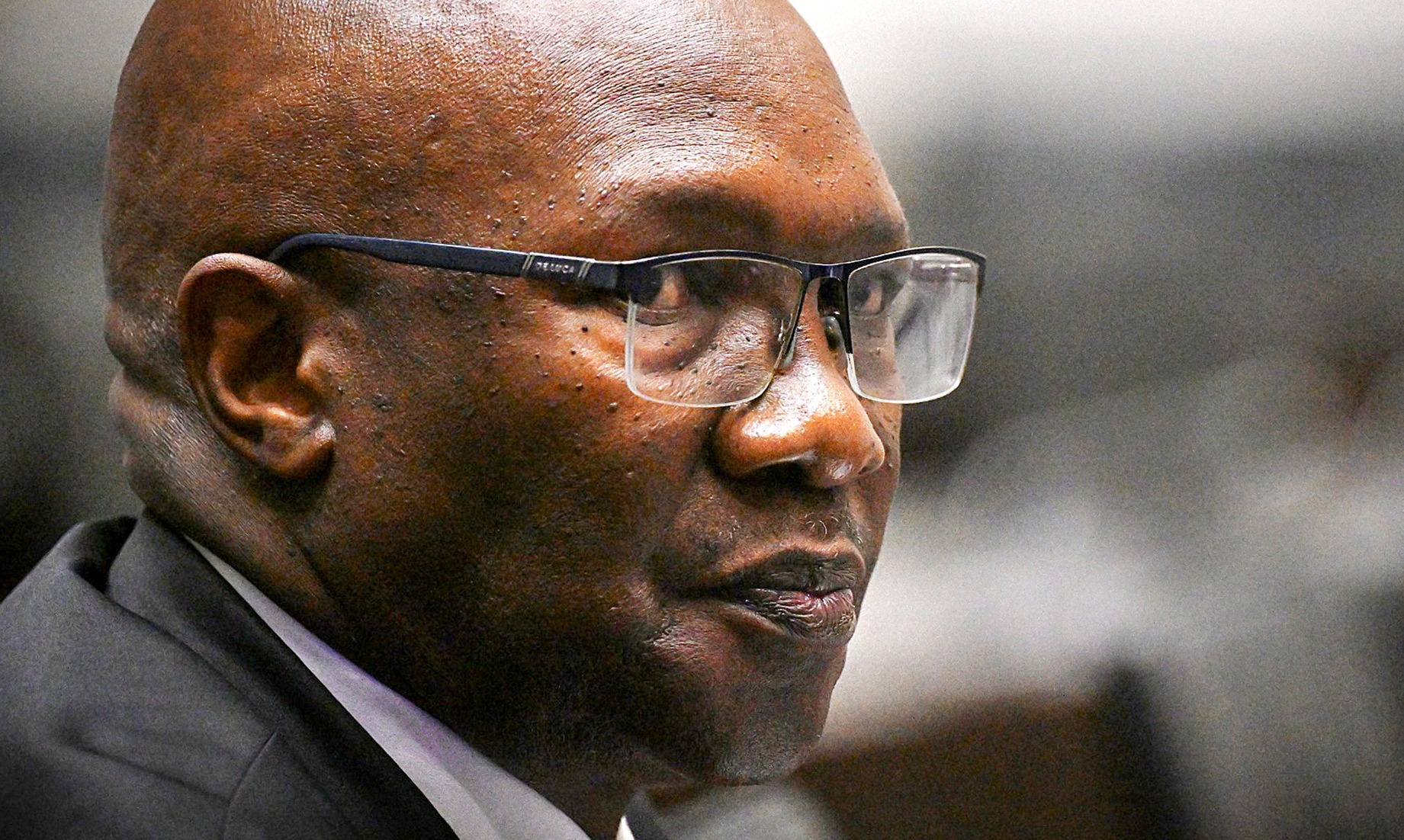
 Crime Intelligence head Lieutenant General Dumisani Khumalo appears before Parliament’s ad hoc committee hearings into alleged corruption, political interference and sabotage within the South African Police Service. (Photo: Phando Jikelo / RSA Parliament)
 National Crime Intelligence head Dumisani Khumalo has alleged that, based on a previous threat analysis, nearly all South African Police Service (SAPS) officers in Gauteng are working for a criminal cartel.
He was testifying on Thursday, 15 January 2026, at Parliament’s ad hoc committee investigating accusations that a cartel, known as the Big Five, has infiltrated South Africa’s criminal justice system, law enforcement, politics and private security.
Khumalo made staggering admissions and allegations, including that police officers were offering protection, for a fee, to crime syndicate members.
He also detailed concerning issues related to two connected, but separate, high-level police operations focused on crime suspects Katiso “KT” Molefe and Vusimuzi “Cat” Matlala.
Read more: Big Five cartel’s dark web of political ties and criminal operations unveiled by Dumisani Khumalo
Both Molefe and Matlala, who respectively face criminal accusations relating to murder and attempted murder, are accused of being Big Five cartel members (they have not been charged over this).
On 6 December 2024, as part of sensitive police investigations, Molefe was to be arrested and Matalala was set to be questioned (he was arrested months later).
These policing operations had necessitated extra support from members of KwaZulu-Natal’s political killings task team (PKTT), which Khumalo was project managing, for an investigative team in Gauteng.
/file/attachments/orphans/ED_588250_571722.jpg "Vusimuzi ‘Cat’ Matlala testifies at the parliamentary ad hoc committee inquiry in the Kgosi Mampuru Correctional Facility in Pretoria on 27 November 2025. (Photo: Gallo Images / Frennie Shivambu)")
‘Cartel cops’
Khumalo testified that through a related threat and risk assessment, “It had come out that almost the whole of SAPS in Gauteng is working for the cartel.”
He said that there had been interference in the Molefe arrest operation, and alleged that some of this emanated from Major General Richard Shibiri, head of the police’s National Organised Crime Unit.
This unit falls under the national commissioner of crime detection, Lieutenant General Shadrack Sibiya, who was previously suspended as a result of this overall scandal.
/file/attachments/orphans/WhatsAppImage2026-01-15at1141191_675095.jpeg "Crime Intelligence head Lieutenant General Dumisani Khumalo appears before Parliament’s ad hoc committee in Cape Town on 15 January 2026. (Photo: Phando Jikelo / RSA Parliament)")
For his part, Sibiya previously told Parliament that he was not corrupt.
Shibiri has not had an opportunity to officially respond to allegations made against him.
Khumalo said in testimony on Thursday that as far as he was aware, an investigation into allegations against Shibiri was well under way.
He also testified that sidelined police minister Senzo Mchunu was coincidentally mentioned at both 6 December 2024 operations.
/file/attachments/2986/ED_589748_818082.jpg "Sidelined police minister Senzo Mchunu at the Madlanga Commission of Inquiry held at Brigitte Mabandla Judicial College in Pretoria on 4 December 2025. (Photo: Gallo Images / Lefty Shivambu)")
‘Mention of Mchunu’
At the Molefe operation, the question arose whether the police officers there to detain Molefe were aware he was a “friend” of the minister’s – Mchunu still held this position at the time.
Meanwhile, Khumalo said it appeared that Matlala was planning to meet Mchunu when officers raided his home.
It was previously alleged that Matala, who once had a lucrative, but now cancelled R360-million contract with the police, was funding Mchunu’s political aspirations, which Mchunu denied.
FOR IMMEDIATE RELEASE
— Senzo Mchunu (@Senzo_Mchunu_) July 9, 2025
⁰9 July 2025
STATEMENT IN RESPONSE TO ALLEGATIONS REGARDING THE MINISTER’S ALLEGED ASSOCIATION WITH MR MATLALA AND MR MOGOTSI
In response to the recent allegations made by Provincial Commissioner Mkhwanazi, and while respecting the President's call for…
This political-policing scandal erupted last year in July when KwaZulu-Natal Police Commissioner Nhlanhla Mkhwanazi first alleged an organised crime cartel had infiltrated law enforcement, politics and private security.
Khumalo, based on his testimony on Thursday, is clearly of the view that this has happened.
He previously testified about cartel activity before the Madlanga Commission of Inquiry, a hearing running parallel to the ad hoc committee.
But his testimony in Parliament on Thursday was much more detailed.
Syndicates, police, and protection fees
“Key to any syndicate to survive is the proximity – close proximity and relationships –with politicians, law enforcement officers and business leaders,” Khumalo said.
“That allows the syndicates to have access to sensitive information, to have access to the investigation processes and statuses, to ensure they are always in a position to manipulate or obstruct legal proceedings.”
He added: “What makes it more difficult these days, especially within SAPS, it’s because there are syndicate members that are within our ranks…
“It has been a career within a career from SAPS to provide protection for a fee. I’m not sure that it qualifies to be an extortion…
“It’s a fact that [this] is only done to sustain the activities, or to protect the activities, of the syndicate and these professional criminals.”
Khumalo told the ad hoc committee that organised crime cartels had criteria that potential members needed to meet.
This, he said, included that they had to:
- Be career criminals who had graduated from lawbreaking, like burglaries, to more serious incidents. These crooks needed to show that they had not been punished for more than half the time they had been breaking the law. “You must have a proven track record.”
- Own multiple companies registered locally and abroad – this made it easier to move “commodities” and “allows for quick money laundering”. This also paved the way towards “tenderpreneurship” – illegally landing government contracts.
- Have dual citizenship as this meant they – and their “commodities” – could move more easily across borders.
- Be able to access firearms, including through the “easiest route” – via private security companies. (Matlala was the director of a security company.)
Some focus during Thursday’s ad hoc committee proceedings was on Mchunu’s actions at the end of December 2024.
Mistaken identity
On the last day of that year, Mchunu, in his capacity as police minister at the time, sent out a controversial directive to disband KwaZulu-Natal’s PKTT and to freeze the filling of vacancies in the Crime Intelligence unit.
While Mchunu previously said that he acted in good faith to ensure police resources were effectively used, countering accusations are that he was influenced to issue the directive because certain crime suspects were under the impression that it would be to their benefit.
Testifying on Thursday about Mchunu’s directive, Khumalo said: “In my view, the letter was supposed to be a personal letter to myself.”
Read more: Mchunu ‘unlawfully’ usurped Masemola’s power in political killings saga, Madlanga Commission hears
As Mkhwanazi had asserted before him, Khumalo believed the directive to disband the PKTT “was a mistaken identity”.
This was because cartel suspects in Gauteng appeared to have been under the impression that the PKTT was investigating them.
However, it was another unit, with assistance from PKTT members, that was actually looking into them – this was the unit that cracked down on Molefe and Matlala.
/file/dailymaverick/wp-content/uploads/2025/10/WFD_3595.jpg "Katiso ‘KT’ Molefe leaves the Sandton Police station on 17 October 2025. Molefe is accused of helping to orchestrate a series of contract killings, including the murder of DJ Sumbody. (Photo: Felix Dlangamandla)")
Misinformation accusations
Earlier on Thursday, the focus was on what Khumalo described as opposition when he took over as head of the Crime Intelligence unit at the end of 2022.
For decades, infighting, accusations of corruption and slush fund looting have circled the unit.
Khumalo testified on Thursday that after he became Crime Intelligence head, resources were still being misused. He said plans to remedy this resulted in misinformation being used against the unit.
For example, “capable” senior officers were identified, transferred, and promoted to implement new performance plans. Khumalo said this led to him being wrongfully accused of appointing people aligned with him.
After every decision taken to improve the unit, he said misinformation was peddled on social and print media.
Ad Hoc Committee on Lt Gen Mkhwanazi’s Allegations - Lt Gen Dumisani Khumalo speaks on the raid on “Cat” Matlala’s house and the “fabrication” of allegations of theft of a Rolex and MacBook. @ParliamentofRSA @SAPoliceService @DOJCD_ZA @NPA_Prosecutes @DefenceCluster pic.twitter.com/8BWxcyqWIO
— Justice-and-security-Cluster (@JustSecuCluster) January 15, 2026
He referred to another example that involved state vehicles being removed from senior managers and redistributed, where needed, to officers at an operational level.
Khumalo said misinformation “started flying” that Crime Intelligence vehicles were “collecting dust” and not being allocated to members.
He said other “famous misinformation” was about informers being paid only R3,000, and that this narrative surfaced after control measures were implemented around informer rewards and remuneration.
In June last year, Khumalo was arrested, along with six colleagues, in connection with an allegedly irregular appointment. They denied the accusations.
It was alleged that his arrest was part of a plot to derail certain Crime Intelligence investigations and protect crime suspects.
The arrest saw Khumalo being removed as head of Crime Intelligence, but late last year he was reportedly reinstated.
As for the ad hoc committee proceedings on Thursday, it was late before members of the committee began questioning Khumalo on his testimony and related issues.
Asked about the Big Five cartel, he said he was aware of its existence, but could not outline all those involved because it was still under investigation.
He alleged that, so far, Mchunu had indirect ties to the cartel, while the sidelined police minister’s political comrade Brown Mogtosi, also implicated in the scandal, was a cartel “cheerleader”.
Khumalo is expected to continue answering MPs’ questions on Friday. DM